
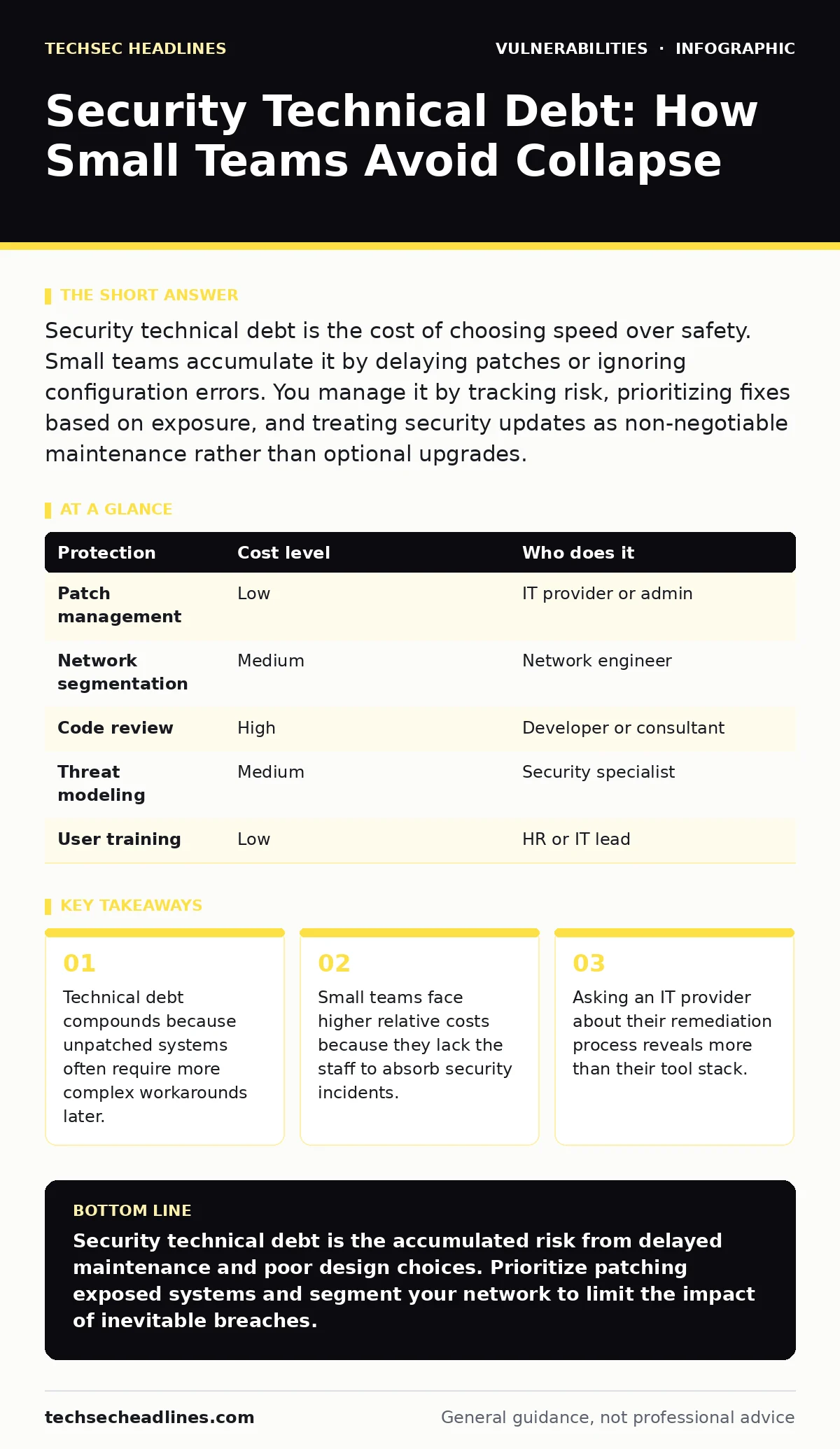
Security technical debt is the cost of choosing speed over safety. Small teams accumulate it by delaying patches or ignoring configuration errors. You manage it by tracking risk, prioritizing fixes based on exposure, and treating security updates as non-negotiable maintenance rather than optional upgrades.
Why Security Technical Debt Accumulates
Security technical debt forms when you choose convenience over security. You skip a patch because the system is currently working. You leave default credentials because changing them takes time. You ignore a warning because the alert seems minor. These small decisions create a backlog of risk. The debt is not financial. It is operational. It represents the future work required to fix today’s shortcuts. Small organizations accumulate this debt faster than large ones. You have fewer staff to handle maintenance. You face immediate pressure to deliver results. You lack the budget for dedicated security staff. The result is a system that works today but becomes fragile over time.
The hidden cost is complexity. A single unpatched vulnerability might seem manageable. But when you add five more unpatched systems, the interaction between them creates new risks. You cannot isolate the failure points. A breach in one area spreads to others. This is why static application security testing (SAST) tools become harder to interpret. The noise from old code obscures the signal from new threats. You spend more time investigating false positives than fixing real issues.
The Multiplier Effect on Small Teams
Large companies absorb security incidents. They have insurance, legal teams, and backup systems. Small teams do not. A single breach can stop operations entirely. Technical debt amplifies this risk. When you delay updates, you increase the window of exposure. Attackers automate their scans. They target known vulnerabilities in popular software. Your delayed patch becomes an easy target. The probability of compromise rises with every day you wait.
Imagine you run a small consulting firm. You use end-of-life software because the new version requires a hardware upgrade you cannot afford. The vendor stops providing security fixes. You are now relying on your own ability to defend the system. You lack the expertise to monitor traffic or detect anomalies. An attacker exploits a known flaw in the old software. You lose client data. The reputational damage prevents future contracts. The debt was not just the missing patch. It was the strategic decision to use unsupported technology without a mitigation plan.
Practical Management of Security Debt
You cannot eliminate all technical debt. You must manage it. Start by creating an inventory of your systems. List every server, application, and device. Note the version and patch status. Identify which systems face the internet. These are your highest priority. Internal systems have lower risk. You can address them later. This triage approach allows you to focus resources where they matter most.
Input validation is a common source of debt. Developers often assume user data is safe. They do not check for malicious characters. This leads to vulnerabilities like LDAP injection or cross-site WebSocket hijacking. Fixing this requires code changes. It is not a simple patch. You must rewrite the logic to handle all possible inputs. This takes time. You must schedule this work. Treat it like any other project task. Do not let it slide to the next quarter.
| Protection | Cost level | Who does it |
|---|---|---|
| Patch management | Low | IT provider or admin |
| Network segmentation | Medium | Network engineer |
| Code review | High | Developer or consultant |
| Threat modeling | Medium | Security specialist |
| User training | Low | HR or IT lead |
Asking the Right Questions of Providers
Many small businesses outsource IT. You rely on the provider to manage security. You must verify their processes. Do not assume they follow best practices. Ask specific questions. Request their patch management policy. How quickly do they apply critical updates? Do they test patches before deployment? Ask about their incident response plan. What happens if a system is compromised? Who notifies you? How do they contain the breach?
You should also ask about their monitoring capabilities. Do they use automatic software updates for all systems? If not, why? Some systems require manual approval to prevent breaking dependencies. This is a valid reason. But you need to know which systems fall into this category. Ask for a report on their current status. Look for systems that are more than 30 days behind on patches. This indicates a backlog. A provider who cannot explain their delay is a risk.
- How do you prioritize security updates versus feature updates?
- What is your process for testing patches in a non-production environment?
- How do you handle systems that cannot be patched due to compatibility?
- Can you provide a monthly report of applied patches and pending vulnerabilities?
The Hidden Cost of Compliance
Compliance frameworks often feel like checklists. You install the required controls. You sign the forms. You believe you are secure. This is a mistake. Compliance is a minimum standard. It does not guarantee safety. Technical debt accumulates in the gaps between compliance requirements and actual security. You might meet the letter of the law but ignore the spirit. For example, you might encrypt data at rest but fail to validate inputs. An attacker can still exploit the application logic.
WordPress plugin vulnerabilities illustrate this point. Many sites install plugins without checking their security history. The site meets compliance requirements for data storage. But the plugin has a known flaw. An attacker exploits the plugin to gain access. The compliance certificate does not protect you. You must go beyond the checklist. You must understand the specific risks of your stack. This requires ongoing effort. It is not a one-time setup.
See also: Incident Triage for Small Teams: Fast, Affordable, and Clear Steps · Computer Worms Examples: How Self-Replicating Code Spreads
Mitigating Risk Through Architecture
You can reduce the impact of technical debt through architecture. Segmentation limits the spread of a breach. If one system is compromised, the attacker cannot easily move to others. This is a structural defense. It does not fix the vulnerability. But it reduces the blast radius. You can implement segmentation with firewalls and virtual networks. This requires planning. You must define which systems talk to each other. You must block all other traffic.
Threat modeling helps you identify these boundaries. You map out your data flows. You identify where the data is most vulnerable. You then design controls to protect those points. This is proactive. It prevents debt from forming in the first place. You do not wait for a breach to realize your architecture is weak. You design for failure. You assume systems will be compromised. You build controls to limit the damage. This mindset shift is critical for small teams.
The Role of Continuous Review
Security is not a static state. It is a process. You must review your systems regularly. New vulnerabilities are discovered every day. Your risk profile changes as you add new software or hire new staff. You must adapt your controls. This requires discipline. You must schedule regular reviews. Do not wait for an incident to trigger a review. Make it part of your routine.
You should also review your third-party dependencies. Many breaches occur through vendors. You must assess their security posture. Do they follow good practices? Do they have a history of breaches? You can influence their behavior by including security requirements in your contracts. This shifts some of the burden to them. But you still retain responsibility for your data. You must verify that they are meeting their obligations.
Long-Term Sustainability
Managing security technical debt is a long-term commitment. You cannot fix everything at once. You must prioritize. Focus on the highest risks. Address the most exposed systems first. Build a culture of security within your team. Encourage staff to report potential issues. Make security part of the development process. This reduces the amount of debt you create. It is easier to fix a small issue early than a large one later.
You must also plan for the future. Technology changes. New threats emerge. You must stay informed. Follow security news. Attend conferences. Read technical blogs. This keeps you aware of new risks. It helps you anticipate changes. You can adjust your strategy before a crisis hits. This proactive approach saves time and money. It keeps your business running smoothly.
Key takeaways
- Technical debt compounds because unpatched systems often require more complex workarounds later.
- Small teams face higher relative costs because they lack the staff to absorb security incidents.
- Asking an IT provider about their remediation process reveals more than their tool stack.
Security technical debt is the accumulated risk from delayed maintenance and poor design choices. Prioritize patching exposed systems and segment your network to limit the impact of inevitable breaches.
Frequently asked questions
What is the difference between technical debt and security debt?
Technical debt refers to any shortcut in development that increases future work. Security debt is a subset that specifically increases the risk of a security breach. All security debt is technical debt, but not all technical debt is a security risk.
How often should I review my security posture?
You should review your posture at least quarterly. Monthly reviews are better for high-risk environments. You must also review immediately after any significant change to your infrastructure or software stack.
Can I outsource security management entirely?
You can outsource the technical work, but you cannot outsource responsibility. You must understand the risks and verify that your provider is meeting your requirements. You remain liable for any breaches that occur.
What is the first step to reducing security debt?
Create a complete inventory of your systems. Identify which ones face the internet. Prioritize patching these systems first. This reduces your most immediate exposure.
How this guide was produced: written by the TechSec Headlines editorial team with AI assistance, checked against the public references listed below, and reviewed when the facts change. See our editorial policy or report an error.