
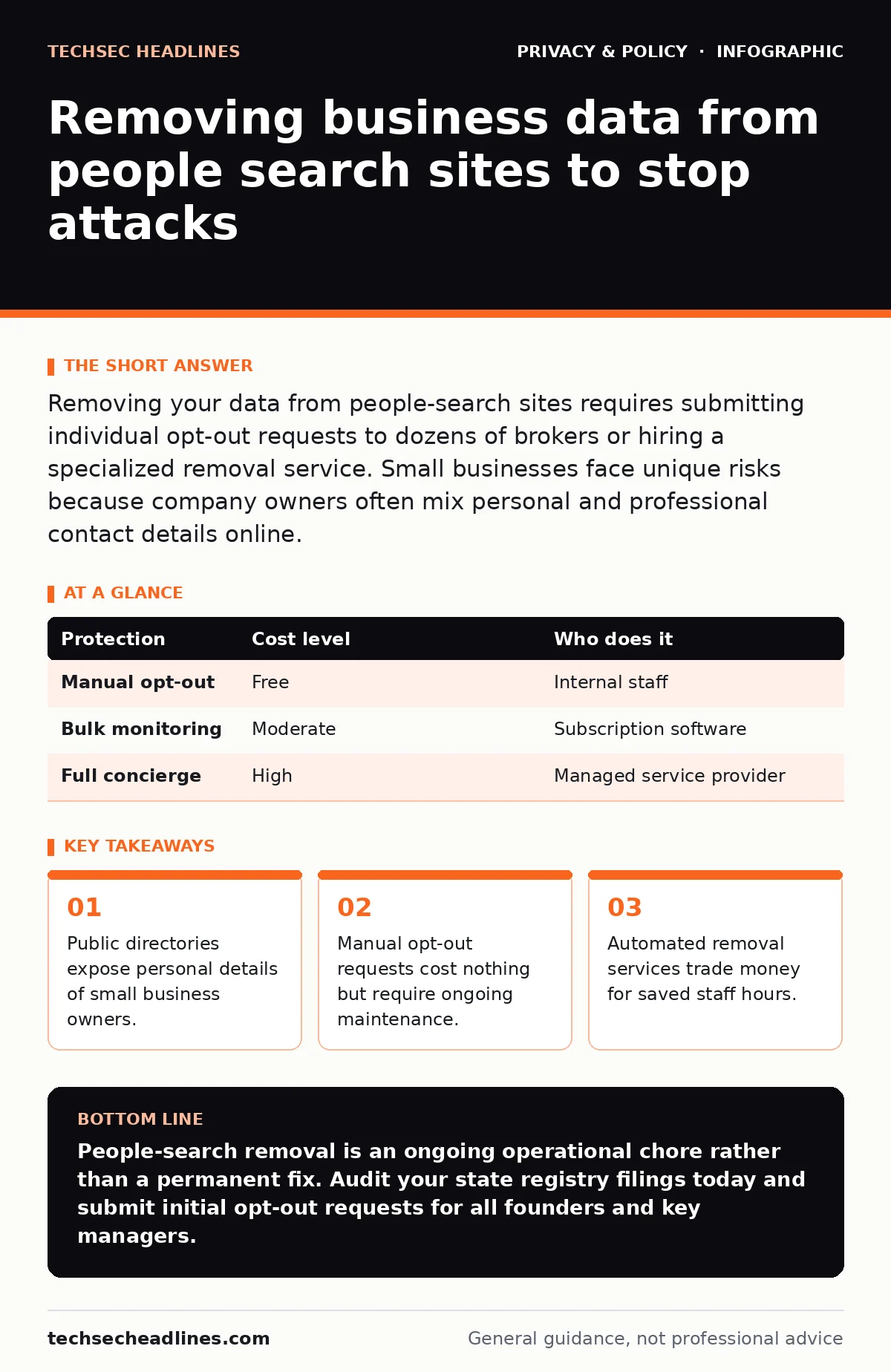
Removing your data from people-search sites requires submitting individual opt-out requests to dozens of brokers or hiring a specialized removal service. Small businesses face unique risks because company owners often mix personal and professional contact details online.
Why small business exposure invites targeted attacks
Small business owners often list personal cell phone numbers and home addresses on state registry filings, creating a direct bridge for attackers. Social engineering relies on personal familiarity to bypass skepticism, making a founder's home address a valuable asset for physical or digital manipulation. When attackers know where you live and who your family members are, phishing emails and phone calls carry much higher credibility. Public databases aggregate these records automatically, meaning your footprint expands faster than you can update it manually.
The mechanics of data broker aggregation
Data brokers harvest public records from court filings, property deeds, and marketing databases to build comprehensive profiles. They stitch these fragments together using unique identifiers like email addresses and phone numbers. Once aggregated, the profile becomes searchable by anyone willing to pay a nominal fee or view ad-supported web pages. Stopping this cycle involves understanding that brokers do not create information; they merely index public facts. Erasing a record from one site often fails because sister companies or parent organizations maintain independent copies of the same dataset.
Manual opt-out strategies for zero budget
Manual removal costs nothing except labor, making it ideal for tight operational budgets. Every major broker maintains a hidden opt-out page that requires identity verification through a disposable email address or a redacted identification card. You must search for your business name, owner names, and historical addresses every 3 months because brokers continuously re-index public sources. This recurring chore consumes dozens of hours annually, which represents a hidden labor cost that many founders overlook.
Comparing your removal options
Choosing how to handle data removal depends on available payroll hours and risk tolerance. Automated tools monitor the ecosystem continuously, whereas manual requests only address current exposures.
| Protection | Cost level | Who does it |
|---|---|---|
| Manual opt-out | Free | Internal staff |
| Bulk monitoring | Moderate | Subscription software |
| Full concierge | High | Managed service provider |
What to delegate and what to keep internal
Delegating privacy maintenance to administrative staff frees leadership to focus on core operations. However, you should never hand over primary identity documents or master email accounts to external vendors during the verification process. Create a dedicated email inbox specifically for opt-out confirmations so your primary communications remain isolated from broker spam. External services handle the tedious form submissions effectively, but internal oversight ensures that sensitive corporate filings are not mishandled.
See also: End-to-End Encryption Messenger Deleted Messages: What Actually Happens
Questions to ask an IT provider before signing
Hiring external help requires strict vetting to ensure the provider does not harvest your data themselves. You must ask targeted questions about their operational security and compliance standards.
- How do you handle and store the identity documents required by strict broker verification processes?
- What happens to our removal profile and confirmation logs if we cancel our subscription?
- Do you utilize subcontractors or offshore call centers to process manual opt-out requests?
- Can you integrate our preferences with existing controls like differential privacy frameworks to minimize future leaks?
Managing the inevitable recurrence of records
Data removal is never a permanent fix because public registries constantly feed new information back into broker pipelines. You must treat privacy maintenance as a recurring administrative hygiene task rather than a one-time project. Combining removal efforts with secure DNS configurations helps prevent metadata leaks during routine browsing. Accepting this reality prevents frustration when old profiles reappear months after successful deletion requests.
Key takeaways
- Public directories expose personal details of small business owners.
- Manual opt-out requests cost nothing but require ongoing maintenance.
- Automated removal services trade money for saved staff hours.
People-search removal is an ongoing operational chore rather than a permanent fix. Audit your state registry filings today and submit initial opt-out requests for all founders and key managers.
Frequently asked questions
How often do data brokers republish removed information?
Brokers typically refresh their databases every 30 to 90 days by re-scraping public registries and court filings.
Can I use my main business email address for opt-out requests?
You should use a dedicated secondary email address because opt-out submissions frequently trigger high volumes of spam and marketing solicitations.
Do state business filings require a home address?
Many jurisdictions allow registered agents or commercial mailbox addresses instead of a founder's residential location on public documents.
Will removing data from search sites stop all spam phone calls?
Removal stops broker-driven aggregation, but it does not prevent calls originating from previous data breaches or direct corporate directory listings.
How this guide was produced: written by the TechSec Headlines editorial team with AI assistance, checked against the public references listed below, and reviewed when the facts change. See our editorial policy or report an error.