
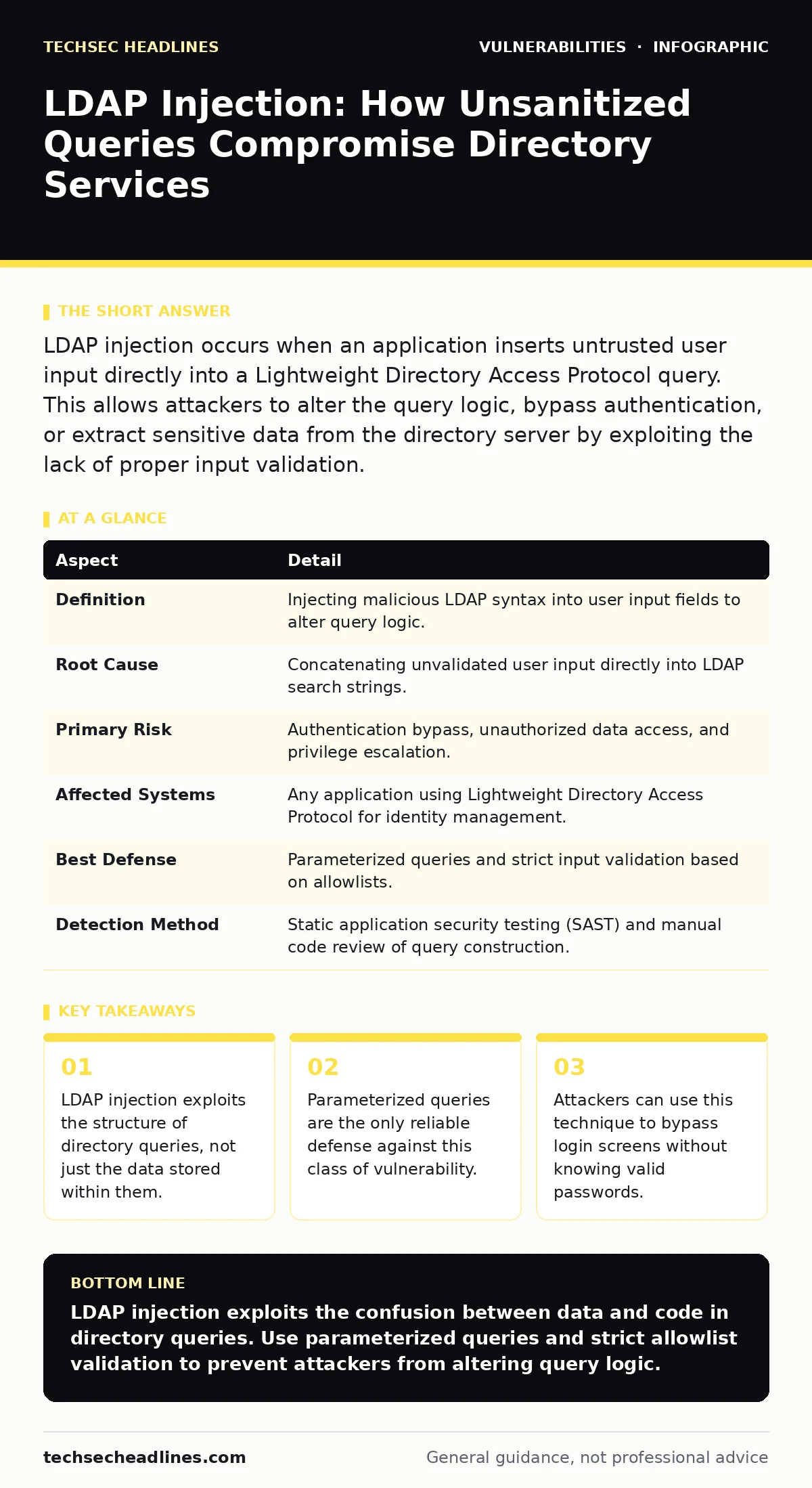
LDAP injection occurs when an application inserts untrusted user input directly into a Lightweight Directory Access Protocol query. This allows attackers to alter the query logic, bypass authentication, or extract sensitive data from the directory server by exploiting the lack of proper input validation.
The Library Catalog Analogy
Imagine a library catalog system where you search for books by typing your request into a box. You type "Mystery novels" and the system finds them. Now imagine the librarian does not just search the database but instead reads your request aloud to the assistant in the back room. If you whisper, "Give me all books," the assistant might hand over the entire library. LDAP injection works similarly. The application sends your input directly to the directory server without filtering it. The server executes the command as if it were part of the original program logic.
This analogy highlights the core risk: the boundary between data and code is blurred. In secure systems, data is strictly treated as data. In vulnerable systems, data can masquerade as code. You must ensure that user input never changes the structure of the query being sent to the backend.
At a Glance
| Aspect | Detail |
|---|---|
| Definition | Injecting malicious LDAP syntax into user input fields to alter query logic. |
| Root Cause | Concatenating unvalidated user input directly into LDAP search strings. |
| Primary Risk | Authentication bypass, unauthorized data access, and privilege escalation. |
| Affected Systems | Any application using Lightweight Directory Access Protocol for identity management. |
| Best Defense | Parameterized queries and strict input validation based on allowlists. |
| Detection Method | Static application security testing (SAST) and manual code review of query construction. |
How LDAP Injection Happens
Lightweight Directory Access Protocol (LDAP) is a standard protocol for accessing and maintaining distributed directory information services. It is widely used for centralized identity management. Applications query the directory to verify user credentials or retrieve user attributes. A typical query might look for a user with a specific username and password.
The vulnerability arises when developers build these queries by concatenating strings. Suppose the application constructs a filter like (&(uid=USER_INPUT)(password=PASS_INPUT)). If a user enters admin) as the username, the resulting query becomes (&(uid=admin)(password=PASS_INPUT)). The closing parenthesis ends the uid check early. The rest of the query may become syntactically invalid or, more dangerously, alter the logical conditions. If the password field is also manipulated, the attacker can force the query to return true regardless of the actual password stored in the directory.
This mechanism relies on the directory server interpreting the injected characters as structural elements of the query. The server does not distinguish between legitimate syntax and injected syntax. It simply executes what it receives. This makes the attack vector purely logical rather than dependent on buffer overflows or memory corruption.
Common Forms of Attack
Attackers use several techniques to exploit this structural weakness. Understanding these forms helps in recognizing the patterns during code reviews or penetration tests.
- Authentication Bypass: The most common goal. The attacker modifies the query to always evaluate to true. This allows login without valid credentials.
- Data Extraction: By manipulating the search filter, an attacker can retrieve specific attributes from other user accounts. This might include email addresses, phone numbers, or internal role assignments.
- Privilege Escalation: If the application uses the query results to assign roles, an attacker can inject conditions that grant administrative privileges. For example, forcing a filter that matches an admin group.
- Blind Injection: When the application does not return error messages or data, attackers use boolean-based techniques. They send queries that change the application behavior slightly, such as delaying the response or changing a page title, to infer information bit by bit.
Each form exploits the same root cause: the lack of separation between the query structure and the data. The difference lies in the attacker's objective and the feedback loop provided by the application.
Who Is Affected
Any organization using a directory service for identity management is at risk if their applications do not properly handle input. This includes large enterprises using centralized authentication, educational institutions managing student records, and healthcare providers securing patient portals. The protocol itself is not insecure. The insecurity lies in how applications interact with the protocol.
Legacy systems are particularly vulnerable. Older frameworks often provided helper functions that encouraged string concatenation for building queries. Modern frameworks often include safer defaults, but developers can still bypass these safeguards by writing custom query logic. The risk is not limited to external-facing web applications. Internal tools, APIs, and mobile backend services can also be vulnerable if they query the directory directly.
The impact depends on the sensitivity of the data in the directory. If the directory stores only public information, the risk is lower. If it stores credentials, personal identifiable information, or access control lists, the risk is severe. Attackers can use compromised credentials to move laterally through the network.
What People Usually Get Wrong
Many developers believe that escaping special characters is sufficient protection. They write functions that replace parentheses, asterisks, and ampersands with safe equivalents. This approach is fragile. LDAP syntax is complex, and new escape sequences may be discovered. More importantly, escaping logic is often incomplete or incorrectly implemented. It is easier to miss one character than to ensure every possible vector is covered.
Another common mistake is relying on output encoding. Encoding data for display in a browser prevents cross-site scripting but does nothing to protect the LDAP query. The query is executed on the server side, before any output is generated. Encoding must happen at the point of query construction, not at the point of display.
Some teams assume that because LDAP is an internal protocol, it is not exposed to the internet. This is a dangerous assumption. Applications that connect to LDAP are often exposed via APIs or web interfaces. Even if the LDAP server is behind a firewall, the application server is likely not. An attacker targeting the application can trigger the injection without ever touching the directory server directly.
How to Reduce the Risk
The most effective defense is using parameterized queries. Instead of concatenating user input into the query string, you pass the input as a separate parameter. The LDAP library then handles the escaping and separation of data from code. This ensures that the input is always treated as data, never as code. Most modern LDAP client libraries support this feature.
If parameterized queries are not available, you must implement strict input validation. This means checking the input against a strict allowlist of expected characters. For a username field, only alphanumeric characters and perhaps a few specific symbols should be allowed. Reject anything else. Do not try to blacklist bad characters. Blacklists are inherently incomplete.
Regular code reviews are necessary to catch instances where string concatenation is used. Static application security testing (SAST) tools can help identify potential injection points automatically. These tools analyze the source code without executing it, looking for patterns that resemble insecure query construction.
Beyond Basic Input Validation
Input validation is the first line of defense, but it is not the only one. You should also consider the principle of least privilege. The application account used to query the LDAP server should have only the permissions it needs. If the account can only read specific attributes, an attacker cannot extract sensitive data even if they bypass authentication.
Threat modeling helps identify where LDAP queries are used in your architecture. Map out all the entry points where user input reaches the directory service. This includes direct web forms, API endpoints, and file uploads that might be parsed and used in queries. By understanding the flow, you can prioritize testing and monitoring.
Security technical debt accumulates when shortcuts are taken in query construction. Refactoring legacy code to use modern, safe libraries is an investment that pays off in reduced risk. Do not ignore old code because it "works." It may be working today, but it could be exploited tomorrow.
Related vulnerabilities often coexist. Weak password policies make credential stuffing easier, which complements injection attacks. WordPress plugin vulnerabilities might provide an initial foothold that allows an attacker to reach internal APIs. Understanding these connections helps build a more resilient security posture.
Key takeaways
- LDAP injection exploits the structure of directory queries, not just the data stored within them.
- Parameterized queries are the only reliable defense against this class of vulnerability.
- Attackers can use this technique to bypass login screens without knowing valid passwords.
LDAP injection exploits the confusion between data and code in directory queries. Use parameterized queries and strict allowlist validation to prevent attackers from altering query logic.
Frequently asked questions
Can LDAP injection occur in non-web applications?
Yes, any application that accepts user input and constructs LDAP queries is vulnerable, including desktop clients, mobile apps, and internal APIs.
Does using a firewall prevent LDAP injection?
No, firewalls control network traffic but do not inspect the logic of application queries. Injection happens at the application layer.
How do I know if my LDAP library supports parameterized queries?
Check the documentation for your specific LDAP client library. Look for methods that accept a filter template and separate data arguments.
Is escaping special characters enough to prevent LDAP injection?
No, escaping is error-prone and often incomplete. Parameterized queries are the preferred and more reliable solution.
How this guide was produced: written by the TechSec Headlines editorial team with AI assistance, checked against the public references listed below, and reviewed when the facts change. See our editorial policy or report an error.