
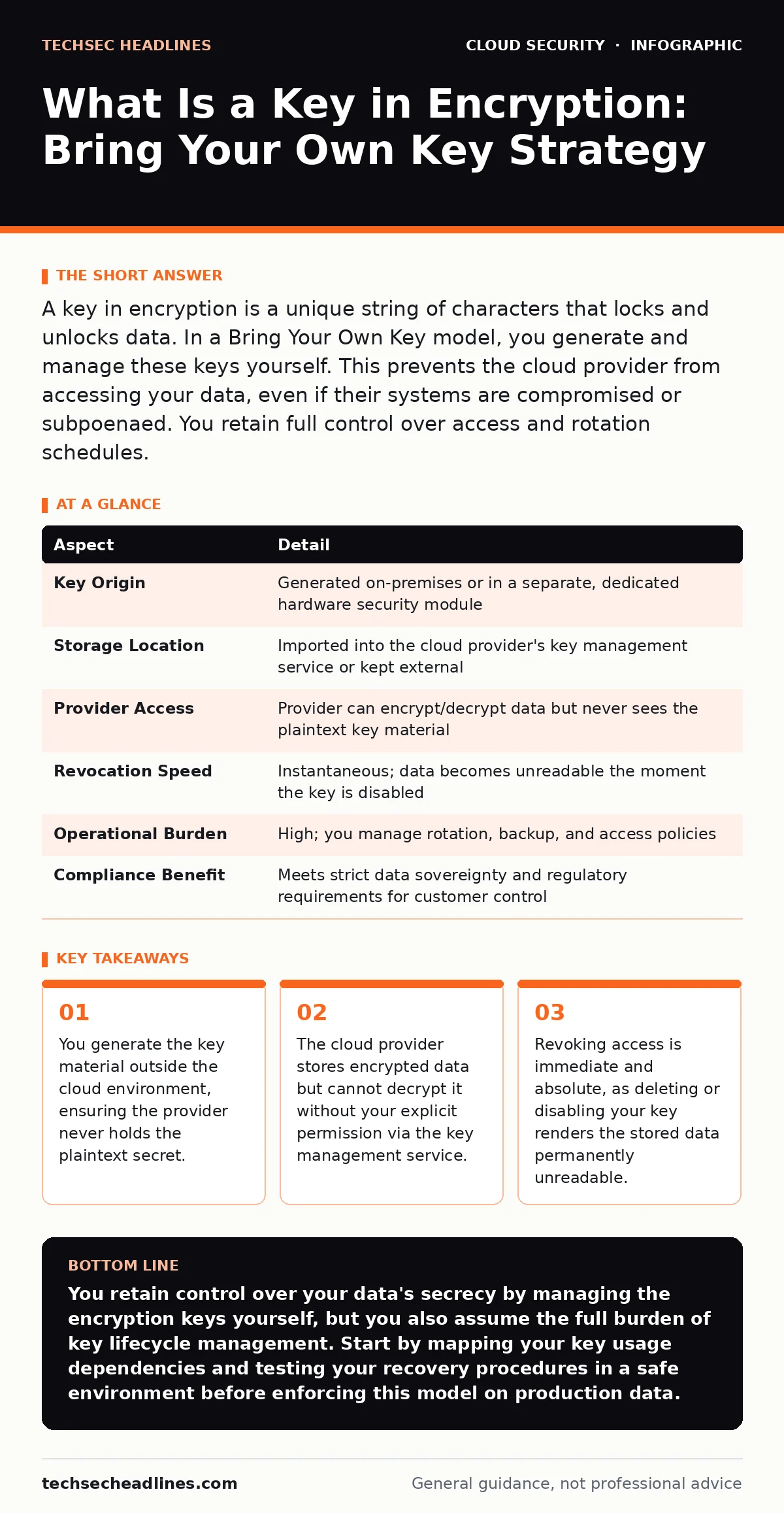
A key in encryption is a unique string of characters that locks and unlocks data. In a Bring Your Own Key model, you generate and manage these keys yourself. This prevents the cloud provider from accessing your data, even if their systems are compromised or subpoenaed. You retain full control over access and rotation schedules.
What is a key in encryption
A key in encryption is a mathematical value that transforms readable data into unreadable ciphertext. Without the correct key, the data remains scrambled and useless to anyone who intercepts it. Think of encryption like a digital safe. The data is the content inside. The encryption algorithm is the locking mechanism. The key is the physical combination or metal key that opens the safe. If you lose the key, the safe remains locked forever.
The manufacturer of the safe cannot open it for you. In cloud computing, the provider typically holds the keys. This means they can technically access your data. Bring Your Own Key changes this dynamic. You hold the keys. The provider only holds the locked safe. This separation of duties is the core security benefit. It ensures that even if an attacker breaches the cloud provider's network, they cannot read your data without also breaching your key storage.
At a glance: BYOK mechanics
| Aspect | Detail |
|---|---|
| Key Origin | Generated on-premises or in a separate, dedicated hardware security module |
| Storage Location | Imported into the cloud provider's key management service or kept external |
| Provider Access | Provider can encrypt/decrypt data but never sees the plaintext key material |
| Revocation Speed | Instantaneous; data becomes unreadable the moment the key is disabled |
| Operational Burden | High; you manage rotation, backup, and access policies |
| Compliance Benefit | Meets strict data sovereignty and regulatory requirements for customer control |
How the separation works
The cloud provider offers a Key Management Service. This service handles the cryptographic operations. It encrypts data at rest. It decrypts data when your application requests it. In a standard model, the provider creates the keys. They manage the lifecycle. They control who can use them. In a Bring Your Own Key model, you create the keys elsewhere. You import them into the provider's service. The service wraps your key. It protects the wrapped key with its own master key.
The provider never unwraps the key without your authorization. This creates a chain of trust. You trust your key generation process. You trust the provider's wrapping mechanism. You do not trust the provider with the raw key. This architecture prevents insider threats at the provider level. It also prevents accidental exposure due to provider misconfiguration. The provider can manage the storage. They can manage the compute. They cannot manage the secrecy of your specific data without your active involvement.
Who this affects most
Organizations with strict regulatory requirements benefit most from this model. Financial institutions often require customer-controlled keys. Healthcare providers must protect patient records. Government agencies mandate data sovereignty. These sectors face audits that demand proof of control. The proof is the key. If the provider holds the key, you cannot prove you control the data. You only prove you trust the provider. Trust is not compliance. Compliance requires technical controls. Bring Your Own Key provides those controls.
It also affects organizations migrating sensitive workloads. See our guide on cloud migration security for strategies on moving data without exposing it. During migration, data often passes through multiple systems. Controlling the key ensures that even if the transit is intercepted, the data remains secure. The key is the single point of failure. If you protect it, you protect the data. If you lose it, you lose the data. There is no recovery. This high stakes environment requires careful planning.
What people usually get wrong
Many assume that Bring Your Own Key means total isolation. This is incorrect. The cloud provider still hosts the data. They still process the requests. They still manage the infrastructure. You only control the key material. The provider can still deny you service. They can still suffer outages. They can still be legally compelled to hand over the encrypted data. The data is useless without the key, but the possession of the data might still violate privacy laws. Another common mistake is neglecting key rotation.
Keys degrade over time. Algorithms become weaker. You must rotate keys regularly. This requires updating all systems that use the keys. If you forget to update one system, it fails to decrypt. Data becomes inaccessible. This is a form of self-inflicted denial of service. See our guide on denial-of-wallet attacks for how economic pressures can force similar operational failures. Security is not just about access. It is about availability. If you lock the door too tightly, you cannot get in.
See also: Facial Recognition Risks: Warning Signs You Miss · What Is Encryption: Meaning, Definition, and How It Works
The hidden cost of control
Control comes with operational overhead. You must build processes for key generation. You must build processes for key import. You must build processes for key rotation. You must build processes for key deletion. Each step requires human action or automated scripts. Scripts can fail. Humans can make mistakes. The complexity grows with scale. Managing 10 keys is easy. Managing 10,000 keys is difficult. You need a robust key management platform. You need monitoring. You need alerts.
You need disaster recovery plans. If your key management system goes down, your cloud data goes down. This creates a new single point of failure. It shifts the risk from the cloud provider to your own infrastructure. You must secure your key management system as rigorously as the cloud itself. This often requires dedicated security staff. It requires specialized training. It requires constant vigilance. The cost is not just money. It is attention. You must pay attention to the keys.
Integrating with broader security
Bring Your Own Key is not a standalone solution. It works best with other controls. You should restrict who can access the key management service. Use strong identity verification. See our guide on OAuth token abuse for how weak authentication can bypass even the best encryption. You should also define clear policies for key usage. Document who can rotate keys. Document who can delete keys. Document the emergency procedures. These policies must be enforced technically. Use cloud guardrails to enforce these policies.
See our guide on cloud guardrails for how to automate compliance checks. You should also consider data residency requirements. See our guide on data residency for how location laws affect key storage. Keys may need to stay in specific jurisdictions. This adds another layer of complexity. You must ensure your key management system respects these boundaries. The goal is a layered defense. Encryption is one layer. Access control is another. Monitoring is another. Bring Your Own Key strengthens the encryption layer. It does not replace the others.
Checklist for implementation
- Generate keys on a dedicated, air-gapped system or hardware security module.
- Test the import process in a non-production environment.
- Document the key rotation schedule and automate it where possible.
- Define and test the emergency key recovery procedure.
- Restrict access to the key management service to a minimum number of users.
- Monitor for unauthorized key access attempts and unusual usage patterns.
- Regularly audit key permissions and remove unnecessary access.
- Train staff on the importance of key security and the consequences of loss.
Key takeaways
- You generate the key material outside the cloud environment, ensuring the provider never holds the plaintext secret.
- The cloud provider stores encrypted data but cannot decrypt it without your explicit permission via the key management service.
- Revoking access is immediate and absolute, as deleting or disabling your key renders the stored data permanently unreadable.
- Operational complexity increases because you must secure, rotate, and back up keys without relying on provider automation.
You retain control over your data's secrecy by managing the encryption keys yourself, but you also assume the full burden of key lifecycle management. Start by mapping your key usage dependencies and testing your recovery procedures in a safe environment before enforcing this model on production data.
Frequently asked questions
Can the cloud provider access my data if I use Bring Your Own Key?
No, the provider cannot decrypt your data without your key. They can only store and process the encrypted ciphertext. They may be able to copy the encrypted data, but they cannot read it.
What happens if I lose my encryption key?
Your data becomes permanently inaccessible. There is no way to recover it. The cloud provider cannot help you recover the key. You must have a secure backup of your keys before implementing this model.
Is Bring Your Own Key better than the default cloud encryption?
It provides greater control and meets stricter compliance requirements. However, it adds operational complexity and risk. Default encryption is easier to manage and sufficient for most general workloads. Choose BYOK only if you have specific regulatory or security needs.
How often should I rotate my encryption keys?
Rotate keys regularly, such as annually or when personnel changes occur. More frequent rotation increases security but also increases operational complexity. Balance security needs with operational capacity.
How this guide was produced: written by the TechSec Headlines editorial team with AI assistance, checked against the public references listed below, and reviewed when the facts change. See our editorial policy or report an error.