
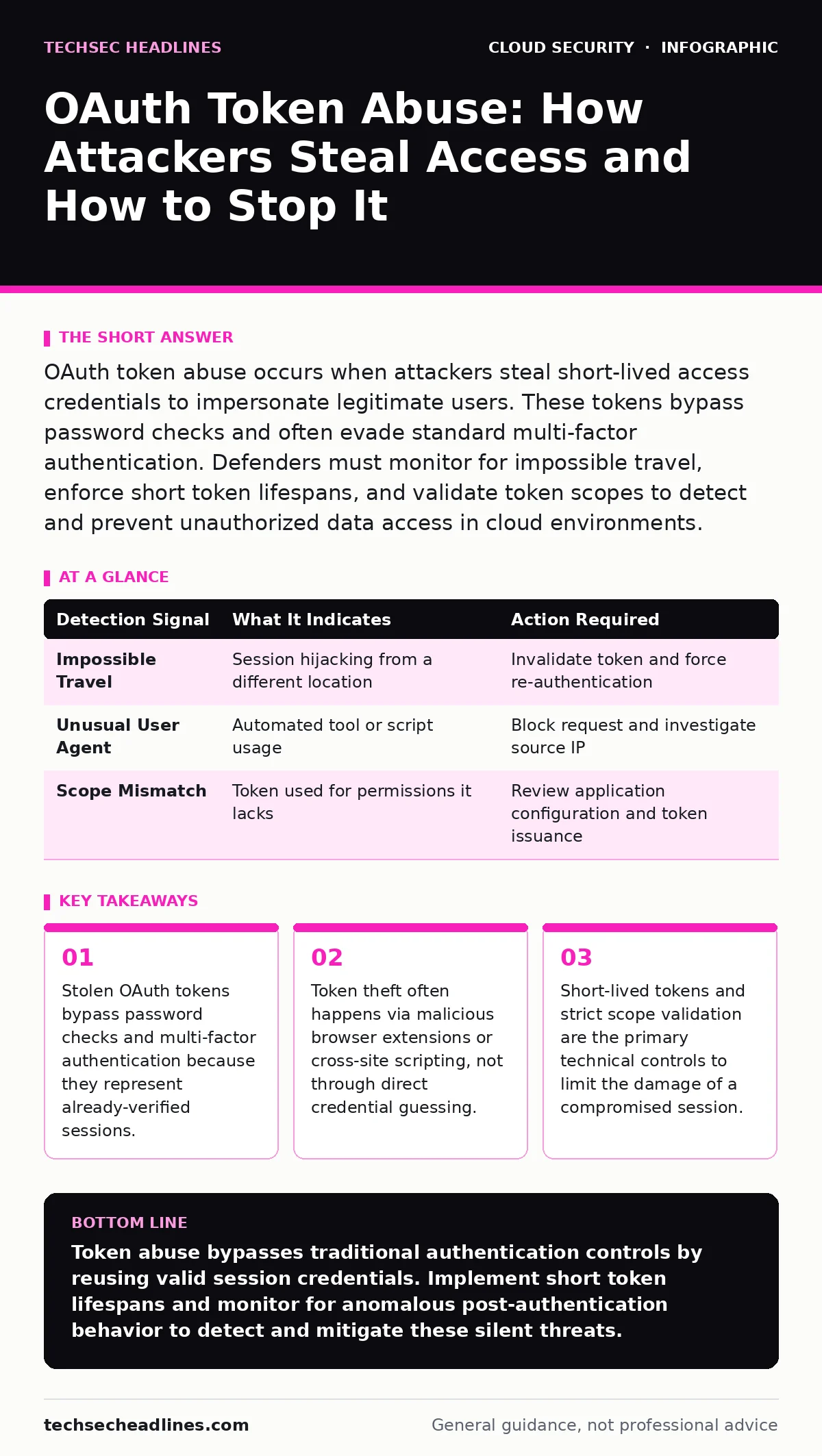
OAuth token abuse occurs when attackers steal short-lived access credentials to impersonate legitimate users. These tokens bypass password checks and often evade standard multi-factor authentication. Defenders must monitor for impossible travel, enforce short token lifespans, and validate token scopes to detect and prevent unauthorized data access in cloud environments.
What is OAuth token abuse?
OAuth token abuse happens when an attacker steals a valid access token to impersonate a user within a cloud application. The attacker uses this stolen credential to perform actions that the original user is permitted to do. This method bypasses standard login screens, meaning the attacker never needs the user’s password or multi-factor authentication code. The system treats the stolen token as a legitimate, authenticated session, granting immediate access to protected resources without additional verification.
How do attackers steal OAuth tokens?
Attackers primarily steal tokens through browser-based exploits or malicious extensions. Cross-site scripting allows an attacker to inject code that exfiltrates the token stored in the browser’s memory or local storage. Malicious browser extensions can also read tokens from active sessions if they request excessive permissions. Another vector involves intercepting tokens transmitted over unencrypted connections, though modern applications rarely make this mistake. The token itself is usually a long, random string that looks like a standard API key.
Why don't standard login alerts detect token theft?
Most security information and event management systems trigger alerts only on login events, such as a new password entry or a failed multi-factor attempt. Token abuse skips these steps entirely because the attacker is reusing an existing, valid session. The cloud provider sees a request with a valid signature and assumes the user is already authenticated. This creates a blind spot where lateral movement occurs silently. You must monitor for anomalous behavior after authentication, not just the act of logging in.
Can multi-factor authentication prevent token abuse?
Multi-factor authentication does not protect against token abuse because the verification step already occurred when the token was originally issued. The token represents a completed authentication event. Once an attacker possesses the token, they can make API calls without presenting any further proof of identity. This is why relying solely on multi-factor authentication for account security is insufficient. You need continuous verification mechanisms that check the context of each request, not just the initial login.
What are the signs of a compromised token?
Look for impossible travel patterns, such as a user accessing resources from two geographically distant locations within minutes. Monitor for unusual API call volumes or access to sensitive data types that the user rarely touches. Check for requests originating from unfamiliar user agents or IP addresses that do not match the user’s typical behavior. Sudden spikes in data export activities are also a strong indicator. These anomalies suggest the session is being controlled by an automated script or an attacker rather than the legitimate user.
| Detection Signal | What It Indicates | Action Required |
|---|---|---|
| Impossible Travel | Session hijacking from a different location | Invalidate token and force re-authentication |
| Unusual User Agent | Automated tool or script usage | Block request and investigate source IP |
| Scope Mismatch | Token used for permissions it lacks | Review application configuration and token issuance |
See also: Data Residency Laws: How to Keep Data in the Right Jurisdiction · What Does DevSecOps Stand For: Practical Security in Code
How can you limit the damage of stolen tokens?
Implement short token lifespans to ensure stolen credentials expire quickly. Configure your identity provider to issue access tokens that last only a few minutes, forcing the application to refresh them frequently. Use refresh tokens that are stored securely and require additional validation for renewal. This limits the window of opportunity for an attacker. Combine this with strict scope definitions so that each token grants only the minimum permissions necessary for the specific task.
Do refresh tokens pose a greater risk?
Refresh tokens pose a higher risk because they often have much longer lifespans than access tokens. If an attacker steals a refresh token, they can generate new access tokens indefinitely without the user’s knowledge. This allows for persistent access that survives the expiration of the initial session. You must treat refresh tokens with higher security controls, such as storing them in encrypted cookie jars or hardware security modules. Never store refresh tokens in browser local storage where they are easily accessible to cross-site scripting attacks.
How does scope validation prevent abuse?
Scope validation ensures that a token can only be used for the specific permissions granted during issuance. If an application requests access to read emails but the token is used to delete files, the server must reject the request. This limits the blast radius of a compromised token. Even if an attacker steals a token, they cannot perform actions outside the defined scope. You must enforce strict scope checks on every API endpoint, not just at the initial authentication phase.
What is the role of token binding?
Token binding ties a cryptographic token to the specific client or device that requested it. This prevents replay attacks where an attacker intercepts a token and tries to use it from a different device. The server verifies that the cryptographic proof presented with the token matches the original client’s key. This mechanism is particularly effective against man-in-the-middle attacks. While not universally implemented, it adds a significant layer of security by ensuring the token is only valid for the original session context.
How do you revoke a compromised token?
You must immediately invalidate the stolen token through your identity provider’s administration console. Most providers offer a way to revoke all active sessions for a specific user or a specific token identifier. This stops the attacker from making further requests. You should also force the user to change their password and re-authenticate to ensure no other tokens are compromised. Monitor the account for a period after revocation to ensure the attacker has not created persistent backdoors or copied data before the token expired.
Key takeaways
- Stolen OAuth tokens bypass password checks and multi-factor authentication because they represent already-verified sessions.
- Token theft often happens via malicious browser extensions or cross-site scripting, not through direct credential guessing.
- Short-lived tokens and strict scope validation are the primary technical controls to limit the damage of a compromised session.
Token abuse bypasses traditional authentication controls by reusing valid session credentials. Implement short token lifespans and monitor for anomalous post-authentication behavior to detect and mitigate these silent threats.
Frequently asked questions
Can I detect token theft using only firewall logs?
Firewall logs often miss token theft because the traffic looks like normal, encrypted HTTPS communication. You need application-layer logging and identity provider audit trails to see the token usage patterns and detect anomalies.
Does using HTTPS prevent OAuth token abuse?
HTTPS prevents eavesdropping during transmission, but it does not protect against token theft via cross-site scripting or malicious browser extensions. The token is secure in transit but vulnerable once it reaches the client’s browser memory.
How long should an OAuth access token last?
Access tokens should have very short lifespans, often just a few minutes. This limits the window of opportunity for an attacker. Refresh tokens can last longer but must be stored securely and validated strictly during renewal.
What is the difference between an access token and an API key?
An access token is short-lived, tied to a specific user session, and often contains scope information. An API key is typically long-lived, tied to an application or service, and does not represent a specific user’s authenticated session.
How this guide was produced: written by the TechSec Headlines editorial team with AI assistance, checked against the public references listed below, and reviewed when the facts change. See our editorial policy or report an error.