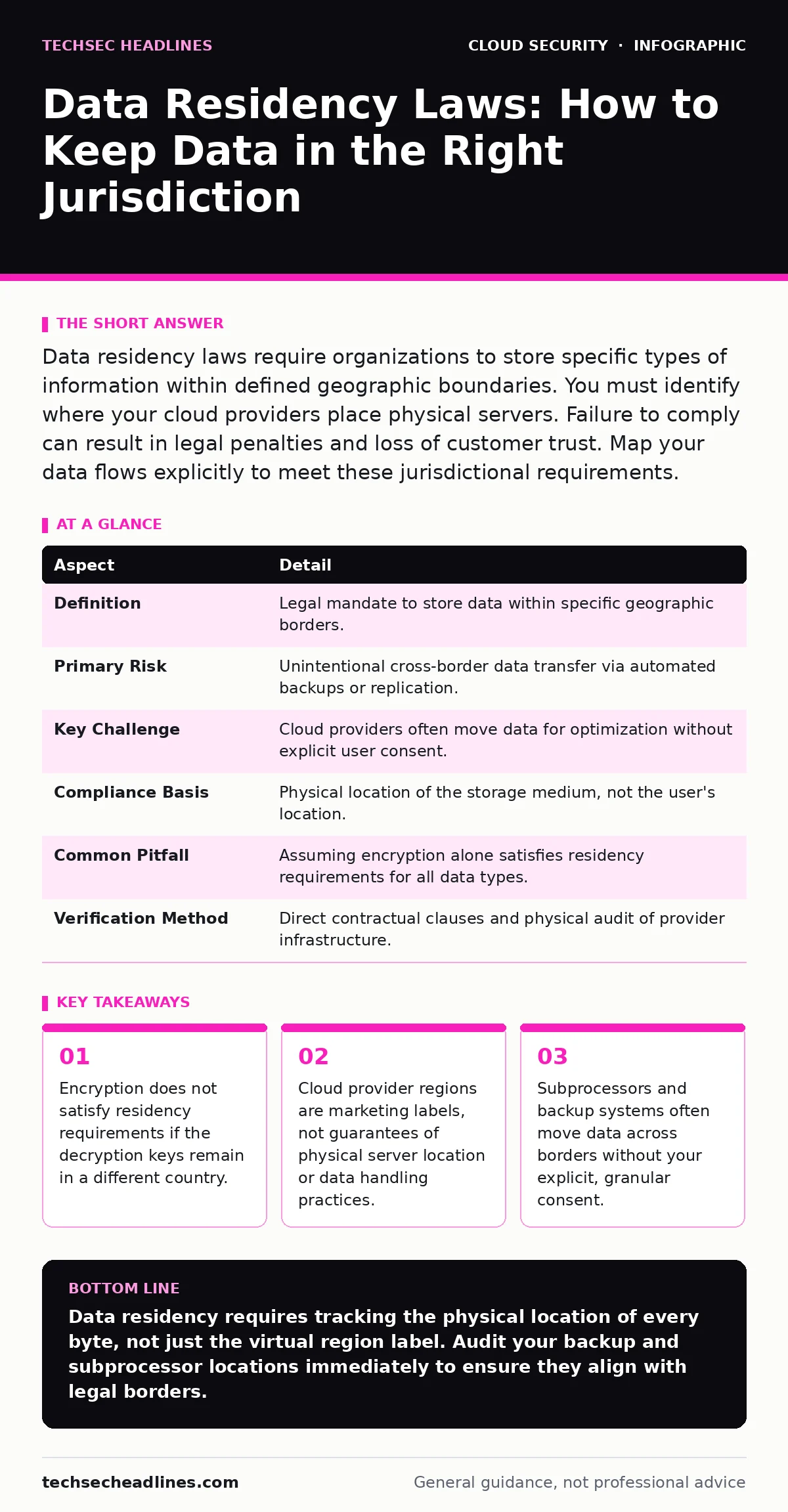
Data residency laws require organizations to store specific types of information within defined geographic boundaries. You must identify where your cloud providers place physical servers. Failure to comply can result in legal penalties and loss of customer trust. Map your data flows explicitly to meet these jurisdictional requirements.
Understanding Physical Constraints in Virtual Environments
Data residency refers to the legal requirement that specific data must be stored within the physical boundaries of a particular country or region. This concept differs from data sovereignty, which governs which laws apply to data once it crosses borders. Residency is about location. Sovereignty is about jurisdiction. You cannot manage compliance if you confuse the two. Imagine shipping a sealed package. Residency dictates which country the warehouse must occupy.
Sovereignty dictates which customs laws apply when the package moves. Cloud environments obscure these physical realities. Virtual machines float above infrastructure. You see a region label like "US-East." You do not see the specific data center building. You do not see the backup tapes moving to a secondary site in another jurisdiction. This abstraction creates compliance blind spots. You must look past the virtual layer to the physical hardware.
| Aspect | Detail |
|---|---|
| Definition | Legal mandate to store data within specific geographic borders. |
| Primary Risk | Unintentional cross-border data transfer via automated backups or replication. |
| Key Challenge | Cloud providers often move data for optimization without explicit user consent. |
| Compliance Basis | Physical location of the storage medium, not the user's location. |
| Common Pitfall | Assuming encryption alone satisfies residency requirements for all data types. |
| Verification Method | Direct contractual clauses and physical audit of provider infrastructure. |
How Cloud Infrastructure Complicates Location Tracking
Cloud providers operate on a global scale. They optimize for performance and cost. This optimization often involves moving data. When you select a region in a cloud console, you are choosing a general area. You are not choosing a specific rack. The provider may replicate your data to a nearby region for disaster recovery. They may move metadata to a central logging facility. These movements happen automatically. They happen without your real-time awareness.
Standard configuration settings rarely expose the final physical destination of every byte. You must review the provider's service level agreements. You must check their data handling policies. Look for clauses regarding subprocessors. Subprocessors are third-party vendors the cloud provider uses to manage infrastructure. They may have facilities in different countries. Your data might touch their systems. This contact counts as a transfer. You need explicit permission for these movements in your contract.
Who Must Comply With Geographic Restrictions
Residency requirements affect any organization processing sensitive data. This includes healthcare providers handling medical records. It includes financial institutions managing transaction histories. It includes government agencies storing citizen information. It also includes small businesses handling personal data of residents in strict jurisdictions. The requirement follows the data, not the size of the company.
If you collect data from individuals in a country with strict residency laws, you must comply. You cannot outsource this responsibility to your cloud provider. The provider facilitates the storage. You remain legally liable for the content. This liability holds even if the provider makes an error. You must verify the provider's capabilities. You must ensure your internal processes align with external laws. This alignment requires continuous monitoring. It is not a one-time setup task.
What People Usually Get Wrong About Residency
Many teams believe encryption solves residency problems. This belief is dangerous. Encryption protects data confidentiality. It does not change data location. If you encrypt data and store it in a prohibited country, you still violate residency laws. The data is still there. It is just unreadable. Some laws require that even encrypted data remain within borders. Others require that decryption keys never leave the border. If the keys are stored in a different country, the data is effectively accessible from that country.
This creates a compliance gap. Another common mistake is trusting region labels. "US-Standard" or "EU-West" are marketing terms. They do not guarantee that metadata, logs, or backups stay within those lines. You must define "data" broadly. Include logs, analytics, and support tickets. These often contain personal information. They often move to central processing hubs. Ignoring them invites non-compliance.
Mapping Data Flows to Physical Reality
You must create a detailed map of your data. Start with classification. Identify which data types have residency requirements. Mark them clearly in your systems. Next, trace the flow. Where does the data go after ingestion? Does it move to a data warehouse? Does it go to a machine learning pipeline? Each hop is a risk point. Document the physical location of each step. If a step is unclear, assume it crosses borders.
Treat ambiguous flows as non-compliant. Work with your cloud provider to lock down locations. Use features that restrict data movement. Disable cross-region replication for sensitive data. If you need replication, ensure the target region meets the same legal standards. Review subprocessor lists regularly. Providers update these lists. New vendors may introduce new jurisdictions. You must approve these changes before they take effect.
See also: Open Security Groups: Risks and Protection for Small Businesses
Implementing Technical Controls for Compliance
Technical controls must enforce legal boundaries. Use storage class restrictions. Prevent data from being moved to regions that do not meet residency standards. Implement key management policies. Store encryption keys in the same jurisdiction as the data. If the data moves, the keys must move with it. If the keys stay, the data becomes unusable in that new location. This creates a fail-safe. You cannot accidentally access data in a prohibited region.
Monitor for anomalies. Set up alerts for unusual data transfers. Large outbound transfers may indicate accidental replication. Investigate these events immediately. Use logging to track every access and movement. Retain these logs securely. They serve as proof of compliance during audits. Do not rely on manual checks. Automation is necessary. Human error will eventually lead to a misconfiguration.
Managing Third-Party and Backup Risks
Backups are the most common source of residency violations. Providers often store backups in cheaper, distant regions. You must configure backup policies explicitly. Disable automatic cross-border backup for sensitive data. If you need off-site backups, choose a region that complies with the same laws. Verify the backup provider's location. Do not assume the backup is in the same region as the primary data. Check the fine print.
Subprocessors may handle backup storage. They may have facilities in unexpected countries. You must contractually prohibit this. If a subprocessor violates the rule, you are liable. Regularly audit your backup locations. Ensure they match your primary data locations. Test your recovery process. Ensure you can restore data without moving it across borders. This testing proves your controls work. It also identifies hidden dependencies.
Conclusion of Compliance Efforts
Data residency is a continuous process. Laws change. Providers change their infrastructure. Your business changes its data needs. You must review your compliance posture regularly. Update your data maps. Refresh your contracts. Train your teams on the physical reality of cloud storage. Do not rely on defaults. Defaults favor convenience, not compliance. You must actively restrict data movement. You must verify every location. This diligence protects your organization from legal risk. It builds trust with your customers. It ensures your data stays where it belongs.
Key takeaways
- Encryption does not satisfy residency requirements if the decryption keys remain in a different country.
- Cloud provider regions are marketing labels, not guarantees of physical server location or data handling practices.
- Subprocessors and backup systems often move data across borders without your explicit, granular consent.
Data residency requires tracking the physical location of every byte, not just the virtual region label. Audit your backup and subprocessor locations immediately to ensure they align with legal borders.
Frequently asked questions
Does encryption satisfy data residency laws?
No, encryption protects confidentiality but does not change the physical location of the data. Residency laws often require the physical storage medium to remain within specific borders, regardless of encryption status.
How do I know where my cloud data is physically stored?
You must review your cloud provider's service agreements and data handling policies. Request specific documentation on subprocessor locations and backup sites. Do not rely on region labels alone.
Can I use a cloud provider if they store backups in another country?
Only if that country has equivalent legal protections and your specific data residency requirements allow it. You must explicitly configure backup destinations to avoid automatic cross-border transfers.
What happens if I accidentally store data in the wrong region?
You may face legal penalties, fines, and loss of customer trust. You must immediately migrate the data to a compliant region and investigate the root cause of the misconfiguration.
How this guide was produced: written by the TechSec Headlines editorial team with AI assistance, checked against the public references listed below, and reviewed when the facts change. See our editorial policy or report an error.