
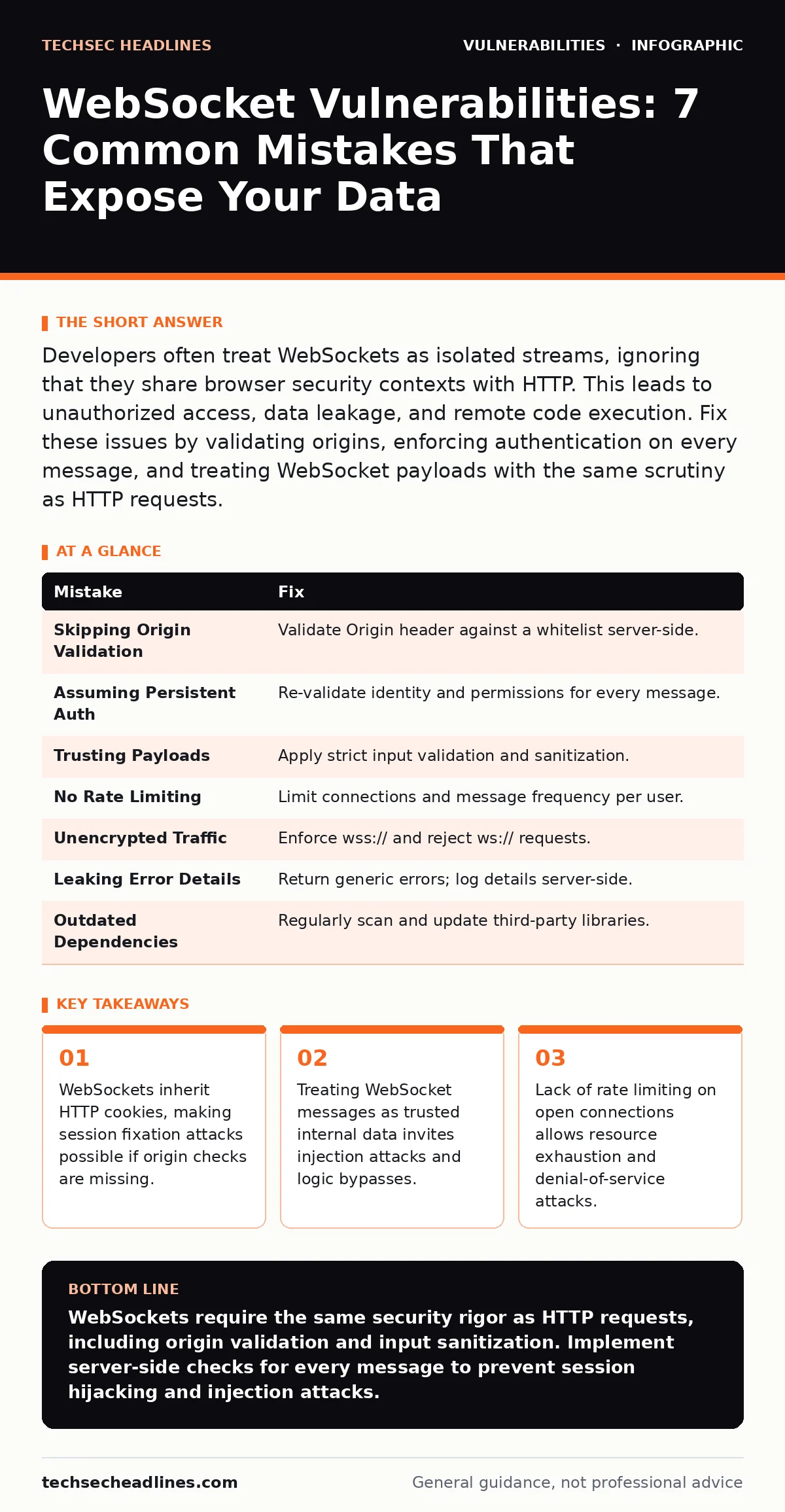
Developers often treat WebSockets as isolated streams, ignoring that they share browser security contexts with HTTP. This leads to unauthorized access, data leakage, and remote code execution. Fix these issues by validating origins, enforcing authentication on every message, and treating WebSocket payloads with the same scrutiny as HTTP requests.
Mistake 1: Skipping Origin Validation During Handshake
WebSockets begin with an HTTP upgrade request. Many servers accept this upgrade without verifying the Origin header. This allows any website to establish a connection to your WebSocket endpoint using your user’s credentials.
Why it hurts:
Cross-site WebSocket hijacking occurs when a malicious site opens a connection to your service. The browser automatically attaches your session cookies to this handshake. If your application trusts the connection source, the attacker can read sensitive data or perform actions on behalf of the victim. This bypasses standard Same-Origin Policy protections that apply to standard HTTP requests.
The fix:
Implement strict origin validation on the server side. Compare the Origin header against a whitelist of allowed domains. Reject any upgrade request that originates from an untrusted source. This ensures that only your application can initiate WebSocket connections for authenticated users.
Mistake 2: Assuming Authentication Persists After Connection
Developers often authenticate users during the initial HTTP handshake and then assume the subsequent WebSocket connection is secure. They fail to re-validate identity or permissions for individual messages sent over the established channel.
Why it hurts:
An attacker who gains access to a valid session can send arbitrary commands. If the server does not verify that the user has permission to perform each specific action, privilege escalation becomes trivial. This mirrors broken object level authorization (BOLA) flaws found in REST APIs, where users can access data belonging to others.
The fix:
Treat every WebSocket message as a new request. Validate the user’s identity and authorization context for each payload. Do not rely on the initial handshake for ongoing security. Implement message-level access controls that check if the sender is allowed to execute the requested operation.
Mistake 3: Treating Payloads as Trusted Internal Data
WebSocket messages are often processed by backend services that assume the data comes from a trusted source. Developers skip input validation because they believe the connection is established and secure.
Why it hurts:
Unvalidated inputs allow injection attacks. An attacker can inject malicious scripts, SQL commands, or LDAP queries into WebSocket messages. This can lead to remote code execution, data theft, or system compromise. The assumption that a persistent connection implies trust is a dangerous cognitive bias in security design.
The fix:
Apply rigorous input validation to all WebSocket payloads. Sanitize data before processing it. Use allowlists for expected data formats and reject anything that deviates. This practice aligns with general input validation principles that protect against injection vulnerabilities across all communication channels.
Mistake 4: Ignoring Rate Limiting on Open Connections
WebSockets maintain persistent connections. Without limits, a single user or attacker can open thousands of connections or send messages at extreme speeds.
Why it hurts:
Resource exhaustion occurs when the server cannot handle the volume of connections or data. This leads to denial-of-service conditions where legitimate users are locked out. Attackers can flood the server with small payloads, consuming memory and CPU resources until the service becomes unresponsive.
The fix:
Implement rate limiting on both connection establishment and message frequency. Define maximum limits for connections per user and messages per second. Queue or drop excess traffic to protect server resources. This ensures availability even under heavy load or attack conditions.
Mistake 5: Failing to Encrypt Traffic End-to-End
Some applications use ws:// instead of wss:// for WebSocket connections. This transmits data in plaintext, exposing it to interception.
Why it hurts:
Man-in-the-middle attacks allow attackers to read and modify data in transit. Sensitive information like personal details, financial data, or authentication tokens becomes visible to anyone on the network path. Even if the initial page loads over HTTPS, a downgrade to ws:// compromises the entire session.
The fix:
Always use wss:// for WebSocket connections. Enforce TLS encryption for all WebSocket traffic. Configure servers to reject non-encrypted upgrade requests. This ensures that data remains confidential and intact between the client and server.
Mistake 6: Exposing Internal Error Details
When WebSocket handlers encounter errors, they often return detailed stack traces or internal diagnostic information to the client.
Why it hurts:
Information disclosure provides attackers with insights into your application’s architecture. Stack traces can reveal library versions, file paths, and logic flows. This information helps attackers craft more precise exploits. It reduces the effort required to find and leverage other vulnerabilities in your system.
The fix:
Log detailed errors server-side but return generic error messages to the client. Use predefined error codes that do not leak internal implementation details. Ensure that production environments suppress verbose debugging information. This limits the intelligence available to potential attackers.
Mistake 7: Neglecting Dependency Security in WebSocket Libraries
WebSocket implementations often rely on third-party libraries. Developers frequently ignore updates or security advisories for these dependencies.
Why it hurts:
Vulnerable dependencies introduce known flaws into your application. Attackers exploit these weaknesses to bypass security controls or execute arbitrary code. Failing to update libraries leaves your system exposed to publicly disclosed vulnerabilities that have available patches. This is a common oversight in maintenance-heavy projects.
The fix:
Regularly audit and update WebSocket libraries. Use dependency scanning tools to identify known vulnerabilities. Subscribe to security advisories for all components in your stack. Promptly apply patches to mitigate risks before attackers can exploit them.
| Mistake | Fix |
|---|---|
| Skipping Origin Validation | Validate Origin header against a whitelist server-side. |
| Assuming Persistent Auth | Re-validate identity and permissions for every message. |
| Trusting Payloads | Apply strict input validation and sanitization. |
| No Rate Limiting | Limit connections and message frequency per user. |
| Unencrypted Traffic | Enforce wss:// and reject ws:// requests. |
| Leaking Error Details | Return generic errors; log details server-side. |
| Outdated Dependencies | Regularly scan and update third-party libraries. |
Key takeaways
- WebSockets inherit HTTP cookies, making session fixation attacks possible if origin checks are missing.
- Treating WebSocket messages as trusted internal data invites injection attacks and logic bypasses.
- Lack of rate limiting on open connections allows resource exhaustion and denial-of-service attacks.
WebSockets require the same security rigor as HTTP requests, including origin validation and input sanitization. Implement server-side checks for every message to prevent session hijacking and injection attacks.
Frequently asked questions
Do WebSockets bypass CORS policies?
WebSockets do not use CORS headers, but browsers enforce origin checks during the handshake. Servers must explicitly validate the `Origin` header to prevent cross-site hijacking.
Can I use JWT tokens for WebSocket authentication?
Yes, you can pass JWT tokens in the initial handshake or within messages. Ensure tokens are validated on the server for every message and that they have short expiration times.
Is static application security testing (SAST) effective for WebSocket code?
SAST tools can identify common vulnerabilities in WebSocket handlers, such as missing input validation. Combine SAST with manual code reviews to catch logic flaws that automated tools might miss.
How do I protect against WebSocket-specific DoS attacks?
Implement connection limits, message size restrictions, and rate limiting. Monitor for abnormal connection patterns and automatically block IPs that exceed thresholds to maintain service availability.
How this guide was produced: written by the TechSec Headlines editorial team with AI assistance, checked against the public references listed below, and reviewed when the facts change. See our editorial policy or report an error.