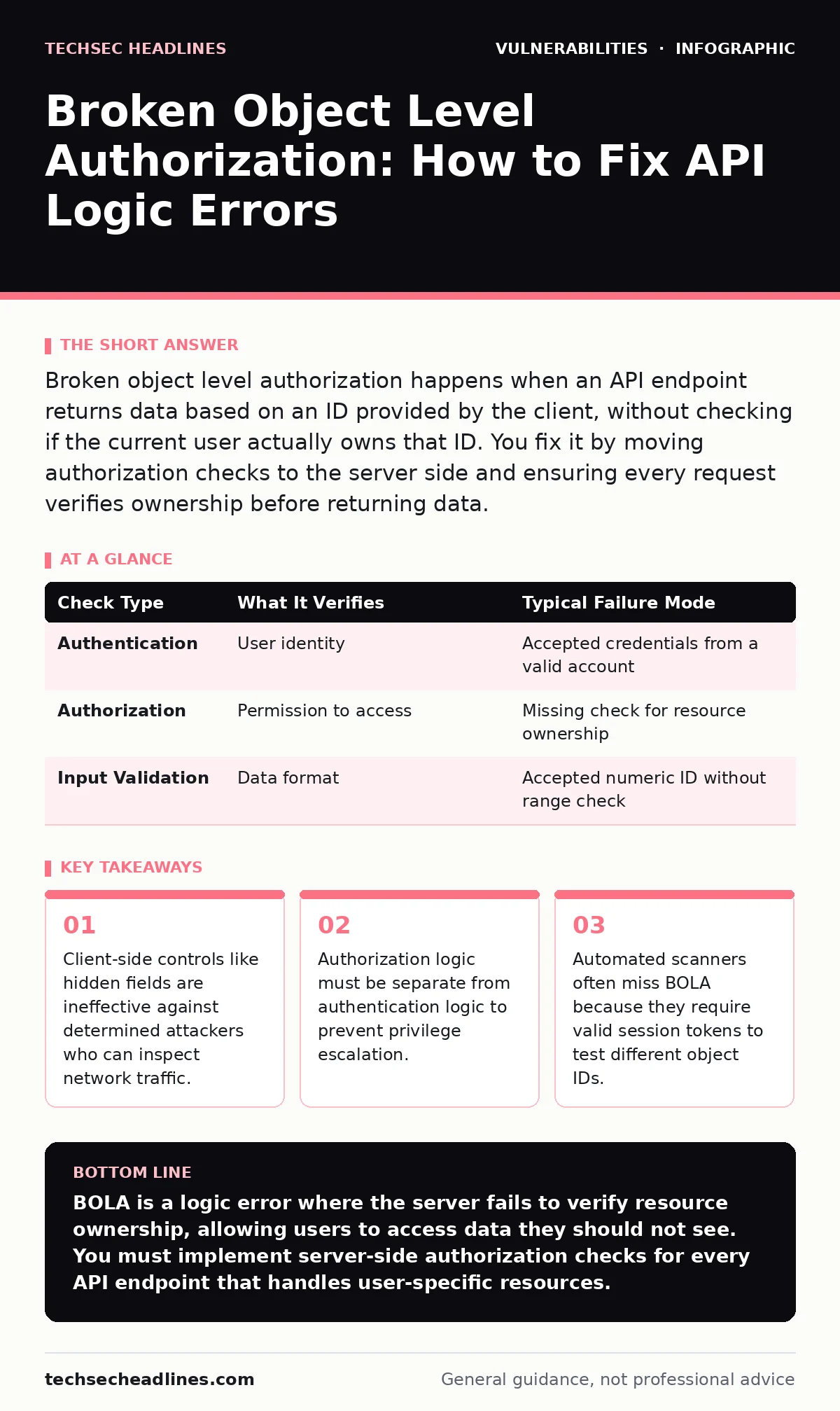
Broken object level authorization happens when an API endpoint returns data based on an ID provided by the client, without checking if the current user actually owns that ID. You fix it by moving authorization checks to the server side and ensuring every request verifies ownership before returning data.
What is broken object level authorization?
Broken object level authorization occurs when an API endpoint returns a resource based on an identifier supplied by the client, without verifying that the authenticated user has permission to access that specific resource. The server authenticates the user correctly but fails to check ownership. This is a logic error, not a code injection flaw.
Why does BOLA happen in modern applications?
Developers often assume that hiding resource IDs in the user interface prevents access. They use frameworks that automatically route requests to the correct database record based on the URL path. The assumption is that if the user cannot see the ID, they cannot access the data. This assumption fails against any tool that can intercept network requests.
How do attackers exploit BOLA vulnerabilities?
Attackers capture a legitimate request using a proxy tool. They replace the object ID in the request with an ID belonging to another user. If the server returns the data, the vulnerability is confirmed. This works because the server only checks if the session is valid, not if the session owner matches the resource owner.
What is the difference between BOLA and IDOR?
BOLA and IDOR refer to the same underlying flaw. Broken object level authorization is the modern term used in the OWASP API Security Top 10. Insecure direct object reference is the older term from the traditional web application top 10. Both describe accessing an object directly by providing its identifier without proper authorization checks.
Why do automated scanners miss BOLA?
Automated vulnerability scanners typically test for syntax errors or injection flaws. They struggle with BOLA because testing requires understanding business logic. A scanner needs two valid accounts to swap IDs and compare responses. Most scanners run as a single user or use anonymous requests, making them blind to authorization logic errors.
| Check Type | What It Verifies | Typical Failure Mode |
|---|---|---|
| Authentication | User identity | Accepted credentials from a valid account |
| Authorization | Permission to access | Missing check for resource ownership |
| Input Validation | Data format | Accepted numeric ID without range check |
How do you fix BOLA in API endpoints?
You must enforce server-side authorization checks for every request. The application should retrieve the resource ID from the database based on the user's session, not from the client input. If the client sends an ID, the server must verify that the ID belongs to the authenticated user before returning the data. Never trust client-side constraints.
What role does input validation play?
Input validation ensures data is in the correct format, such as a valid UUID or integer. It does not prevent BOLA. An attacker can provide a perfectly formatted ID that belongs to someone else. Validation is a hygiene factor, not a security control for authorization. See our guide on input validation for more on data hygiene.
Why is hiding IDs not a security measure?
Hiding IDs in the user interface provides no security. Attackers can view source code, inspect network traffic, or guess sequential IDs. This is known as security through obscurity. It gives a false sense of safety while the underlying authorization logic remains broken. Real security requires explicit permission checks.
How do you test for BOLA effectively?
Create two test accounts with different permission levels. Log in as the first user and capture a request for their own data. Modify the object ID in the request to match the second user's resource. Send the modified request. If the server returns the second user's data, you have a BOLA vulnerability. Repeat this for every endpoint that references specific resources.
What are the trade-offs of strict authorization?
Strict authorization adds latency to every request. The server must perform a database lookup to verify ownership. This can impact performance under high load. However, the cost of a data breach far exceeds the millisecond delay. You must balance performance with security by caching authorization decisions where possible.
Does BOLA affect only web applications?
No, BOLA affects any system that exposes resources via identifiers. This includes mobile apps, IoT devices, and internal microservices. If a service uses an ID to locate a resource and trusts the caller to provide that ID, it is vulnerable. The principle applies regardless of the protocol or platform used.
How does BOLA relate to other vulnerabilities?
BOLA often co-exists with broken function level authorization. If a user can access another user's object ID, they might also be able to perform actions on that object. This can lead to privilege escalation. Review your authorization matrix to ensure users cannot perform actions on resources they do not own.
What should you do if you find BOLA?
Report the vulnerability to the application owner immediately. Provide proof of concept steps showing how to access unauthorized data. Do not access or modify sensitive data beyond what is necessary to demonstrate the flaw. Responsible disclosure helps fix the issue before attackers exploit it at scale.
Key takeaways
- Client-side controls like hidden fields are ineffective against determined attackers who can inspect network traffic.
- Authorization logic must be separate from authentication logic to prevent privilege escalation.
- Automated scanners often miss BOLA because they require valid session tokens to test different object IDs.
BOLA is a logic error where the server fails to verify resource ownership, allowing users to access data they should not see. You must implement server-side authorization checks for every API endpoint that handles user-specific resources.
Frequently asked questions
Can I use JWTs to prevent BOLA?
JSON Web Tokens can store user roles, but they do not automatically prevent BOLA. You still need to verify that the resource ID in the request matches the user ID in the token.
Is BOLA the same as SQL injection?
No, SQL injection exploits database query construction, while BOLA exploits missing authorization logic. They are distinct vulnerability classes with different root causes.
Do I need to check authorization on read requests?
Yes, authorization checks are required for all actions, including reads. Accessing data without permission is a breach of confidentiality, even if the data cannot be modified.
How do I secure APIs that use sequential IDs?
Use random identifiers like UUIDs instead of sequential integers. While this thwarts guessing, it does not stop targeted attacks. You must still implement server-side ownership checks.
How this guide was produced: written by the TechSec Headlines editorial team with AI assistance, checked against the public references listed below, and reviewed when the facts change. See our editorial policy or report an error.