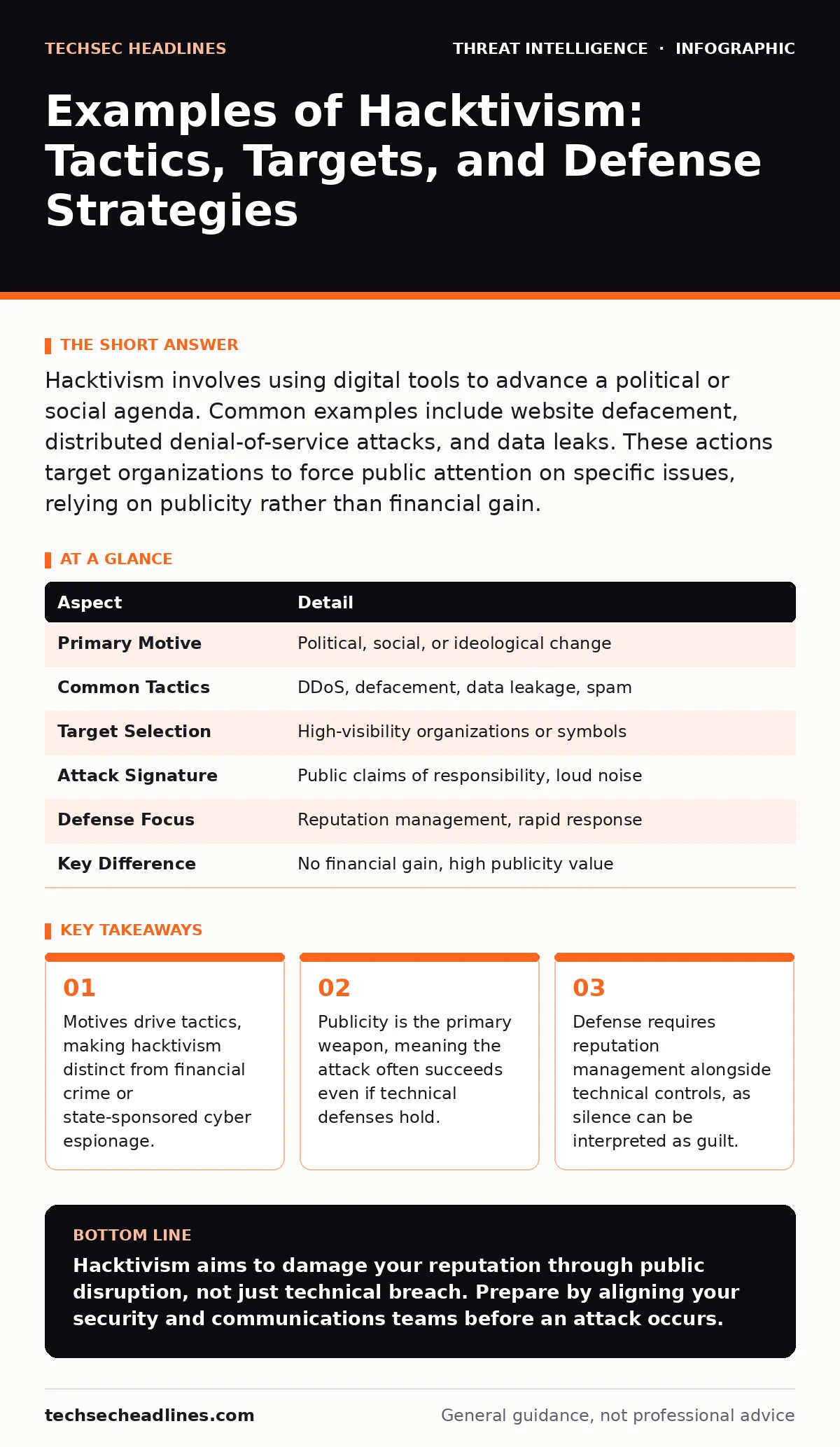
Hacktivism involves using digital tools to advance a political or social agenda. Common examples include website defacement, distributed denial-of-service attacks, and data leaks. These actions target organizations to force public attention on specific issues, relying on publicity rather than financial gain.
Understanding the Mechanics of Digital Protest
Imagine a group of protesters painting slogans on a building wall. Now imagine they do this by altering the code of a website visible to millions. This is the core of hacktivism. It combines hacking with activism. The goal is not money. The goal is attention.
Hacktivism works by exploiting vulnerabilities in digital systems to make a statement. Attackers might crash a server to disrupt service. They might change the text on a homepage to spread a message. They might publish private emails to embarrass an organization. The technical method matters less than the public reaction.
The attacker seeks two things: disruption and narrative control. By causing an outage, they prove the target is vulnerable. By leaking data, they shape the story about the target. The damage is often reputational. The financial loss is secondary. The psychological impact on the target’s staff and customers is primary.
At a Glance: Hacktivism Breakdown
| Aspect | Detail |
|---|---|
| Primary Motive | Political, social, or ideological change |
| Common Tactics | DDoS, defacement, data leakage, spam |
| Target Selection | High-visibility organizations or symbols |
| Attack Signature | Public claims of responsibility, loud noise |
| Defense Focus | Reputation management, rapid response |
| Key Difference | No financial gain, high publicity value |
Typical Examples of Hacktivism
People often ask for examples of hacktivism to understand the scope of the threat. The tactics vary, but the intent remains consistent. You will see these patterns across different groups and causes.
- Website Defacement: Attackers replace the content of a website with their own message. This is low-tech but high-visibility. It signals that the organization’s security is weak. It forces the public to see the attacker’s slogan.
- Distributed Denial-of-Service (DDoS): Attackers flood a server with traffic to make it unavailable. This disrupts business operations. It creates frustration for customers. It serves as a digital blockade.
- Data Leaks: Attackers steal sensitive documents and publish them online. This forces the organization to react to the leak. It shifts the narrative to the attacker’s preferred story. It can cause long-term trust issues.
- Spam Campaigns: Attackers send massive volumes of email promoting a cause. This wastes the target’s resources. It clutters inboxes. It spreads the activist message to a wide audience.
These examples show a pattern. The attacker wants you to talk about them. They want the media to report their message. The technical breach is just the delivery mechanism for the political statement.
Who Gets Targeted and Why
Hacktivists choose targets based on visibility, not value. A small bank with good security is less interesting than a large corporation with a controversial policy. The attacker wants maximum eyes on the conflict.
Organizations in the public eye are prime targets. This includes government agencies, large retailers, and entertainment companies. If your brand is known, you are a billboard. Hacktivists use your brand to amplify their message. The more people who know you, the more people who will see the attack.
The motive is often moral outrage. The attacker believes the target is doing wrong. They feel justified in breaking laws to expose the truth. This makes them unpredictable. They do not follow standard criminal logic. They follow ideological logic. You cannot negotiate with them for money. You can only change the narrative or harden your defenses.
What People Usually Get Wrong
Many security teams treat hacktivism like a standard cyber attack. This is a mistake. The goals are different. The response must be different. Ignoring the political context leads to poor decisions.
One common error is assuming the attack stops when the server is fixed. It does not. The attacker wants the story to continue. They will leak more data. They will threaten more attacks. The technical fix is only step 1. The communication strategy is step 2.
Another error is underestimating the internal impact. Employees feel unsafe. Customers feel betrayed. The attack exposes the organization as vulnerable. This can lead to staff turnover. It can lead to customer churn. The human cost is often higher than the technical cost.
A third error is ignoring the source. Hacktivists often work in loose networks. They share tools and techniques. Understanding the group’s history helps predict their next move. Is this a one-time protest? Or is this a sustained campaign? The answer changes your defense posture.
See also: What Is Recovery Time Objective and How to Set It
Defense Strategies for Activist Attacks
Defending against hacktivism requires a mix of technical controls and public relations. You must protect your systems. You must also protect your reputation. These two efforts must work together.
First, harden your external-facing systems. Use web application firewalls to block common attacks. Implement rate limiting to slow down DDoS attempts. Keep your software updated to close known vulnerabilities. This reduces the easy wins for attackers.
Second, prepare your communication plan. Have statements ready for different scenarios. Decide who speaks to the media. Practice responding quickly. Speed matters in hacktivism. If you wait, the attacker controls the story. If you respond fast, you can shape the narrative.
Third, monitor your digital footprint. Use threat intelligence sharing to learn about emerging groups. Watch social media for threats. Look for chatter about your organization. Early warning gives you time to prepare. It allows you to activate your incident response team before the attack hits.
The Hidden Costs of Response
The visible cost of hacktivism is downtime. The hidden cost is trust. Every attack erodes confidence in your brand. Customers wonder if their data is safe. Partners wonder if you are reliable. This damage takes months to repair.
Another hidden cost is distraction. Your security team spends hours investigating the attack. They spend days hardening systems. This takes time away from other projects. It slows down innovation. It increases operational stress. The attacker wins by forcing you to work on their terms.
Finally, there is the legal cost. You may need to investigate the breach. You may need to notify regulators. You may face lawsuits from customers. These costs add up quickly. They are rarely included in initial budgets. Plan for them in advance.
Understanding these costs helps you prioritize defense. You are not just protecting servers. You are protecting your business continuity. You are protecting your brand equity. The investment in prevention pays off in avoided chaos.
Looking Beyond the Immediate Threat
Hacktivism is part of a larger ecosystem. It often overlaps with other threats. Attackers may use similar tools as those in cyber espionage. They may exploit the same vulnerabilities as financial criminals. Understanding these connections improves your defense.
Review your approach to incident triage. Ensure your team can distinguish between a hacktivist attack and a standard intrusion. The response differs. A hacktivist attack requires public communication. A standard intrusion requires quiet containment. Confusing the two leads to mistakes.
Consider how the cyber kill chain applies here. Hacktivists often skip stages. They may go straight to exploitation. They do not need to move laterally. They do not need to maintain persistence. They just need to make noise. Adjust your detection rules to catch these fast-moving attacks.
Stay informed about trends. New tools emerge regularly. New groups form. New causes gain traction. Your defense must evolve. Use breach and attack simulation to test your readiness. Practice responding to hypothetical scenarios. This keeps your team sharp. It ensures you are prepared for the next wave.
Key takeaways
- Motives drive tactics, making hacktivism distinct from financial crime or state-sponsored cyber espionage.
- Publicity is the primary weapon, meaning the attack often succeeds even if technical defenses hold.
- Defense requires reputation management alongside technical controls, as silence can be interpreted as guilt.
Hacktivism aims to damage your reputation through public disruption, not just technical breach. Prepare by aligning your security and communications teams before an attack occurs.
Frequently asked questions
How do I know if an attack is hacktivism?
Look for public claims of responsibility and a political or social message. Hacktivists want credit. They post on social media or message boards. They explain their motive clearly.
Can hacktivism lead to financial loss?
Yes, indirectly. Downtime costs money. Reputational damage loses customers. Legal fees add up. The attacker does not steal money, but the financial impact on the victim is real.
Should I ignore small hacktivist attacks?
No. Small attacks test your defenses. They signal that you are a target. Ignoring them encourages larger attacks. Respond professionally and harden your systems.
Does insurance cover hacktivism?
It depends on your policy. Some policies cover business interruption. Some cover legal fees. Check your terms. Cyber insurance is complex. Read the exclusions carefully.
How this guide was produced: written by the TechSec Headlines editorial team with AI assistance, checked against the public references listed below, and reviewed when the facts change. See our editorial policy or report an error.