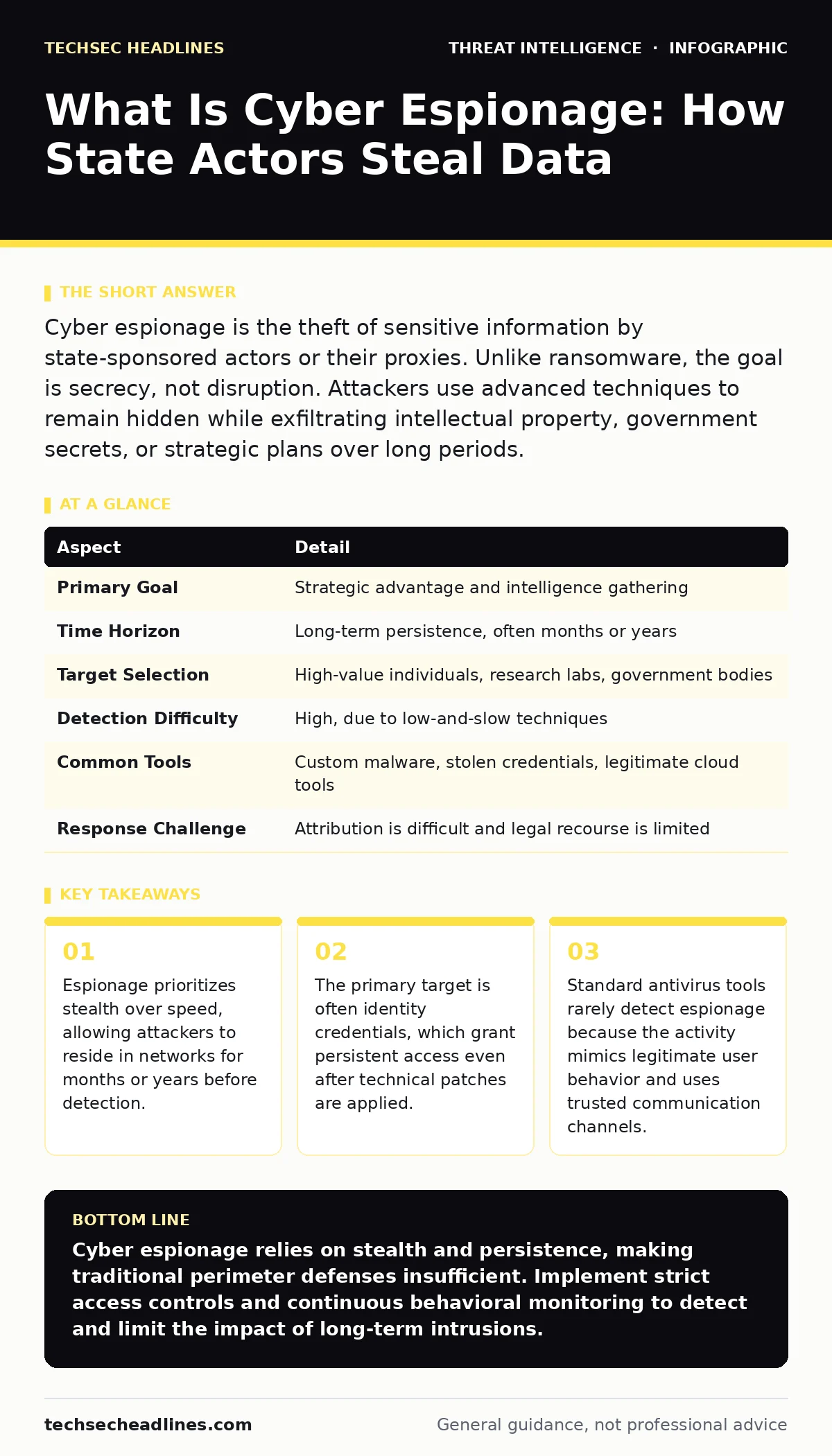
Cyber espionage is the theft of sensitive information by state-sponsored actors or their proxies. Unlike ransomware, the goal is secrecy, not disruption. Attackers use advanced techniques to remain hidden while exfiltrating intellectual property, government secrets, or strategic plans over long periods.
Everyday Analogy: The Corporate Spy
Imagine a corporate spy who does not break into a building through the window. Instead, this person applies for a job, passes background checks, and sits at a desk in the lobby. They have a badge, a name tag, and access to the elevator. They do not steal the vault contents in one night. They copy small documents during lunch breaks, burn them in a trash can, and leave before anyone notices. The security guards see a legitimate employee every day. The theft is slow, quiet, and invisible to the cameras that only watch for forced entry.
Cyber espionage works exactly like this. The attacker does not smash through firewalls with brute force. They gain legitimate access, blend in with normal traffic, and extract data slowly. This approach avoids the noise that triggers automated alerts.
What Is Cyber Espionage
What is cyber espionage? It is the systematic theft of confidential information by foreign governments, their agencies, or private contractors acting on their behalf. The objective is strategic advantage, not immediate financial gain. Attackers seek intellectual property, military plans, political strategies, or personal data on key individuals.
This differs from cybercrime, where the goal is usually money. In crime, speed matters because detection cuts off revenue. In espionage, patience matters because exposure ends the operation. The attacker accepts a slower pace to ensure they are never caught. This trade-off defines the entire threat model.
| Aspect | Detail |
|---|---|
| Primary Goal | Strategic advantage and intelligence gathering |
| Time Horizon | Long-term persistence, often months or years |
| Target Selection | High-value individuals, research labs, government bodies |
| Detection Difficulty | High, due to low-and-slow techniques |
| Common Tools | Custom malware, stolen credentials, legitimate cloud tools |
| Response Challenge | Attribution is difficult and legal recourse is limited |
How Espionage Operates in Practice
Espionage relies on the cyber kill chain, a framework that describes the steps of an attack. Espionage operators excel at the early stages: reconnaissance and weaponization. They spend weeks researching a target to find a specific employee with high-level access. They then craft a lure, such as a fake job posting or a tailored document, designed specifically for that person.
Once the target opens the lure, the attacker installs a implant. This is a small piece of software that stays hidden. It does not encrypt files or demand ransom. It waits. When the user logs into a sensitive system, the implant captures the session token or password. It then sends this data back to the attacker over a channel that looks like normal web traffic. This technique, often involving domain fronting, hides the command server behind a popular service like a video streaming site.
The attacker now has a foothold. They move laterally, using the stolen credentials to access other systems. Because they use valid passwords, the network logs show legitimate activity. The SIEM (Security Information and Event Management) system sees a user logging in from a normal location. It does not flag the event as malicious.
Who Is Really at Risk
Students and new professionals often assume only major governments are targets. This is incorrect. Espionage operators target anyone who can reach valuable data. This includes university researchers, small defense subcontractors, and even journalists. If you have access to sensitive information, you are a target.
The risk is not limited to high-security networks. Attackers often breach smaller organizations to pivot into larger partners. A small supplier with weak security may be the entry point into a major corporation. This supply chain risk means that your security posture depends on your vendors. You cannot control their systems, but you can monitor the connections between them.
What People Usually Get Wrong
Many defenders focus too much on perimeter defense. They build high walls and assume that if the wall holds, the data is safe. This mindset fails against espionage. Espionage actors often enter through the user, not the firewall. A phishing email bypasses the firewall entirely.
Another common error is assuming that encryption solves the problem. Encryption protects data at rest and in transit. It does not protect data that is being viewed on a screen. If an attacker has remote access to your computer, they can take screenshots or read the data in memory. Encryption is useless against an attacker who sits behind your monitor, even if that monitor is virtual.
Finally, organizations often ignore incident triage for low-severity alerts. Espionage starts with small, seemingly harmless events. A failed login here, a weird process there. These signals are noise until you connect them. Ignoring low-level alerts allows the attacker to establish persistence. You must investigate every anomaly, no matter how small.
See also: Cyber Kill Chain vs MITRE ATT&CK: The Structural Difference · Initial Access Broker Mistakes That Open Your Network
Practical Defense Strategies
You cannot stop every espionage attempt. The goal is to increase the cost and time required for the attacker. This buys you time to detect and respond.
- Enforce Multi-Factor Authentication (MFA): This is the single most effective control. If an attacker steals a password, MFA blocks them from logging in. Use hardware keys or authenticator apps, not SMS. SMS can be intercepted.
- Limit Privileged Access: Users should only have the permissions they need for their job. This limits the damage if credentials are stolen. Regularly review and remove unnecessary access.
- Monitor for Anomalous Behavior: Use breach and attack simulation to test your defenses. This involves running safe, controlled attacks to see if your detection tools catch them. If your tools miss the simulation, they will miss the real attack.
- Segment Your Network: Divide your network into smaller zones. If an attacker breaches one zone, they cannot easily move to others. This slows down lateral movement.
The Hidden Cost of Persistence
The most dangerous aspect of espionage is persistence. Attackers want to stay in your network as long as possible. They create backdoors, such as hidden user accounts or scheduled tasks that run at night. These backdoors allow them to return even if you patch the original vulnerability.
This persistence creates a hidden cost. You may think you have secured your systems after a patch, but the attacker is still inside. They use the old backdoor to bypass the new security. This is why continuous monitoring is necessary. You must assume you are already compromised and look for signs of life.
Moving Beyond Basic Hygiene
Basic hygiene, like updating software, is necessary but not sufficient. Espionage actors exploit human behavior and process gaps. You must train employees to recognize sophisticated lures. This is not just about not clicking links. It is about understanding why a link might be dangerous.
Consider threat intelligence sharing. By sharing indicators of compromise with other organizations, you gain visibility into tactics used against your sector. This helps you detect attacks that have not yet reached your network. However, sharing must be done carefully to avoid exposing your own weaknesses.
Espionage is a long game. Defending against it requires a long-term mindset. You must accept that you will be targeted and prepare for the inevitable breach. The goal is not prevention, but detection and response.
Key takeaways
- Espionage prioritizes stealth over speed, allowing attackers to reside in networks for months or years before detection.
- The primary target is often identity credentials, which grant persistent access even after technical patches are applied.
- Standard antivirus tools rarely detect espionage because the activity mimics legitimate user behavior and uses trusted communication channels.
Cyber espionage relies on stealth and persistence, making traditional perimeter defenses insufficient. Implement strict access controls and continuous behavioral monitoring to detect and limit the impact of long-term intrusions.
Frequently asked questions
How is cyber espionage different from hacktivism?
Hacktivism aims to disrupt systems or send a political message, often causing public outages. Espionage aims to steal data quietly without disrupting operations or drawing attention.
Can small businesses be targets of cyber espionage?
Yes, small businesses are often targeted as entry points to larger partners or because they hold specific niche data. Their weaker security makes them attractive initial targets for attackers. Q
How this guide was produced: written by the TechSec Headlines editorial team with AI assistance, checked against the public references listed below, and reviewed when the facts change. See our editorial policy or report an error.