Breach and attack simulation platforms automate adversary techniques to test your security controls. They do not replace human analysis or guarantee security. Most teams misuse them by chasing coverage metrics instead of validating detection logic. You must align simulations with actual threat models to avoid false confidence in your security posture.
Misreading: Automation replaces human detection engineering
Correct reading: Breach and attack simulation platforms automate the execution of known techniques, but they cannot replace the human judgment required to tune detection rules. The platform triggers an event, but your security team must verify that the alert fired correctly and that the response procedure works. Automation handles the repetition of generating traffic. It does not handle the nuance of distinguishing malicious behavior from legitimate business processes.
Imagine a platform simulating a phishing payload execution. The tool generates the file and runs it. Your SIEM receives the log. The platform reports "Detected." This report is meaningless if your analysts never reviewed the alert or if the alert was a false positive that they ignored. The value comes from the feedback loop between the simulation and the analyst. Without that loop, you are just generating noise. You must treat the simulation as a test case for your detection engineering team, not as a replacement for it.
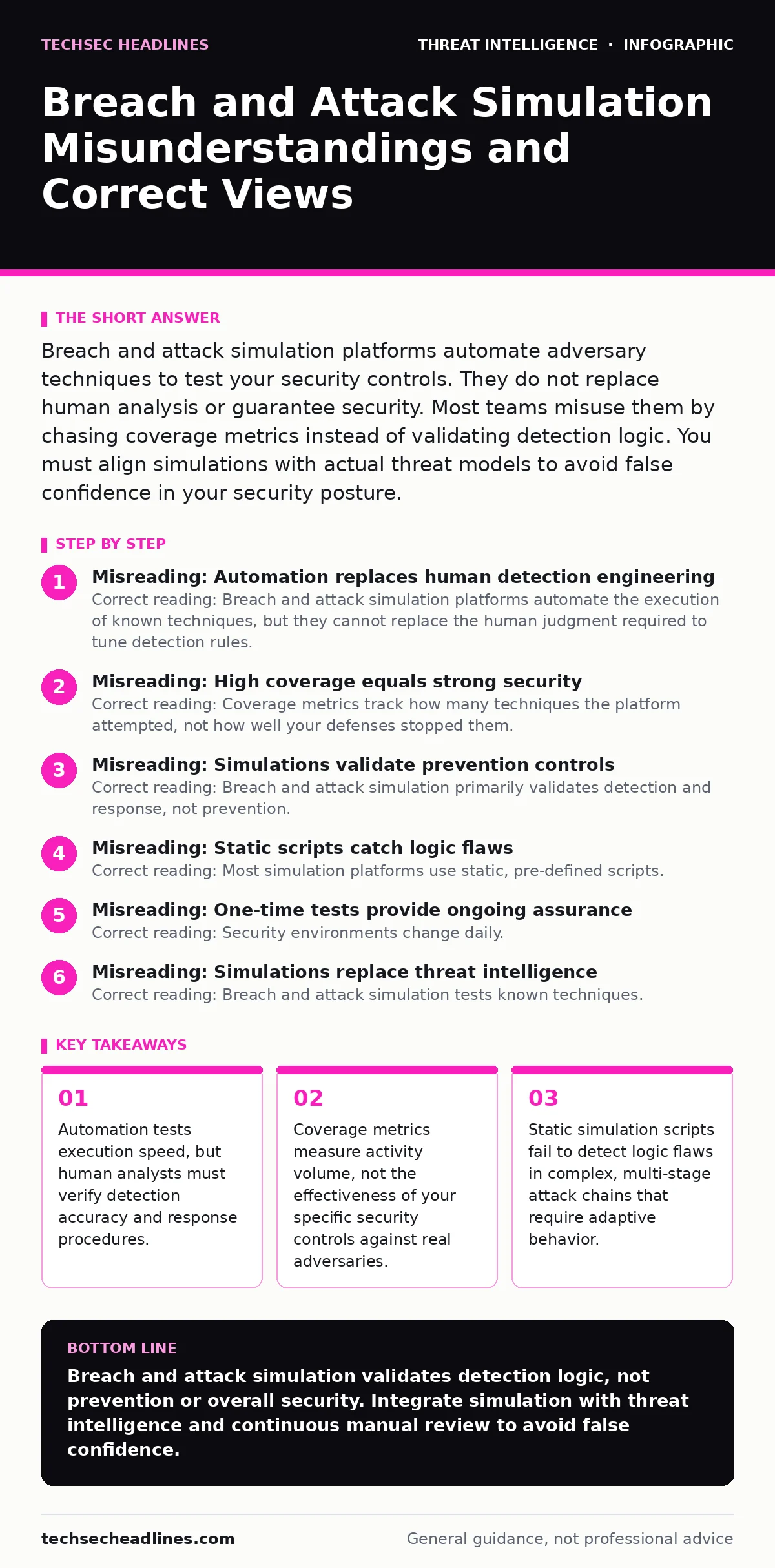
Misreading: High coverage equals strong security
Correct reading: Coverage metrics track how many techniques the platform attempted, not how well your defenses stopped them. A high coverage score often reflects a wide net of basic tests rather than deep validation of critical controls. Coverage is a vanity metric if it does not correlate with your actual risk profile.
Focus on the quality of the test, not the quantity. Testing 10 common techniques with high fidelity is more valuable than testing 100 techniques with shallow execution. If the simulation cannot replicate the specific constraints of your network, the coverage number is misleading. You must define which techniques matter for your organization. Then, verify that your controls detect those specific techniques. Do not trust a dashboard that claims you are secure because it checked many boxes.
Misreading: Simulations validate prevention controls
Correct reading: Breach and attack simulation primarily validates detection and response, not prevention. Most platforms assume a certain level of initial access or bypass standard perimeter controls to test internal defenses. They show you what happens when an attacker is already inside. They do not prove that your firewall or endpoint protection stopped the initial entry. Assuming prevention is validated because the simulation ran is a dangerous error.
Suppose you run a simulation that mimics a credential dump. The tool succeeds in dumping hashes. Your platform reports that the technique was executed. This tells you your endpoint detection and response system may have missed the activity. It does not tell you if your password policy prevented the attacker from getting the credentials in the first place. You must separate prevention testing from detection testing. Use other methods to validate that your perimeter controls block entry. Use breach and attack simulation to validate that your internal sensors catch the breach.
Misreading: Static scripts catch logic flaws
Correct reading: Most simulation platforms use static, pre-defined scripts. These scripts follow a rigid path and cannot adapt to unexpected controls or network changes. Real attackers adapt. They change their approach when they hit a wall. Static scripts will fail if the environment changes slightly, or they will succeed in ways that do not reflect real-world complexity. You cannot find logic flaws in your security architecture with a tool that cannot think.
Imagine a simulation that tries to escalate privileges using a specific Windows API call. If your system blocks that call, the script fails. The platform reports "Blocked." But a real attacker would use a different API call or a different method to achieve the same result. The static script does not try the alternative path. You miss the gap in your defense. You need to design simulations that test the outcome, not just the specific method. This requires manual testing or advanced platforms that can adjust their behavior based on the environment.
Misreading: One-time tests provide ongoing assurance
Correct reading: Security environments change daily. New applications are deployed. Configurations are updated. Permissions are modified. A simulation run last month may not reflect your current security posture. Breach and attack simulation must be continuous to be useful. Running it once before an audit provides a snapshot that is immediately outdated. Continuous simulation reveals how changes impact your detection capabilities over time.
You cannot rely on a past success to prove current security. A configuration change in your identity provider might break a detection rule that was working yesterday. Only continuous simulation will catch this regression. You must integrate simulation into your change management process. When you deploy a new system, run the relevant simulations. When you update a security rule, verify it still detects the expected techniques. Treat simulation as a continuous validation loop, not a periodic event.
See also: What Is Cyber Espionage: How State Actors Steal Data · Cyber Kill Chain vs MITRE ATT&CK: The Structural Difference
Misreading: Simulations replace threat intelligence
Correct reading: Breach and attack simulation tests known techniques. It does not provide context on who is targeting you or why. Threat intelligence informs which techniques are relevant to your industry and geography. Without intelligence, you are testing random techniques that may never be used against you. You waste resources on low-risk scenarios while ignoring high-risk ones. Simulation and intelligence must work together.
Suppose your organization is a target for cyber espionage groups. These groups use sophisticated, slow-moving techniques. A generic simulation platform may focus on fast, noisy attacks like ransomware. You will have high coverage for ransomware techniques but low coverage for espionage techniques. You feel secure because the dashboard is green. But you are blind to the real threat. You must use threat intelligence to prioritize which simulations to run. Align your testing with the actual adversaries that threaten you.
Misreading: Simulation proves resilience against advanced threats
Correct reading: Simulation platforms test known, documented techniques. They do not test zero-day exploits or novel attack chains. Advanced persistent threats often use custom malware and unique tactics that are not in any public framework. A simulation platform cannot test for what it does not know. You cannot claim resilience against advanced threats based on simulation results alone. You must combine simulation with other security measures.
Imagine a new vulnerability emerges in a widely used library. No simulation platform will have a test for this specific vulnerability until it is documented and added to their library. In the meantime, you are vulnerable. Simulation provides a baseline of known security. It does not provide a shield against the unknown. You must invest in other areas, such as patch management and vulnerability scanning, to address unknown risks. Simulation is a tool for validation, not a comprehensive security solution.
Key takeaways
- Automation tests execution speed, but human analysts must verify detection accuracy and response procedures.
- Coverage metrics measure activity volume, not the effectiveness of your specific security controls against real adversaries.
- Static simulation scripts fail to detect logic flaws in complex, multi-stage attack chains that require adaptive behavior.
Breach and attack simulation validates detection logic, not prevention or overall security. Integrate simulation with threat intelligence and continuous manual review to avoid false confidence.
Frequently asked questions
How often should I run breach and attack simulations?
Run simulations continuously or at least daily. Security configurations change frequently, and static tests become outdated quickly. Continuous simulation ensures you catch regressions in your detection rules as soon as they occur.
Can simulation platforms detect zero-day vulnerabilities?
No. Simulation platforms only test known, documented techniques. They cannot detect or test for zero-day vulnerabilities or novel attack methods that are not yet in their library. You must use other tools for vulnerability discovery.
Do I need a dedicated team for breach and attack simulation?
You do not need a dedicated team, but you need dedicated ownership. Assign a detection engineer or security analyst to review simulation results regularly. They must validate alerts and tune rules to ensure the simulations provide accurate feedback on your security posture.
How do I choose which techniques to simulate?
Use threat intelligence to prioritize techniques that are relevant to your industry and geography. Focus on techniques used by adversaries that actively target organizations like yours. Do not simulate random techniques from a generic list without considering your specific risk profile.
How this guide was produced: written by the TechSec Headlines editorial team with AI assistance, checked against the public references listed below, and reviewed when the facts change. See our editorial policy or report an error.