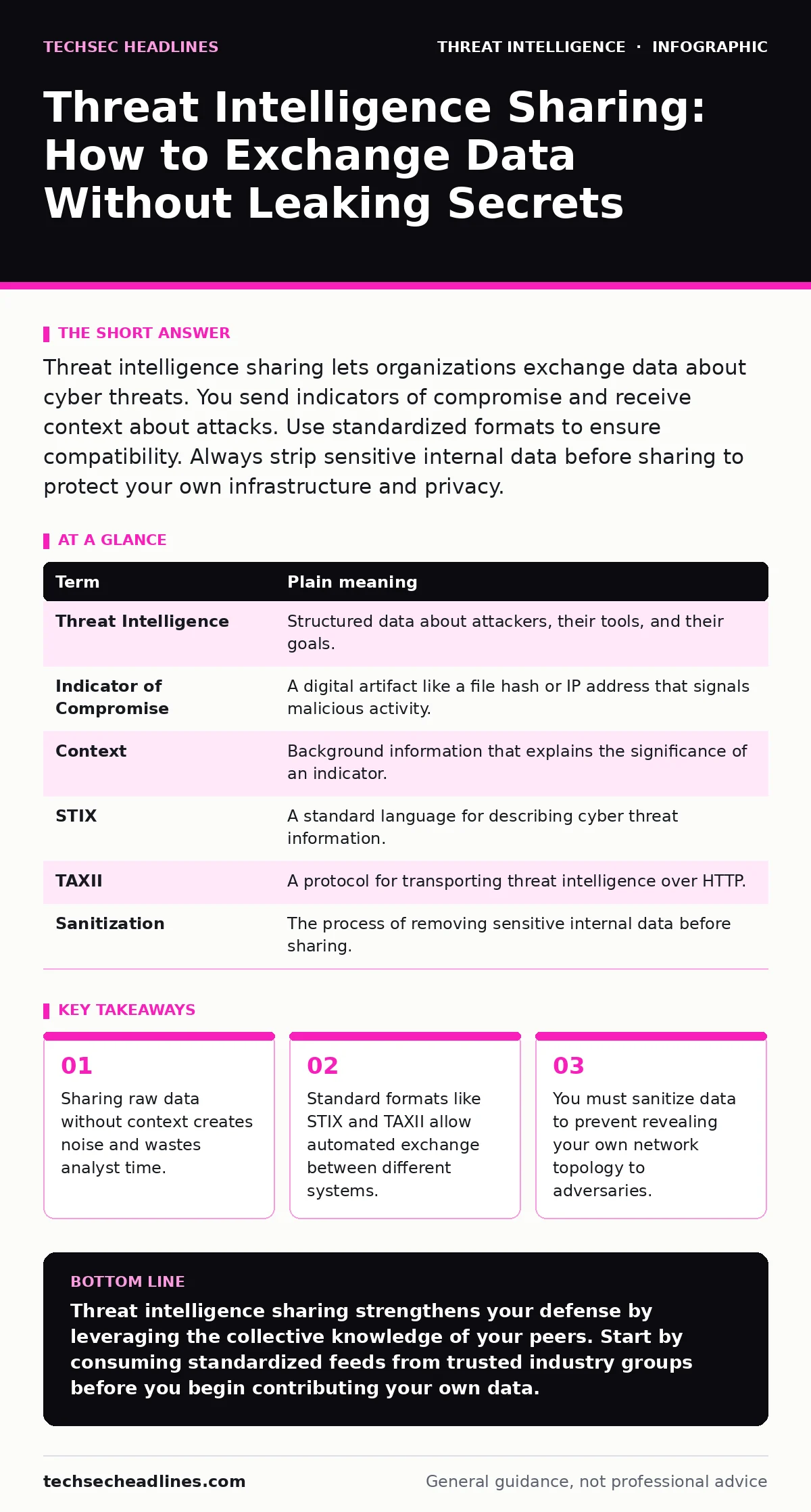
Threat intelligence sharing lets organizations exchange data about cyber threats. You send indicators of compromise and receive context about attacks. Use standardized formats to ensure compatibility. Always strip sensitive internal data before sharing to protect your own infrastructure and privacy.
The Neighborhood Watch Model
Imagine you live in a large apartment complex. If a burglar tries to pick the lock on unit 4B, the resident calls the police. They do not just say "someone broke in." They describe the burglar’s height, clothing, and the specific tool used. Other residents then check their own locks and windows. This is threat intelligence sharing. You are exchanging specific details about an attacker so others can defend themselves. The goal is collective defense, not gossip.
Defining the Components
You need to understand the parts of the system before you start sharing. Threat intelligence is structured data about current or potential threats. Indicators of compromise are specific artifacts that show a system has been breached. Context explains why an indicator matters. Without context, a single IP address is just a number. With context, it is a known command-and-control server used by a specific group.
| Term | Plain meaning |
|---|---|
| Threat Intelligence | Structured data about attackers, their tools, and their goals. |
| Indicator of Compromise | A digital artifact like a file hash or IP address that signals malicious activity. |
| Context | Background information that explains the significance of an indicator. |
| STIX | A standard language for describing cyber threat information. |
| TAXII | A protocol for transporting threat intelligence over HTTP. |
| Sanitization | The process of removing sensitive internal data before sharing. |
The Value of Context
Sharing an IP address is easy. Sharing why that IP is dangerous is harder but more valuable. Suppose you see traffic to a known malicious domain. If you share only the domain, your peers block it. If you share the domain plus the malware family it delivers, they can look for the malware itself. This saves them from waiting for the next blocklist update. Context turns raw data into actionable defense. It reduces the time between detection and response.
Standardizing the Exchange
You cannot share data if your systems cannot read each other’s formats. This is where open standards matter. STIX defines how to describe threats. TAXII defines how to move that data. Think of STIX as the grammar and TAXII as the postal service. Using these standards means you can share with any organization that speaks the same language. You do not need custom integrations for every partner. This reduces maintenance overhead and errors.
The Hidden Cost of Sharing
Sharing is not free. The biggest risk is leaking your own operational security. Imagine you report an attack on your payment server. If you include the server’s internal IP address or its specific software version, you have just told attackers where to look next. This is called intelligence leakage. You must sanitize your data. Remove any information that identifies your specific network structure. Share the threat, not your blueprint.
See also: What Is Cyber Espionage: How State Actors Steal Data · Cyber Kill Chain vs MITRE ATT&CK: The Structural Difference
Trust and Reputation
You share with partners you trust. If a partner shares low-quality or false data, your systems will generate noise. You must vet your sources. Look for organizations that follow strict sanitization rules. Participate in closed communities rather than open social media. Closed groups allow for accountability. If a member shares bad data, they can be removed. This maintains the quality of the intelligence pool. High-quality data leads to faster, more accurate defenses.
A First Practical Step
You do not need a complex infrastructure to start. Begin by joining a sector-specific information sharing group. These groups are often run by industry associations. They provide a secure channel for exchange. Use their guidelines for formatting your reports. Start by consuming data. Subscribe to their feeds and integrate them into your monitoring tools. This lets you see the value without risking your own data. Once you are comfortable, begin contributing sanitized indicators.
Automating the Process
Manual sharing is slow and error-prone. Automation ensures consistency. Configure your security tools to export indicators in STIX format. Use a TAXII server to push this data to your partners. This removes the human element from the exchange. It reduces the chance of accidental data leakage. It also ensures your peers receive updates in real time. Automation scales your defense capabilities. It turns sharing from a chore into a continuous process.
Key takeaways
- Sharing raw data without context creates noise and wastes analyst time.
- Standard formats like STIX and TAXII allow automated exchange between different systems.
- You must sanitize data to prevent revealing your own network topology to adversaries.
Threat intelligence sharing strengthens your defense by leveraging the collective knowledge of your peers. Start by consuming standardized feeds from trusted industry groups before you begin contributing your own data.
Frequently asked questions
Is threat intelligence sharing legal?
Yes, provided you share only public or anonymized data and respect privacy laws. Always consult legal counsel for specific compliance requirements.
What if I receive bad intelligence?
Treat all external data as unverified. Validate indicators against your own environment before taking action. Report false positives to the source.
Do I need expensive software to share?
No. Many open-source tools support STIX and TAXII standards. You can start with basic scripts and free platforms.
How do I know who to trust?
Look for established industry groups with clear membership vetting processes. Avoid open, anonymous channels for sensitive data.
How this guide was produced: written by the TechSec Headlines editorial team with AI assistance, checked against the public references listed below, and reviewed when the facts change. See our editorial policy or report an error.