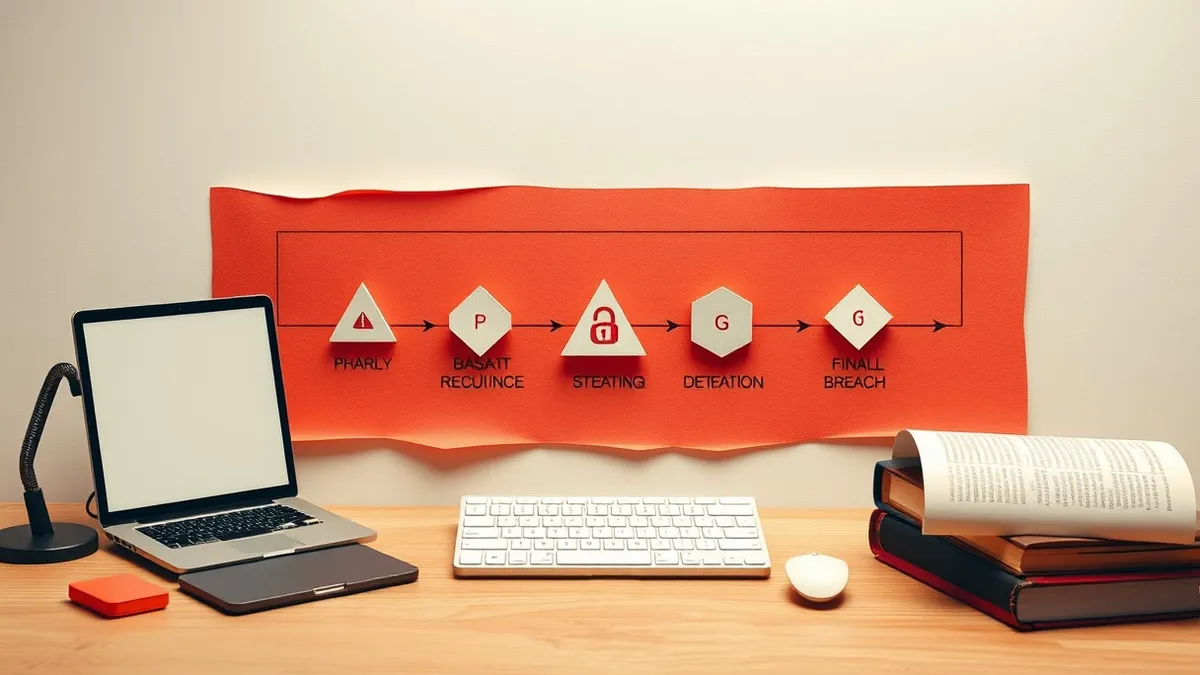
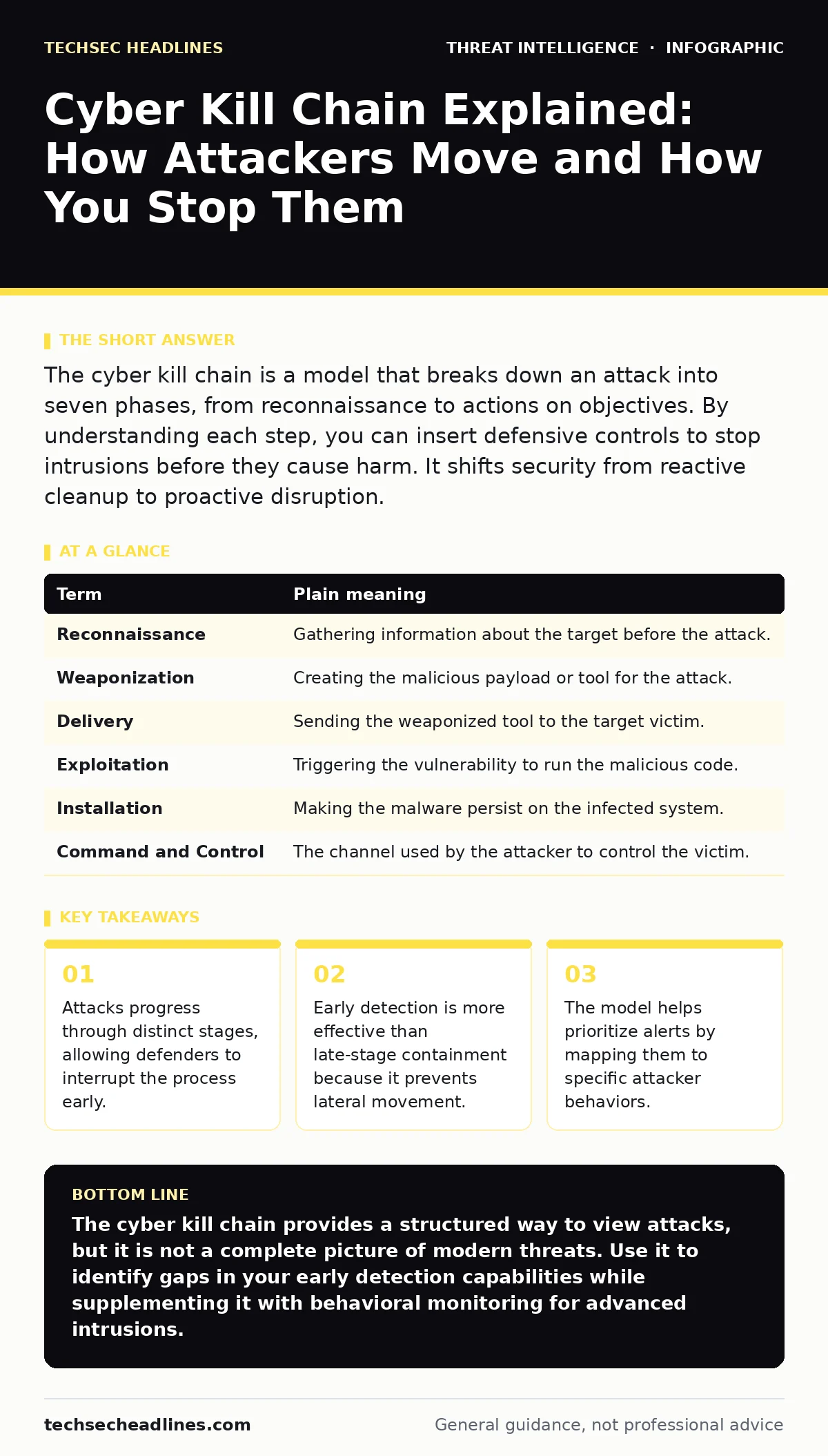
The cyber kill chain is a model that breaks down an attack into seven phases, from reconnaissance to actions on objectives. By understanding each step, you can insert defensive controls to stop intrusions before they cause harm. It shifts security from reactive cleanup to proactive disruption.
The Home Renovation Analogy
Imagine you are hiring a contractor to renovate a kitchen. A dishonest contractor does not just walk in and steal the appliances. They first watch the house from the street to find the best time to enter. They then research the layout online. Next, they pose as a legitimate worker to gain trust. They bring in their own tools and supplies. They quietly remove the locks while the homeowner is away. Finally, they take what they want and leave without triggering the alarm. This step-by-step progression is the core idea behind the cyber kill chain.
Each step in this analogy maps to a specific phase of a digital attack. The attacker must succeed at every stage to reach their goal. If you stop them at any point, the entire effort fails. This model was originally developed by military strategists to describe how air defenses could shoot down enemy aircraft. In cybersecurity, it describes how intruders move through a network.
Breaking Down the Seven Phases
The model divides an intrusion into seven distinct steps. The first is Reconnaissance, where the attacker gathers information about the target. This might involve scanning for open ports or finding employee names on social media. The second phase is Weaponization, where the attacker creates the payload. They might embed malware in a PDF document or a software update.
The third phase is Delivery. The attacker sends the weaponized file to the victim via email or a compromised website. The fourth phase is Exploitation. If the victim opens the file, the malicious code runs and takes advantage of a vulnerability in the software. The fifth phase is Installation. The malware installs itself on the device to persist even after a reboot.
The sixth phase is Command and Control. The infected device checks in with the attacker’s server to receive new instructions. The final phase is Actions on Objectives. The attacker steals data, encrypts files for ransom, or uses the computer as part of a botnet.
| Term | Plain meaning |
|---|---|
| Reconnaissance | Gathering information about the target before the attack. |
| Weaponization | Creating the malicious payload or tool for the attack. |
| Delivery | Sending the weaponized tool to the target victim. |
| Exploitation | Triggering the vulnerability to run the malicious code. |
| Installation | Making the malware persist on the infected system. |
| Command and Control | The channel used by the attacker to control the victim. |
Why the Model Matters for Detection
Most security teams focus on the final stages, such as data exfiltration. This is like waiting until the contractor has already stolen the appliances to call the police. By the time you see the damage, the attacker has already achieved their goal. The kill chain encourages you to look for signs in the earlier phases.
For example, monitoring for unusual outbound connections can detect the Command and Control phase. You can block the attacker before they steal anything. This approach aligns with the broader intelligence cycle, where you continuously gather and analyze threat data to improve your defenses. It turns passive logging into active hunting.
Common Points of Confusion
Many readers confuse the cyber kill chain with other frameworks. The MITRE ATT&CK framework is more detailed and focuses on tactics and techniques rather than a linear progression. The kill chain is simpler and better for high-level strategy. It does not describe every technical trick an attacker might use.
Another confusion is the assumption that all attacks follow this exact order. Some attackers skip phases. For instance, a simple phishing attack might combine delivery and exploitation in a single email link. The model is a generalization, not a strict rulebook. It helps you think like an attacker, but you must adapt it to your specific environment.
Integrating with Your Security Stack
To use the kill chain effectively, you need visibility across your network. A SIEM (Security Information and Event Management) system aggregates logs from various sources. It allows you to correlate events and spot patterns that match specific kill chain phases. Without centralized logging, you will miss early indicators.
You should also consider incident triage procedures. When an alert fires, your team needs to know which phase of the attack it represents. This helps prioritize response efforts. A reconnaissance scan is low priority. A confirmed installation of malware is high priority. Clear definitions speed up decision-making.
See also: Examples of Hacktivism: Tactics, Targets, and Defense Strategies · WordPress Plugin Vulnerability Response and Recovery Steps
Advanced Threats and Model Limitations
The kill chain was designed for traditional malware. It struggles with more advanced techniques. Pass-the-ticket attacks and golden ticket attacks bypass many detection mechanisms because they use legitimate credentials. These attacks often skip the exploitation and installation phases entirely.
Cyber espionage groups also operate differently. They may spend months in the reconnaissance phase, moving slowly to avoid detection. They do not always follow the linear path described here. For these threats, you need additional strategies, such as threat intelligence sharing with other organizations. This helps you see the bigger picture and anticipate moves that do not fit the standard model.
Try This Now
- Map your current security controls to each phase of the kill chain. Identify which phases have no coverage.
- Review your SIEM rules to ensure they alert on early indicators, such as unusual reconnaissance activity.
- Simulate an attack scenario that skips the installation phase. Test your team's response to credential-based intrusions.
Key takeaways
- Attacks progress through distinct stages, allowing defenders to interrupt the process early.
- Early detection is more effective than late-stage containment because it prevents lateral movement.
- The model helps prioritize alerts by mapping them to specific attacker behaviors.
The cyber kill chain provides a structured way to view attacks, but it is not a complete picture of modern threats. Use it to identify gaps in your early detection capabilities while supplementing it with behavioral monitoring for advanced intrusions.
Frequently asked questions
How does the kill chain differ from MITRE ATT&CK?
The kill chain describes the high-level stages of an attack, while MITRE ATT&CK details the specific tactics, techniques, and procedures attackers use at each stage.
Can defenders stop an attack at any phase?
Yes, the model is designed so that disruption at any point prevents the attacker from reaching their final objective, making early phases ideal for intervention.
Does the kill chain apply to cloud environments?
Yes, the phases apply to cloud infrastructure, but the specific techniques for reconnaissance and command and control differ from traditional on-premise networks.
How this guide was produced: written by the TechSec Headlines editorial team with AI assistance, checked against the public references listed below, and reviewed when the facts change. See our editorial policy or report an error.