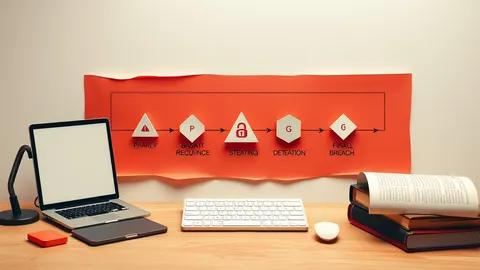
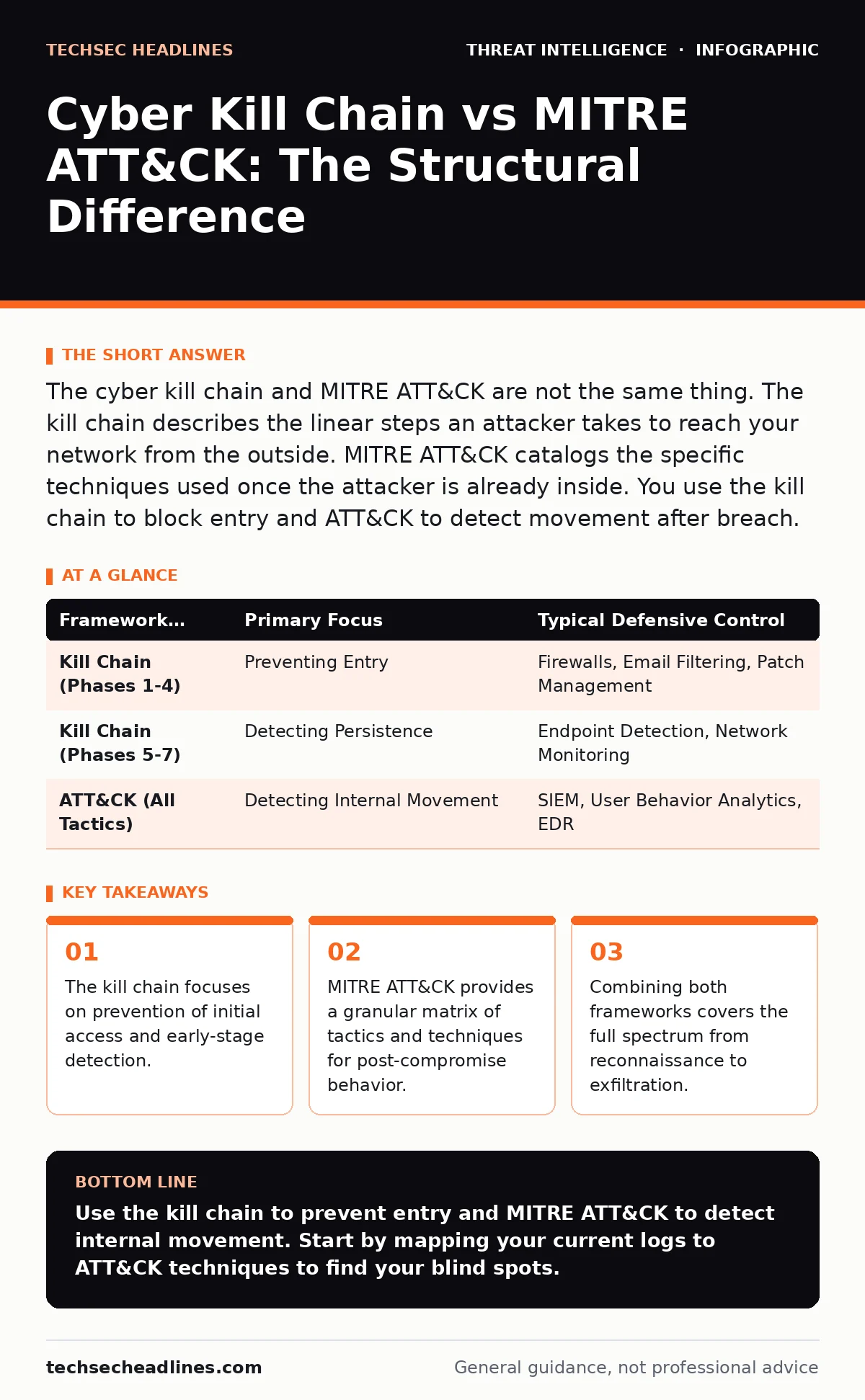
The cyber kill chain and MITRE ATT&CK are not the same thing. The kill chain describes the linear steps an attacker takes to reach your network from the outside. MITRE ATT&CK catalogs the specific techniques used once the attacker is already inside. You use the kill chain to block entry and ATT&CK to detect movement after breach.
What is the core difference between cyber kill chain and mitre framework?
The cyber kill chain and the MITRE ATT&CK framework serve different phases of an attack. The kill chain models the attacker’s journey from the outside world to your target, emphasizing the steps required to gain initial access. MITRE ATT&CK models the attacker’s behavior once they are already inside your environment, focusing on lateral movement and data theft. You use the kill chain to harden your perimeter and use ATT&CK to monitor internal traffic for suspicious activity.
How does the cyber kill chain structure an attack?
The cyber kill chain breaks down an intrusion into 7 discrete phases. Reconnaissance involves gathering information about the target. Weaponization pairs an exploit with a delivery mechanism. Delivery sends the weaponized payload to the victim. Exploitation triggers the vulnerability on the target system. Installation places persistent malware on the device. Command and Control establishes communication between the attacker and the victim. Actions on Objectives achieve the final goal, such as data theft or system destruction.
Why does MITRE ATT&CK start after the kill chain ends?
MITRE ATT&CK assumes the attacker has already bypassed your perimeter defenses. It categorizes behavior into 14 tactics, starting with Initial Access and ending with Impact. This framework details hundreds of specific techniques attackers use to maintain access, escalate privileges, and move laterally. It does not care how the attacker got in, only what they do next. This distinction allows defenders to build detection rules for internal network anomalies rather than just firewall logs.
| Framework Phase | Primary Focus | Typical Defensive Control |
|---|---|---|
| Kill Chain (Phases 1-4) | Preventing Entry | Firewalls, Email Filtering, Patch Management |
| Kill Chain (Phases 5-7) | Detecting Persistence | Endpoint Detection, Network Monitoring |
| ATT&CK (All Tactics) | Detecting Internal Movement | SIEM, User Behavior Analytics, EDR |
When should you use the kill chain for defense?
You use the kill chain when designing preventive controls. It helps you identify weaknesses in your external-facing systems. If your organization suffers frequent phishing attacks, you look at the Delivery phase. If you see unpatched servers, you look at the Exploitation phase. The kill chain forces you to think about the attacker’s preparation before they ever touch your network. It is less useful for detecting sophisticated threats that have already established a foothold.
When should you use MITRE ATT&CK for defense?
You use MITRE ATT&CK when building detection capabilities. It helps you identify gaps in your monitoring tools. If your logs show unusual privilege escalation, you map that behavior to an ATT&CK technique. If you see data moving to unexpected cloud storage, you check the Exfiltration tactic. This framework allows you to simulate real-world attacks using breach and attack simulation tools. It ensures your security team can detect activity that bypasses traditional perimeter defenses.
See also: WordPress Plugin Vulnerability Response and Recovery Steps
How do these frameworks handle advanced persistent threats?
Advanced persistent threats often move slowly and quietly. The kill chain may fail to detect them because they spend months in the Reconnaissance phase. MITRE ATT&CK excels here by mapping low-and-slow techniques. It helps you spot subtle changes in user behavior or network traffic. You can correlate multiple small events that individually look benign but together indicate a compromise. This approach is critical for defending against cyber espionage groups that prioritize stealth over speed.
What are the limitations of each framework?
The kill chain is linear and assumes attackers follow a strict order. Modern attackers often skip phases or move backward. They may achieve Actions on Objectives before fully establishing Command and Control. MITRE ATT&CK can be overwhelming due to its size. It contains thousands of techniques, many of which are irrelevant to your specific industry. You must filter the matrix to focus on techniques that matter to your environment. Ignoring this filtering leads to alert fatigue and wasted resources.
How do you integrate both frameworks in practice?
You integrate both frameworks by layering your defenses. Use the kill chain to design your security architecture and prevent initial access. Use MITRE ATT&CK to tune your SIEM and endpoint detection tools. This combination ensures you block attacks at the door and catch those that slip through. You can also use threat intelligence sharing to update your rules with the latest observed techniques. This dual approach provides a more complete view of your security posture.
What is the impact on incident response?
During an incident, the kill chain helps you understand the scope of the breach. It tells you how far the attacker progressed before detection. MITRE ATT&CK helps you contain the threat. It identifies the specific techniques used, allowing you to block similar methods. You can use this information to improve your response playbooks. Understanding the difference between these frameworks makes your response faster and more accurate.
Key takeaways
- The kill chain focuses on prevention of initial access and early-stage detection.
- MITRE ATT&CK provides a granular matrix of tactics and techniques for post-compromise behavior.
- Combining both frameworks covers the full spectrum from reconnaissance to exfiltration.
Use the kill chain to prevent entry and MITRE ATT&CK to detect internal movement. Start by mapping your current logs to ATT&CK techniques to find your blind spots.
Frequently asked questions
Can I use the kill chain for internal network security?
The kill chain is less effective for internal security because it focuses on external entry. Use MITRE ATT&CK for internal network monitoring and detection.
Is MITRE ATT&CK only for large enterprises?
No, MITRE ATT&CK is scalable. Small organizations can focus on a subset of techniques relevant to their industry and infrastructure.
How often should I update my ATT&CK mappings?
Update your mappings whenever new threats emerge or when you change your infrastructure. Regular reviews ensure your detection rules remain effective.
Do initial access brokers affect these frameworks?
Initial access brokers sell entry points, which fits the kill chain’s Delivery phase. Once inside, their activity maps to ATT&CK’s Initial Access tactic.
How this guide was produced: written by the TechSec Headlines editorial team with AI assistance, checked against the public references listed below, and reviewed when the facts change. See our editorial policy or report an error.