
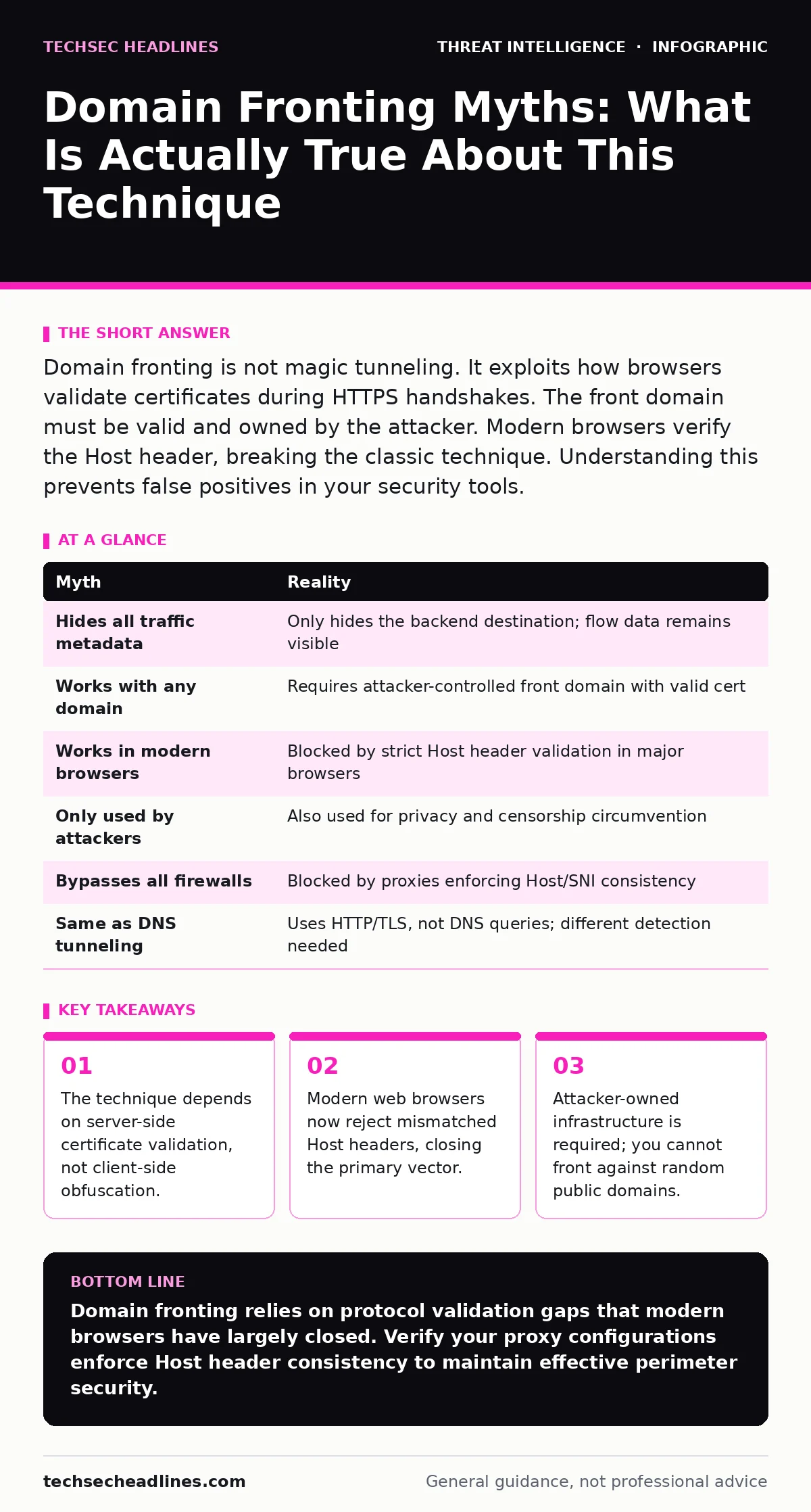
Domain fronting is not magic tunneling. It exploits how browsers validate certificates during HTTPS handshakes. The front domain must be valid and owned by the attacker. Modern browsers verify the Host header, breaking the classic technique. Understanding this prevents false positives in your security tools.
Myth: Domain fronting hides traffic from all network observers
Reality: It only hides the specific destination from devices that cannot inspect encrypted TLS payloads. Network appliances that perform deep packet inspection or analyze traffic patterns can often still identify the activity. The technique relies on the fact that the initial TLS handshake is encrypted. An observer sees a connection to a legitimate-looking domain.
They cannot see the inner HTTP request that specifies the true destination. However, the volume, timing, and size of packets may reveal unusual behavior. If you are monitoring for data exfiltration, do not assume encryption equals invisibility. The metadata remains visible. You must analyze flow characteristics, not just content.
Myth: Any popular website can be used for domain fronting
Reality: You must own or control the front domain to serve the correct TLS certificate. The browser validates that the certificate presented by the server matches the domain in the URL. If you try to front through a site you do not control, the certificate check fails. The connection is terminated immediately.
This is a fundamental constraint of the HTTPS protocol. It prevents unauthorized use of third-party infrastructure for this specific technique. You cannot simply pick Google or Facebook and route your traffic through them without their infrastructure supporting the specific header behavior. The front domain must be configured to accept the connection and forward it internally.
Myth: Modern browsers still support classic domain fronting
Reality: Major browser vendors have patched the specific implementation flaws that allowed this. Chrome, Firefox, and Safari now strictly validate the Host header against the certificate. If the Host header in the HTTP request does not match the domain in the TLS handshake, the browser blocks the request. This change was made to close the security gap. The classic method of using a CDN’s shared infrastructure to hide the backend destination no longer works in standard web browsers. Some specialized tools or older clients might still exhibit this behavior, but they are rare. Relying on this technique in a modern environment is likely to fail.
Myth: Domain fronting is only used by malicious actors
Reality: Legitimate organizations use similar mechanisms for privacy and censorship circumvention. Researchers and journalists in restrictive regimes may use this to access blocked content. The technique itself is neutral. It exploits a protocol design choice. The intent determines whether it is abusive or defensive. Security tools that flag all domain fronting behavior will generate significant noise. You must distinguish between malicious command and control traffic and legitimate privacy preservation. Context matters. If you see this traffic from a known researcher’s machine, it may be expected. If it comes from a workstation in your finance department, it is suspicious.
Myth: Domain fronting bypasses all proxy and firewall rules
Reality: It bypasses rules that only inspect the SNI field or the initial URL. It does not bypass proxies that enforce strict Host header validation. It does not bypass firewalls that block traffic based on IP reputation or behavioral analysis. Many enterprise proxies are configured to reject requests where the Host header does not match the SNI. This configuration effectively neutralizes the technique. If your proxy is properly configured, domain fronting will fail. The request will be dropped before it reaches the internet. Do not assume your perimeter is vulnerable just because the technique exists. Verify your proxy settings. Ensure they enforce header consistency.
See also: Implement Secure Email Gateways: A Step-by-Step Technical Guide · Prevent Browser Extension Vulnerabilities: Priority Actions That Work
Myth: Domain fronting is the same as DNS tunneling
Reality: They are fundamentally different mechanisms with different goals. DNS tunneling encodes data within DNS queries to bypass filters. Domain fronting uses the HTTP protocol to hide the backend destination. DNS tunneling often generates high volumes of small packets. Domain fronting looks like normal HTTPS traffic. The detection methods for each are different. You cannot use DNS tunneling signatures to catch domain fronting. You must look for HTTP header anomalies. Confusing the two leads to ineffective detection strategies. Ensure your security tools are tuned for the specific protocol behavior.
Summary of Myths and Realities
| Myth | Reality |
|---|---|
| Hides all traffic metadata | Only hides the backend destination; flow data remains visible |
| Works with any domain | Requires attacker-controlled front domain with valid cert |
| Works in modern browsers | Blocked by strict Host header validation in major browsers |
| Only used by attackers | Also used for privacy and censorship circumvention |
| Bypasses all firewalls | Blocked by proxies enforcing Host/SNI consistency |
| Same as DNS tunneling | Uses HTTP/TLS, not DNS queries; different detection needed |
Understanding these distinctions helps you build better detection rules. It also prevents wasted effort on patched vulnerabilities. When conducting incident triage, knowing that browser-based fronting is dead helps you focus on other indicators. You can look for non-browser clients or specialized tools instead. This knowledge refines your intelligence cycle by prioritizing relevant threats. It ensures your threat intelligence sharing efforts focus on active, viable techniques. Do not let outdated myths clutter your security posture. Focus on what actually works in the current environment.
Key takeaways
- The technique depends on server-side certificate validation, not client-side obfuscation.
- Modern web browsers now reject mismatched Host headers, closing the primary vector.
- Attacker-owned infrastructure is required; you cannot front against random public domains.
- Traffic analysis can still detect anomalies even when the payload is encrypted.
Domain fronting relies on protocol validation gaps that modern browsers have largely closed. Verify your proxy configurations enforce Host header consistency to maintain effective perimeter security.
Frequently asked questions
Can I still use domain fronting for privacy?
Not via standard web browsers. Specialized tools or older clients might still work, but they are difficult to maintain and detectable.
How do I detect non-browser domain fronting?
Look for HTTP requests where the Host header differs from the SNI field. Your proxy logs should reveal these mismatches if configured correctly.
Is domain fronting a form of encryption?
No. It uses existing encryption (TLS) to hide the destination. It does not provide encryption itself. The payload is still encrypted by TLS.
Should I block all domain fronting traffic?
Consider the context. Blocking all such traffic may disrupt legitimate privacy tools. Focus on detecting anomalous patterns and unauthorized infrastructure.
How this guide was produced: written by the TechSec Headlines editorial team with AI assistance, checked against the public references listed below, and reviewed when the facts change. See our editorial policy or report an error.