
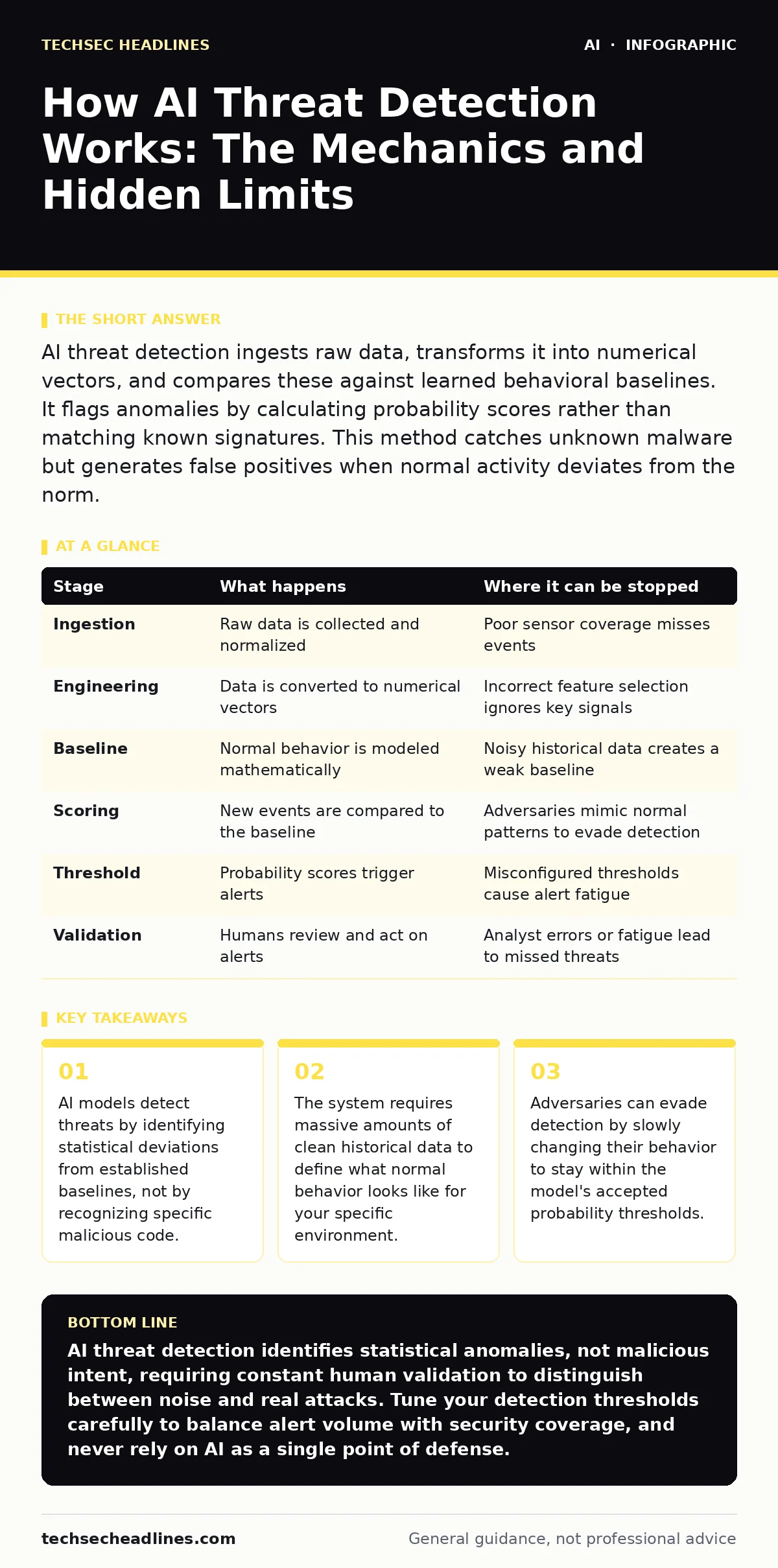
AI threat detection ingests raw data, transforms it into numerical vectors, and compares these against learned behavioral baselines. It flags anomalies by calculating probability scores rather than matching known signatures. This method catches unknown malware but generates false positives when normal activity deviates from the norm.
Data Ingestion and Normalization
The process begins with raw data collection. Sensors on endpoints, network appliances, and identity providers generate logs, packet captures, and telemetry streams. This data is noisy and unstructured. The system ingests this stream and normalizes it into a consistent format.
Normalization strips away irrelevant metadata and aligns timestamps. It converts different log formats into a single schema. Without this step, the model cannot compare an authentication event with a file access event. The system discards high-volume, low-value data to reduce noise. This filtering is critical because garbage in produces garbage out.
Feature Engineering and Vectorization
Raw logs are not useful to a machine learning model. The system must convert text and numbers into mathematical representations. This step is called feature engineering. The system extracts specific attributes from the data, such as process execution frequency, login location, or data transfer volume.
These features are then converted into vectors. A vector is a list of numbers that represents an object in multi-dimensional space. Each dimension corresponds to a specific feature. The system places every event into this space. Similar events cluster together. This geometric representation allows the algorithm to calculate distances between behaviors.
Baseline Construction
The model needs a reference point to identify anomalies. It constructs a baseline of normal behavior by analyzing historical data. This baseline defines the expected range for every feature. It learns that users typically log in during business hours and access specific file shares.
This construction is not a one-time event. The baseline updates continuously as behavior changes. If a user starts working from a new location, the baseline expands to include this new pattern. This adaptability is a double-edged sword. It reduces false positives for legitimate changes but allows slow, creeping attacks to blend in. The system assumes that gradual change is normal.
Anomaly Scoring and Probability
New events are mapped into the same vector space as the baseline. The system calculates how far the new event sits from the cluster of normal behavior. This distance translates into a probability score. A high score indicates a high likelihood of malicious activity.
The model does not label the event as "malware" or "attack." It labels it as "statistically unlikely." This distinction matters. The system flags deviations, not intents. A user downloading a large file at 3 a.m. gets a high score. A botnet exfiltrating data at 9 a.m. might get a low score if it mimics normal traffic patterns.
Decision Thresholds and Alerting
A raw probability score is useless without context. The system applies a decision threshold to determine if an alert is warranted. Setting this threshold involves a trade-off. A low threshold catches more true threats but generates many false positives. A high threshold reduces noise but misses subtle attacks.
Security analysts often struggle with this balance. Too many alerts lead to alert fatigue. Analysts ignore warnings, increasing the risk of missing a real incident. Too few alerts create a false sense of security. The threshold must be tuned for your specific environment. There is no universal setting that works for every organization.
Human-in-the-Loop Validation
Automated systems cannot verify context. When the AI flags an anomaly, a human analyst must investigate. The analyst reviews the alert, checks the surrounding events, and determines if action is needed. This step adds latency but reduces errors.
The analyst’s decision feeds back into the system. If the analyst marks an alert as a false positive, the model adjusts its baseline. If they confirm an attack, the model reinforces the pattern. This feedback loop is vital for long-term accuracy. Without it, the model drifts and becomes less effective over time.
| Stage | What happens | Where it can be stopped |
|---|---|---|
| Ingestion | Raw data is collected and normalized | Poor sensor coverage misses events |
| Engineering | Data is converted to numerical vectors | Incorrect feature selection ignores key signals |
| Baseline | Normal behavior is modeled mathematically | Noisy historical data creates a weak baseline |
| Scoring | New events are compared to the baseline | Adversaries mimic normal patterns to evade detection |
| Threshold | Probability scores trigger alerts | Misconfigured thresholds cause alert fatigue |
| Validation | Humans review and act on alerts | Analyst errors or fatigue lead to missed threats |
Limits and Adversarial Evasion
AI detection has inherent limits. It relies on the assumption that attacks will look different from normal behavior. Adversaries know this. They use techniques to hide within the noise. One method is slow data exfiltration. By moving small amounts of data over a long period, they stay below the statistical threshold.
Another method is behavior mimicking. Attackers study normal traffic patterns and craft their malware to match them. This is known as adversarial machine learning. The model sees the traffic as normal because it fits the baseline. The system cannot distinguish between a legitimate user and a sophisticated imposter.
Understanding these limits is critical for effective security. Do not rely solely on AI detection. Combine it with other controls. For deeper insights on how to test these systems, review our guide on AI security testing. Additionally, consider the broader implications of AI supply chain risks when deploying these tools.
The Cost of False Positives
Every alert costs time. Analysts must triage each one. False positives waste resources and desensitize teams. This is the hidden cost of AI detection. The system is only as good as the attention it receives.
To mitigate this, focus on high-fidelity signals. Prioritize alerts that indicate critical assets or sensitive data. Ignore low-risk deviations. This approach reduces noise and allows analysts to focus on real threats. Remember that AI is a tool, not a solution. It requires constant tuning and human oversight.
Integrating with Broader Security
AI threat detection does not operate in a vacuum. It must integrate with identity management, endpoint protection, and network controls. This integration allows for automated responses. For example, if the AI detects suspicious login activity, the system can trigger multi-factor authentication.
However, automation carries risks. Incorrect responses can disrupt business operations. Always include manual approval steps for critical actions. This balance between speed and safety is key. As you build your security program, consider how AI agents might interact with these systems. Our guide on securing AI agents offers practical advice on this topic.
Key takeaways
- AI models detect threats by identifying statistical deviations from established baselines, not by recognizing specific malicious code.
- The system requires massive amounts of clean historical data to define what normal behavior looks like for your specific environment.
- Adversaries can evade detection by slowly changing their behavior to stay within the model's accepted probability thresholds.
AI threat detection identifies statistical anomalies, not malicious intent, requiring constant human validation to distinguish between noise and real attacks. Tune your detection thresholds carefully to balance alert volume with security coverage, and never rely on AI as a single point of defense.
Frequently asked questions
Can AI detect zero-day exploits?
AI can detect the behavioral anomalies caused by zero-day exploits, but it cannot identify the specific vulnerability being exploited. It flags unusual system changes rather than known code signatures.
How much data do I need for AI detection?
You need a significant amount of historical data to build an accurate baseline of normal behavior. The more diverse and representative the data, the better the model performs.
Will AI replace security analysts?
No. AI automates data processing and pattern recognition, but it cannot understand context or make complex decisions. Human analysts are needed to investigate alerts and refine the model.
How do I prevent AI detection evasion?
You cannot prevent evasion entirely. Combine AI detection with other controls like network segmentation and least privilege access. This limits the damage even if an attack evades detection.
How this guide was produced: written by the TechSec Headlines editorial team with AI assistance, checked against the public references listed below, and reviewed when the facts change. See our editorial policy or report an error.