
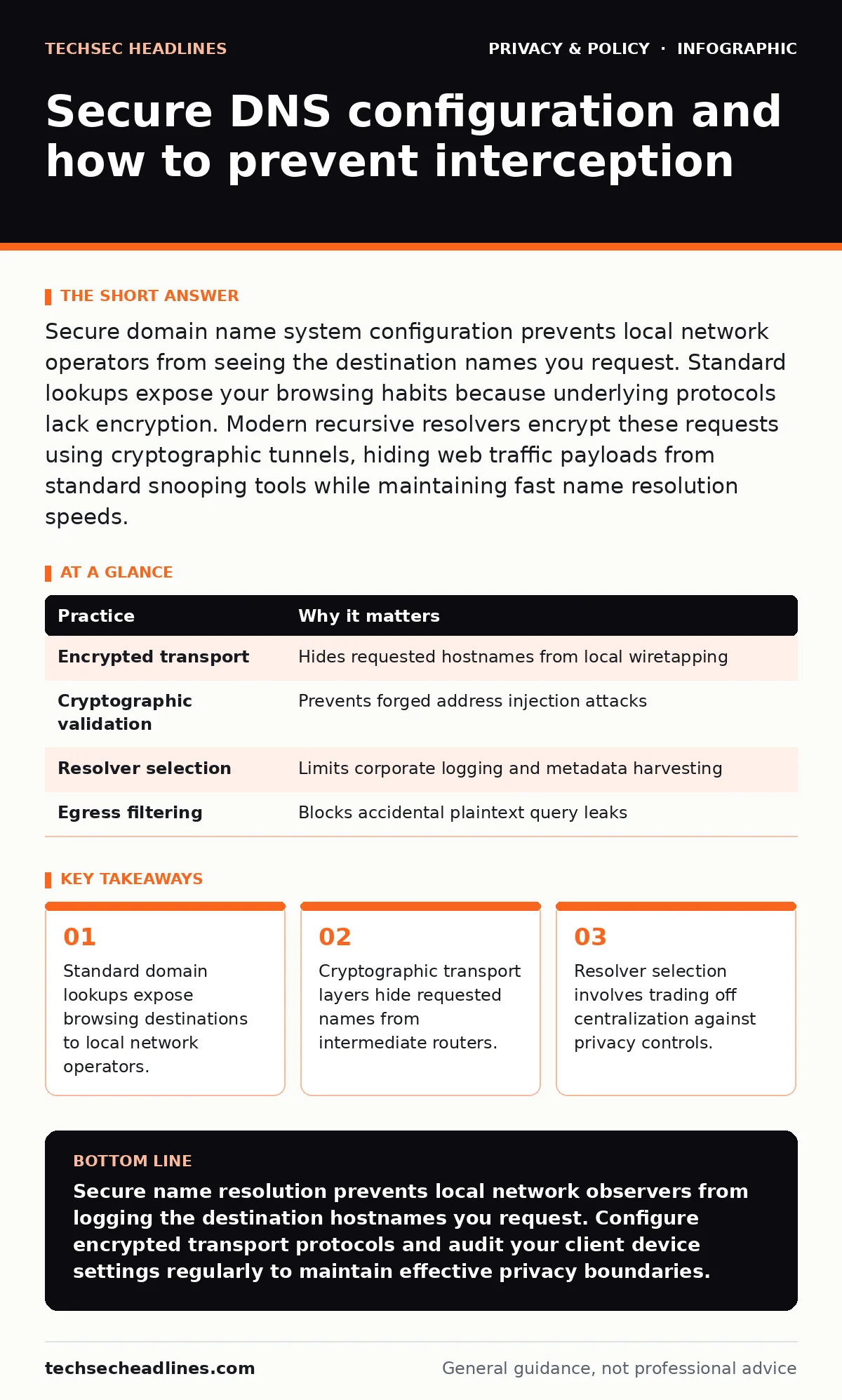
Secure domain name system configuration prevents local network operators from seeing the destination names you request. Standard lookups expose your browsing habits because underlying protocols lack encryption. Modern recursive resolvers encrypt these requests using cryptographic tunnels, hiding web traffic payloads from standard snooping tools while maintaining fast name resolution speeds.
Understanding Name Resolution Vulnerabilities
Domain name system traffic translates human-readable hostnames into numeric internet protocol addresses so computers can communicate. Standard name resolution requests lack encryption entirely, meaning any administrative entity positioned between your device and the authoritative server reads your exact web destinations. Network operators inspect these plaintext packets to log user activity or inject targeted content. Imagine connecting to a public wireless network where every hostname you request gets recorded by the local router administrator before routing completes.
Network visibility creates significant privacy risks that extend far beyond simple browsing habits. Malicious actors intercepting unencrypted name resolution data redirect traffic toward fraudulent destinations through cache poisoning techniques. Effective privacy demands securing the translation layer itself, separating name lookups from passive wiretapping by third parties. Protecting this communication channel requires intentional technical adjustments across client operating systems and network hardware configurations.
Implementing Seven Core Protective Practices
1. Enforce encrypted transport
Encrypted name resolution wraps translation requests inside secure TLS or HTTPS tunnels, preventing external inspection of requested hostnames. Standard plaintext queries expose your exact traffic patterns, whereas encrypted channels obscure destination names from local network administrators. DNS over HTTPS standardizes this transport method directly inside application layers. Configure your operating system or browser software to mandate encrypted transport for every outgoing name lookup.
2. Validate cryptographic chains
Cryptographic validation ensures the numeric addresses returned by a resolver originate from legitimate administrative authorities without tampering. Unverified responses allow malicious routers to feed false addresses into your system memory. Modern recursive resolvers implement DNSSEC to cryptographically sign resource records at every level of the domain hierarchy. Enable strict validation settings so your device automatically drops any name resolution response failing cryptographic signature checks.
3. Choose privacy-focused resolvers
Resolver selection dictates who observes your browsing metadata and how long those query logs persist on external servers. Commercial internet service providers often harvest unencrypted resolution histories to build user profiles for ad tracking networks. Independent recursive resolvers pledge strict no-logging policies and independent security audits to protect user anonymity. Select a resolver that explicitly prohibits selling request logs and supports modern cryptographic transport mechanisms.
4. Configure local stub fallback
Local stub resolvers handle outgoing name requests on your device before forwarding them to upstream servers. Misconfigured stub software leaks plaintext queries directly to default gateway routers whenever primary cryptographic channels fail. Robust stub configuration forces strict failure modes rather than defaulting to unencrypted transport during network interruptions. Test your system regularly to ensure local software never bypasses encrypted tunnels during temporary connection drops.
5. Monitor resolution latency
Performance monitoring detects unexpected routing delays introduced by encrypted transport overhead or distant resolver endpoints. Encrypted name resolution sometimes incurs latency penalties due to cryptographic handshake requirements and remote server distance. Measure round-trip response times across multiple privacy-focused providers to maintain optimal browsing speeds without sacrificing data protection. Balance security requirements against responsiveness by choosing resolvers with geographically distributed node networks.
6. Audit client device settings
Client operating systems often maintain multiple competing network interfaces that override global privacy configurations during connection changes. Virtual private network software and secondary network adapters frequently reset custom resolver addresses without user notification. Regular security audits of network interface settings catch silent regressions that expose plaintext queries to local gateways. Maintain centralized control over client resolution paths by locking down system network configuration profiles.
7. Restrict outbound plaintext traffic
Firewall rules provide a final defensive barrier by blocking unencrypted outbound traffic targeting standard port fifty-three. Rogue applications or misconfigured background services frequently bypass system resolvers to issue manual plaintext queries directly to the internet. Strict egress filtering drops unauthorized unencrypted lookup attempts entirely, forcing all system software to use designated encrypted channels. Implement firewall policies that deny unauthorized port traffic to prevent accidental metadata leakage.
Evaluating Resolver Centralization Trade-offs
Centralizing name resolution among a handful of massive cloud infrastructure providers introduces systemic single-point-of-failure vulnerabilities globally. Massive query volumes flow through centralized entities, granting those organizations unprecedented insight into global internet traffic patterns and user behavior. Suppose a major resolver infrastructure experiences a widespread operational outage, immediately disabling web access for millions of dependent client devices worldwide. Decentralized alternatives offer better resilience against targeted disruptions, though they often require more manual configuration effort from users.
Performance optimization drives many users toward large centralized providers because those networks maintain massive caching tiers near major population centers. Smaller community-run resolvers prioritize absolute data minimization over raw speed, trading fractional milliseconds of latency for enhanced user privacy guarantees. Evaluate your personal threat model to determine whether absolute query privacy or maximum resolution speed takes priority in your environment. Maintaining awareness of this infrastructural centralization helps you make informed compromises regarding your network configuration.
Securing Upstream Communication Channels
Upstream communication security relies upon establishing authenticated cryptographic handshakes between your local stub resolver and the designated recursive provider. Unauthenticated upstream paths remain vulnerable to sophisticated person-in-the-middle attacks where malicious actors forge valid-looking resolution responses. Modern protocol standards implement strict certificate pinning and cryptographic authentication to verify the true identity of upstream recursive servers. Enable these validation checks to ensure your device never communicates with unauthorized proxy nodes masquerading as legitimate providers.
Network path encryption protects payload confidentiality, but metadata regarding query timing and packet size remains partially visible to sophisticated observers. Advanced attackers analyze packet size distributions and timing patterns to infer specific website destinations even when actual hostnames are encrypted. Implement padding mechanisms and query batching strategies if your threat model requires defending against advanced traffic analysis techniques. Understanding these residual metadata leaks prevents a false sense of absolute anonymity when using encrypted name resolution alone.
Managing Endpoint Fallback Mechanisms
Endpoint fallback behaviors represent a hidden vulnerability where client software automatically reverts to unencrypted resolution when secure connections fail. Automatic fallback logic prioritizes immediate connectivity over security, silently leaking plaintext queries across local network wires during temporary outages. Disable automatic fallback features in your operating system settings to ensure applications fail safely rather than exposing private metadata. Configure explicit notification alerts whenever your primary encrypted resolution path encounters persistent connectivity blocks.
Network administrators often deploy captive portals on public wireless networks that intercept unencrypted name traffic to force authentication web pages. Encrypted resolution tools sometimes conflict with captive portal detection, breaking public network login procedures until security settings are temporarily adjusted. Maintain a structured workflow for handling captive portals without permanently weakening your system-wide name resolution security posture. Testing fallback behavior on isolated guest networks helps identify potential leakage vectors before encountering hostile environments.
| Practice | Why it matters |
|---|---|
| Encrypted transport | Hides requested hostnames from local wiretapping |
| Cryptographic validation | Prevents forged address injection attacks |
| Resolver selection | Limits corporate logging and metadata harvesting |
| Egress filtering | Blocks accidental plaintext query leaks |
See also: Computer Worms Examples: How Self-Replicating Code Spreads
Auditing Network Resolution Behavior
Network behavior auditing involves capturing and inspecting outgoing packets to verify that no plaintext name resolution requests escape your device. Specialized packet analysis tools display the exact destination ports and payload contents leaving your primary network interface during normal browsing sessions. Suppose you notice unencrypted traffic appearing on port fifty-three despite having strict system-wide privacy configurations enabled. Trace the offending background process immediately to prevent silent metadata leakage from undermining your overall security posture.
Continuous monitoring catches silent configuration regressions caused by automatic software updates or newly installed operating system background services. Establish a routine schedule for checking your active resolution paths using independent verification tools available on the open web. Document your baseline network behavior so anomalies stand out clearly during routine security maintenance and configuration reviews.
Key takeaways
- Standard domain lookups expose browsing destinations to local network operators.
- Cryptographic transport layers hide requested names from intermediate routers.
- Resolver selection involves trading off centralization against privacy controls.
Secure name resolution prevents local network observers from logging the destination hostnames you request. Configure encrypted transport protocols and audit your client device settings regularly to maintain effective privacy boundaries.
Frequently asked questions
Does secure domain name resolution hide the specific web pages I visit?
Encrypted name resolution hides the domain names you request, but external observers still see the internet protocol address of the final web server. Full page paths remain encrypted when using modern web transport security layers.
Can my internet service provider still track my browsing if I use encrypted lookups?
Internet service providers cannot read the specific hostnames you request when using encrypted transport, but they still observe the numeric destination addresses you connect to afterward. Additional privacy tools are required to mask your final server connections completely.
Why do some public wireless networks break when I enable encrypted resolution?
Captive portals on public networks rely on intercepting unencrypted name resolution queries to force authentication web pages. Enabling encrypted transport bypasses this local interception, requiring you to access login pages manually.
Are independent recursive resolvers slower than my default provider?
Independent recursive resolvers sometimes exhibit slightly higher latency depending on your geographic distance from their nearest server nodes. Modern content delivery networks usually offset this difference by maintaining widely distributed infrastructure worldwide.
How this guide was produced: written by the TechSec Headlines editorial team with AI assistance, checked against the public references listed below, and reviewed when the facts change. See our editorial policy or report an error.