Digital privacy rights grant you control over how organizations collect, use, and share your personal information. You can request access to your data, demand corrections, and ask for deletion. These rights exist in many jurisdictions, but they require active enforcement. Understanding the specific mechanisms helps you protect your identity and reduce your digital footprint effectively.
What is a data subject?
A data subject is any individual whose personal information is processed by an organization. This definition is broad and includes you, your neighbors, and even employees of the company collecting the data. Personal data refers to any information that can identify you directly or indirectly. This includes obvious details like your name and address, as well as technical identifiers like your device ID or cookie data.
Can I ask what data a company holds on me?
Yes, you can submit a data subject access request to obtain a copy of the personal information an organization holds about you. This request forces the entity to disclose what they have collected, where they got it, and who they share it with. The response must be clear and concise, avoiding legal jargon that obscures the actual data. This transparency allows you to verify if the data is accurate and if the processing is lawful. For deeper guidance on this process, see our guide on data subject access requests.
Can I make them delete my data?
You can request the erasure of your personal data, commonly known as the right to be forgotten. Organizations must comply unless they have a legitimate legal reason to keep the data, such as tax records or contract fulfillment. This right does not mean every trace of you vanishes instantly. Backups and archived logs may retain the data for a period defined by their retention policy. It forces a conversation about necessity rather than allowing indefinite storage.
Do I have control over how my data is shared?
You generally have the right to object to the processing of your data for direct marketing purposes. This means companies must stop sending you promotional emails or targeted ads if you opt out. For other types of processing, you can object if the organization relies on legitimate interests rather than your explicit consent. This objection requires the company to prove their interest outweighs your privacy rights. If they cannot justify the processing, they must stop.
Can I stop automated decisions about me?
You have the right not to be subject to a decision based solely on automated processing, including profiling, if it produces legal effects or significantly affects you. Imagine an algorithm denies you a loan or adjusts your insurance premium without human review. You can request human intervention to challenge that decision. This prevents opaque algorithms from making life-altering choices without accountability. It ensures a person reviews the logic and can correct errors that machines might miss.
See also: Differential Privacy Machine Learning: How It Works Without Leaking Data
How does consent work in practice?
Valid consent must be freely given, specific, informed, and unambiguous. Pre-ticked boxes do not count as consent because you must take an active step to agree. Organizations must explain what they are doing in plain language, not buried in terms of service. You can withdraw consent at any time, and it must be as easy to withdraw as it was to give. This prevents dark patterns from tricking you into agreeing to data collection you did not intend.
What is data portability?
Data portability allows you to receive your personal data in a structured, commonly used, and machine-readable format. You can then transmit this data to another controller without hindrance. This facilitates switching services, such as moving your social graph or transaction history to a new platform. It breaks vendor lock-in by giving you ownership of the data you created. The receiving organization must be able to process the data easily for this to be effective.
Does the law protect me everywhere?
Privacy laws vary significantly by jurisdiction, but many regions now have frameworks that protect individual rights. The European Union’s GDPR and California’s CCPA are prominent examples, but other regions are adopting similar standards. Even if you are not in these regions, companies often apply global standards to simplify compliance. You should check the specific laws in your country to understand your exact rights. International transfers of data may also be restricted to protect your information.
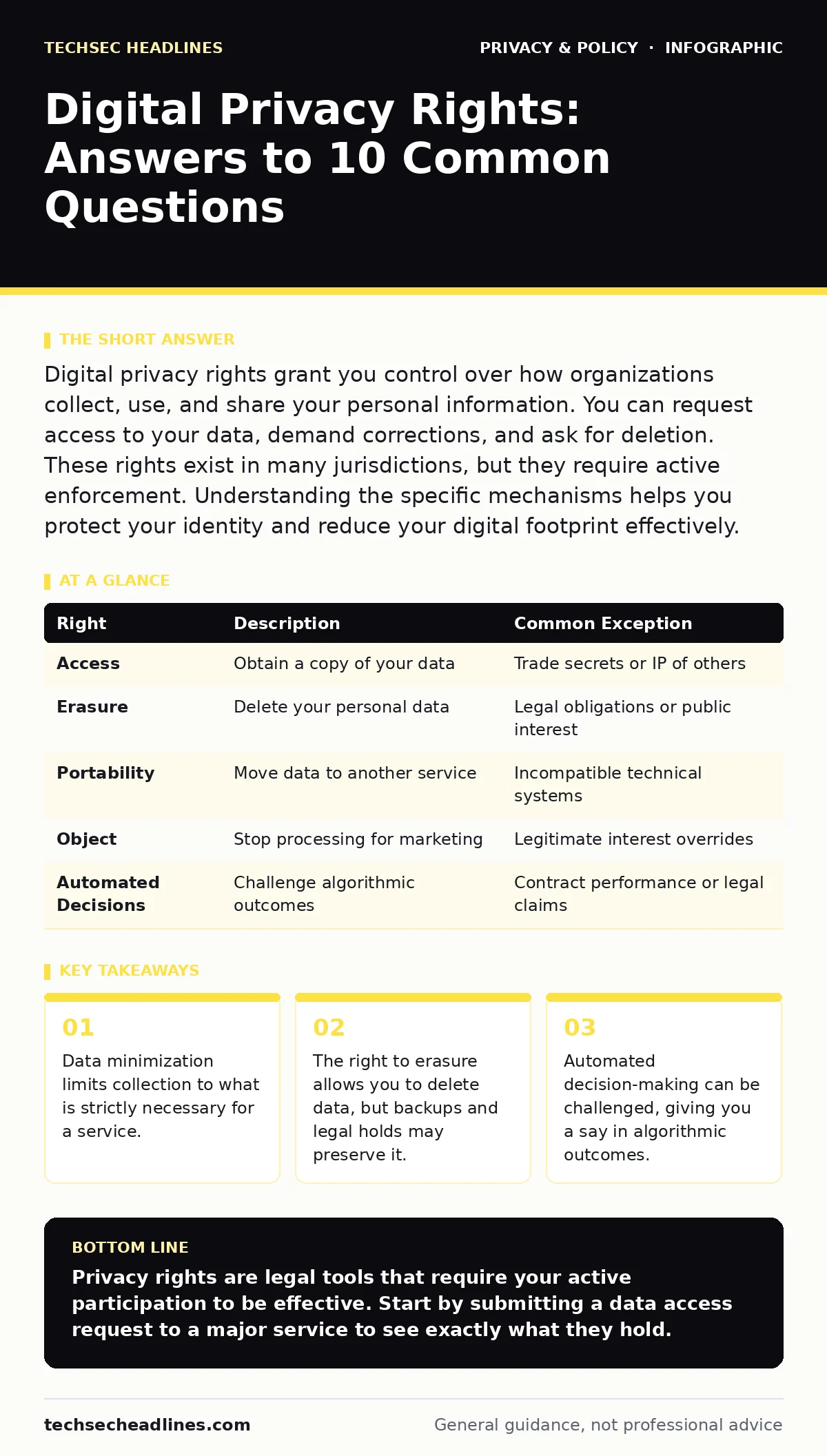
| Right | Description | Common Exception |
|---|---|---|
| Access | Obtain a copy of your data | Trade secrets or IP of others |
| Erasure | Delete your personal data | Legal obligations or public interest |
| Portability | Move data to another service | Incompatible technical systems |
| Object | Stop processing for marketing | Legitimate interest overrides |
| Automated Decisions | Challenge algorithmic outcomes | Contract performance or legal claims |
What is data minimization?
Data minimization is the principle that organizations should only collect data that is adequate, relevant, and limited to what is necessary. This reduces the risk of exposure if a breach occurs. It also limits the potential for misuse of your information. If a company asks for your birthdate to deliver a pizza, that violates minimization. You can question why specific data points are required and refuse to provide unnecessary information. This shifts the burden of proof to the data collector.
How do privacy tools help enforce these rights?
Technical tools can automate the enforcement of your privacy preferences. Privacy-focused browsers block trackers and prevent fingerprinting by default. These tools reduce the amount of data available for collection in the first place. Using email aliases allows you to compartmentalize your identity and revoke access if one alias is compromised. For more on managing these credentials, see our guide on password managers for families. These tools complement legal rights by reducing the attack surface.
What are the risks of smart devices?
Smart home devices often collect more data than necessary for their primary function. They may listen for wake words, record ambient noise, or track movement patterns. This data can be used for profiling or sold to third parties. The risks extend beyond your home if the data is linked to your online identity. See our guide on smart home privacy risks for details on securing these devices. You should review the privacy policy of each device and disable unnecessary features.
Can apps abuse my permissions?
Mobile apps often request permissions that are not needed for their core functionality. This is known as mobile app permission abuse. A flashlight app does not need access to your contacts or location. Granting these permissions increases the risk of data leakage. You should review permissions regularly and revoke any that seem excessive. This limits the data an app can access even if it is compromised.
How do I protect myself from facial recognition?
Facial recognition technology can identify you without your consent or knowledge. This poses significant risks to anonymity and freedom of movement. The technology can be biased and prone to errors. See our guide on facial recognition risks for ways to mitigate these threats. You can use makeup or clothing to disrupt recognition patterns, but this is not always practical. Advocating for bans on its use in public spaces is a more systemic solution.
What is DNS over HTTPS?
DNS over HTTPS encrypts your domain name queries, preventing ISPs and attackers from seeing which websites you visit. Standard DNS queries are sent in plain text, allowing anyone on the network to monitor your browsing habits. This protocol adds a layer of privacy to your internet traffic. See our guide on DNS over HTTPS for configuration steps. It does not hide your IP address, but it obscures the specific sites you connect to.
Key takeaways
- Data minimization limits collection to what is strictly necessary for a service.
- The right to erasure allows you to delete data, but backups and legal holds may preserve it.
- Automated decision-making can be challenged, giving you a say in algorithmic outcomes.
Privacy rights are legal tools that require your active participation to be effective. Start by submitting a data access request to a major service to see exactly what they hold.
Frequently asked questions
Can I sue a company for violating my privacy?
You may have the right to seek compensation if a company violates data protection laws and causes you harm. The process varies by jurisdiction and often requires demonstrating actual damage.
Does deleting my account delete all my data?
Deleting your account stops active processing, but companies may retain data for legal or security reasons. Check the privacy policy for specific retention periods.
Can I stop a company from selling my data?
In many jurisdictions, you can opt out of the sale of your personal information. This right is often exercised through a link in the privacy policy or a browser signal.
What if a company ignores my request?
You can escalate the issue to the relevant data protection authority. They have the power to investigate and impose fines on non-compliant organizations.
How this guide was produced: written by the TechSec Headlines editorial team with AI assistance, checked against the public references listed below, and reviewed when the facts change. See our editorial policy or report an error.