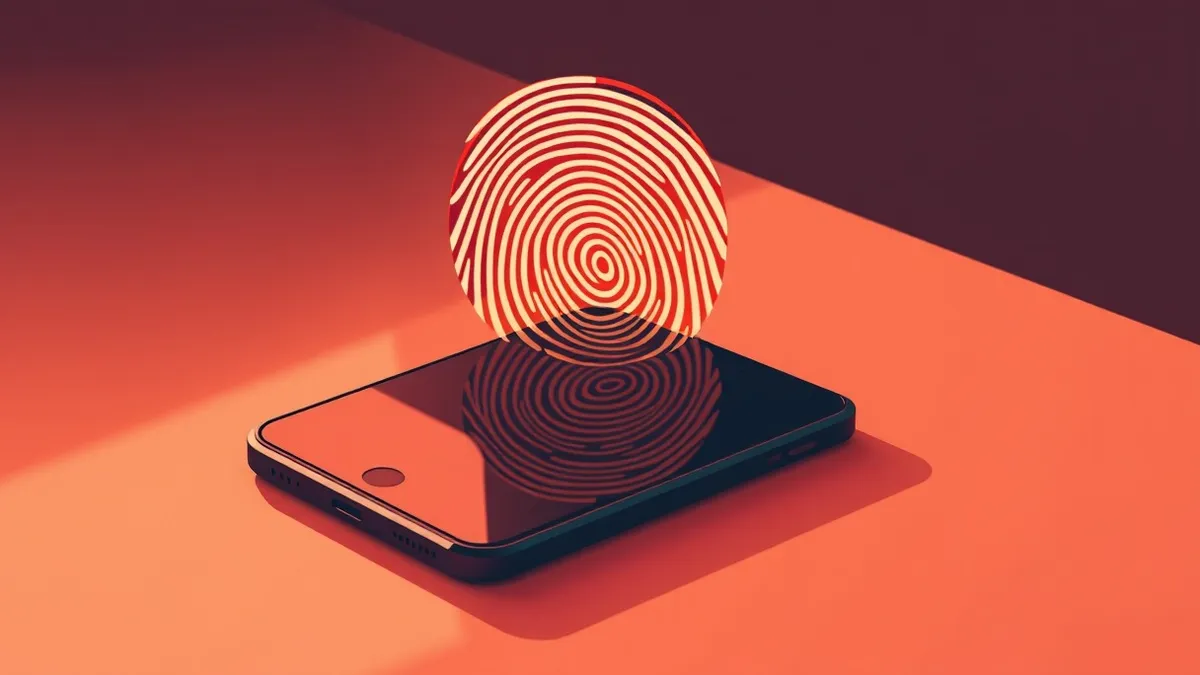
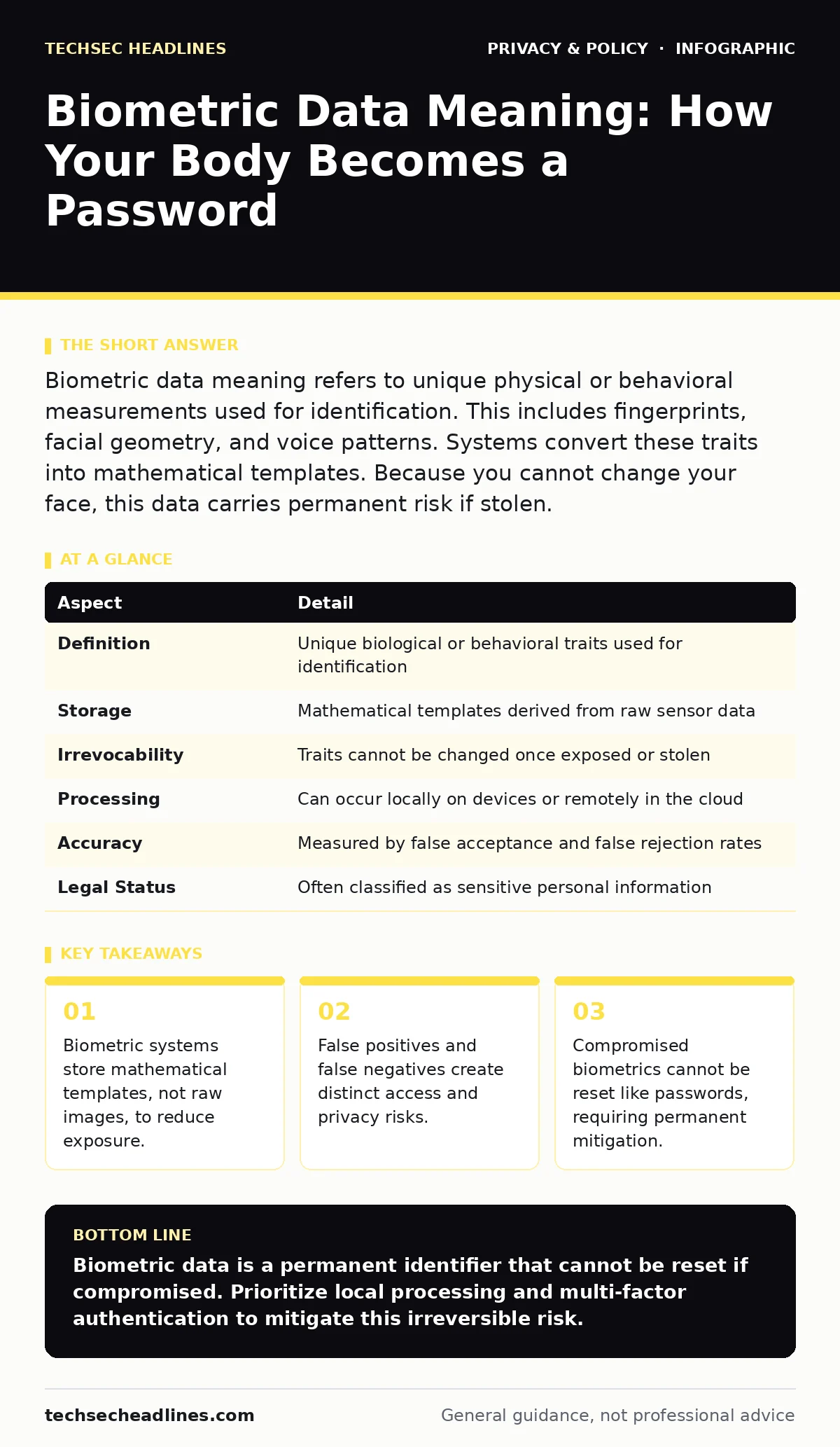
Biometric data meaning refers to unique physical or behavioral measurements used for identification. This includes fingerprints, facial geometry, and voice patterns. Systems convert these traits into mathematical templates. Because you cannot change your face, this data carries permanent risk if stolen.
Everyday Analogy: The Unchangeable Key
Imagine you use a physical key to enter your home. If you lose that key, you can cut a new one. If someone copies it, you change the lock. Biometric data works differently. Your fingerprint is like a key that is fused to your skin. You cannot cut a new one. You cannot rekey the lock on your finger. This analogy highlights the fundamental difference between traditional secrets and biological identifiers. The convenience of never forgetting your key comes with the cost of never being able to replace it.
Biometric Data Meaning
Biometric data meaning centers on measurable biological or behavioral characteristics. These traits identify you uniquely among a population. Common examples include fingerprints, iris patterns, facial structure, and voice prints. Systems capture these traits through sensors. The software then converts the raw input into a digital template. This template is a set of numbers representing the unique features. The system compares new inputs against stored templates to verify identity. This process replaces knowledge-based secrets like passwords with being-based verification.
| Aspect | Detail |
|---|---|
| Definition | Unique biological or behavioral traits used for identification |
| Storage | Mathematical templates derived from raw sensor data |
| Irrevocability | Traits cannot be changed once exposed or stolen |
| Processing | Can occur locally on devices or remotely in the cloud |
| Accuracy | Measured by false acceptance and false rejection rates |
| Legal Status | Often classified as sensitive personal information |
How Biometric Verification Works
The process begins with enrollment. You present your trait to a sensor. The system maps specific points, such as ridge endings in a fingerprint or distance between eyes. It creates a mathematical template from these points. This template is stored for future comparison. During verification, the system captures a new sample. It compares the new sample to the stored template. The algorithm calculates a similarity score. If the score exceeds a threshold, access is granted. This threshold determines the trade-off between security and convenience. A higher threshold reduces false positives but increases false negatives.
The Hidden Cost of Convenience
Biometric authentication feels seamless because it removes the cognitive load of remembering secrets. This convenience hides a significant architectural risk. Traditional passwords are secrets you know. Biometrics are traits you are. When a password is leaked, you reset it. When biometric data is leaked, you remain the target. Attackers can use stolen templates to create synthetic spoofs. These spoofs can bypass verification systems. The damage is permanent because your biological traits do not change. This permanence shifts the burden of security from the user to the system architecture.
Who Biometric Data Affects
Biometric data affects anyone who uses modern digital services. Mobile devices use facial recognition for unlocking. Banks use voice verification for customer support. Workplaces use fingerprint scanners for time tracking. Governments use facial recognition for identification documents. The impact extends beyond the individual user. System administrators bear the responsibility of securing the templates. Developers must implement secure storage and transmission. Users face the long-term risk of identity theft. The widespread adoption of these systems means exposure is inevitable for most people.
See also: Differential Privacy Machine Learning: How It Works Without Leaking Data
What People Usually Get Wrong
Many users believe biometric data is just another password. This misconception leads to poor security hygiene. Users assume that if a system is hacked, they can simply change their biometric credential. This is impossible. Another common error is trusting the visual representation. Systems do not store photos of your face. They store mathematical abstractions. Understanding this distinction is vital for assessing risk. If the template is stolen, attackers do not get a photo. They get a digital key that can open specific doors. This nuance changes how you evaluate the severity of a breach.
Practical Mitigation Strategies
You can reduce risk by controlling where your data lives. Prefer systems that process biometrics locally on your device. Local processing means the template never leaves your hardware. This prevents mass exposure through server breaches. Use biometric data as a second factor, not the only factor. Combine it with a PIN or password. This adds a layer of revocable security. If the biometric template is stolen, the attacker still needs the PIN. Regularly review app permissions. Disable biometric access for apps that do not strictly require it.
Privacy and Policy Implications
Biometric data is often classified as sensitive information under privacy laws. Regulations may require explicit consent for collection. Users may have the right to request deletion. However, technical constraints can complicate deletion. If a template is derived from raw data, deleting the raw data may not remove the derived template. Understanding these technical limitations helps you exercise your rights effectively. Review privacy policies for storage locations. Look for statements about local processing versus cloud storage. This information determines your actual exposure level.
Related Privacy Mechanisms
Biometric security does not exist in isolation. It intersects with other privacy controls. For instance, end-to-end encryption protects data in transit, ensuring that biometric templates are not intercepted. Mobile app permission abuse remains a risk if apps request biometric access without clear justification.
Users should also consider email aliases to reduce the surface area for identity linking. Understanding data subject access requests allows you to query what biometric data is held. These mechanisms work together to create a layered defense. Differential privacy techniques can also be used to anonymize aggregated biometric data.
Final Considerations for Users
Biometric data offers convenience at the cost of revocability. You must weigh these factors carefully. Always prefer local processing when available. Combine biometrics with traditional secrets. Monitor your devices for unauthorized access. Understand that your biological traits are permanent credentials. This understanding changes how you approach digital identity. It shifts the focus from convenience to long-term risk management.
Key takeaways
- Biometric systems store mathematical templates, not raw images, to reduce exposure.
- False positives and false negatives create distinct access and privacy risks.
- Compromised biometrics cannot be reset like passwords, requiring permanent mitigation.
- Local processing on devices offers significantly more privacy than cloud storage.
Biometric data is a permanent identifier that cannot be reset if compromised. Prioritize local processing and multi-factor authentication to mitigate this irreversible risk.
Frequently asked questions
Can biometric data be changed if stolen?
No, biological traits like fingerprints and facial structure are permanent. You cannot replace them like a password or credit card number.
Do apps store photos of my face?
Most compliant systems store mathematical templates, not images. These templates represent features but cannot be reverse-engineered into a photo.
Is local biometric storage safer than cloud storage?
Yes, local storage prevents mass exposure. If your device is lost, only your data is at risk. Cloud breaches can expose millions of templates at once.
How do I know if an app uses biometrics?
Check the app permissions on your device. Look for requests for camera, microphone, or fingerprint sensor access. Review the privacy policy for storage details.
How this guide was produced: written by the TechSec Headlines editorial team with AI assistance, checked against the public references listed below, and reviewed when the facts change. See our editorial policy or report an error.