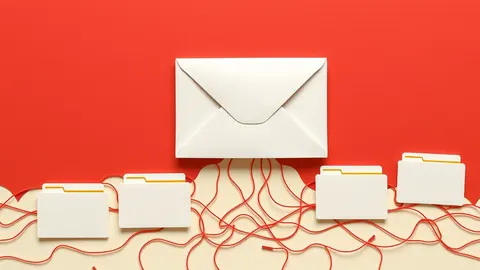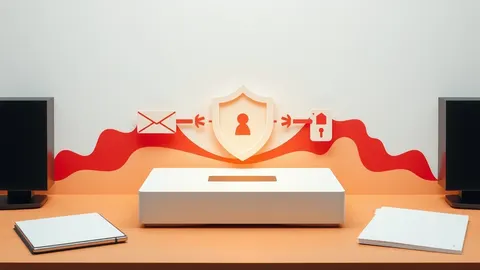
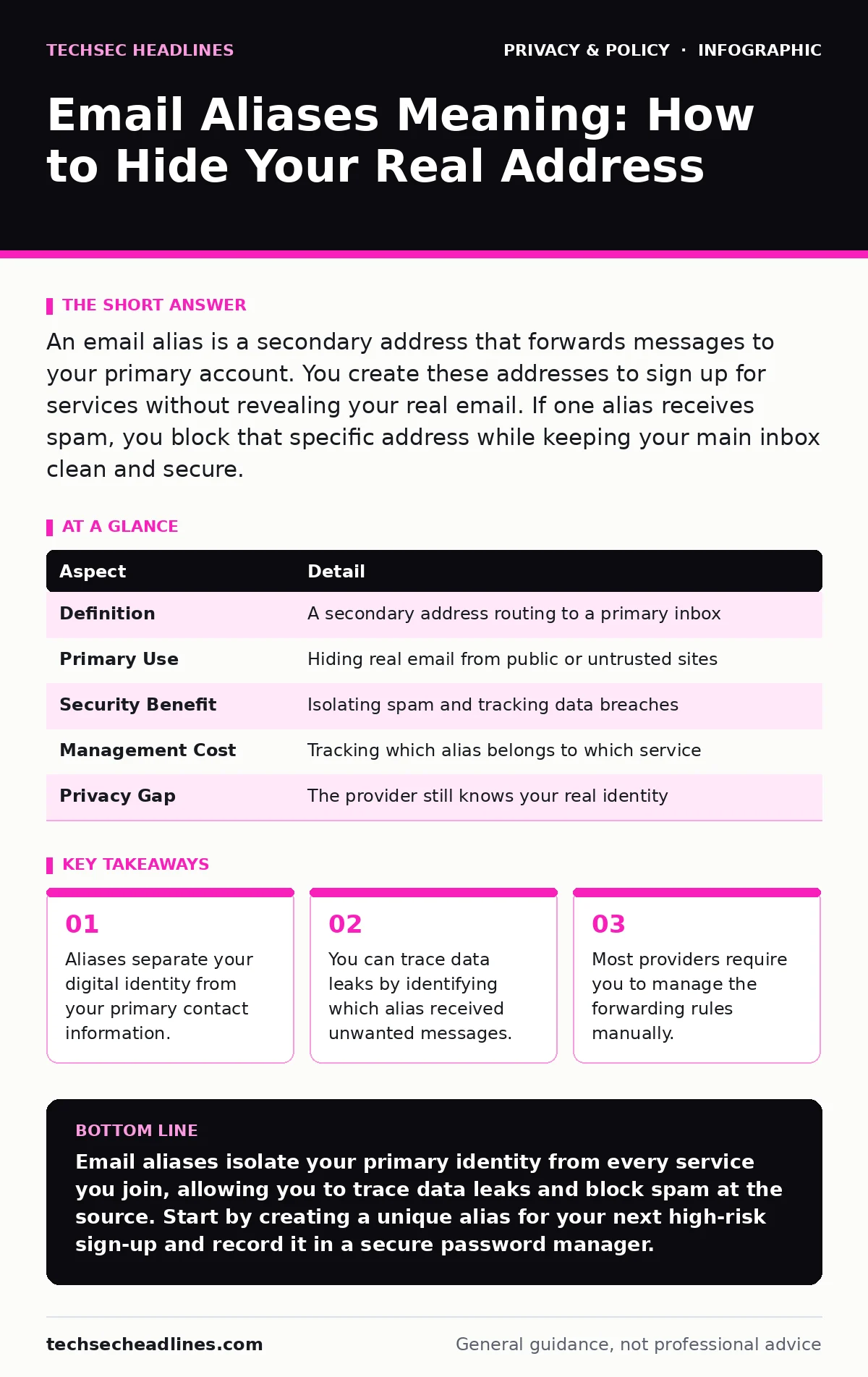
An email alias is a secondary address that forwards messages to your primary account. You create these addresses to sign up for services without revealing your real email. If one alias receives spam, you block that specific address while keeping your main inbox clean and secure.
The Mailroom Analogy
Imagine a large office building with a single main entrance. Every visitor must sign in at the front desk, seeing your name and department. Now imagine a system that gives you 100 different mailboxes in the lobby. You can give a different mailbox number to every vendor, club, or website. All mail still reaches your desk, but the sender only sees the mailbox number. If a vendor starts sending junk, you simply stop checking that specific mailbox. You never reveal your actual office location.
| Aspect | Detail |
|---|---|
| Definition | A secondary address routing to a primary inbox |
| Primary Use | Hiding real email from public or untrusted sites |
| Security Benefit | Isolating spam and tracking data breaches |
| Management Cost | Tracking which alias belongs to which service |
| Privacy Gap | The provider still knows your real identity |
What Is the Email Aliases Meaning?
The email aliases meaning refers to the practice of using alternative addresses that forward to a single primary inbox. You create these addresses to interact with the internet without exposing your true contact details. This technique allows you to compartmentalize your digital life. You assign one alias to banking, another to social media, and a third to news subscriptions. When an address starts receiving spam, you know exactly which service sold or leaked your data. You block that specific alias and create a new one for future use.
How Email Aliasing Works
The mechanism relies on simple email routing rules. Your email provider accepts messages sent to the alias and redirects them to your main account. The sender sees the alias in the "To" field. They never see your primary address. Some providers generate random strings automatically. Others let you type custom names. You can usually reply from the alias, making the conversation appear normal to the recipient. The provider handles the forwarding logic in the background. You do not need a separate account for each alias. This keeps your inbox unified while your identity remains fragmented.
Who Benefits from Aliases
Anyone who signs up for online services benefits from this separation. You protect your primary address from mass marketing campaigns. You reduce the noise in your main inbox. Security researchers use aliases to monitor threat intelligence without exposing their personal contact info. Journalists use them to protect sources. Regular users use them to avoid having their real name associated with every purchase or registration. The benefit scales with the number of services you use. More aliases mean more granular control over your privacy.
The Hidden Costs of Convenience
Aliases are not free. You must track which alias belongs to which service. If you lose that record, you cannot identify the source of spam. You also create a dependency on your email provider. If the provider changes its alias rules or shuts down the feature, you may lose access to accounts tied to those addresses. Some services block known alias domains. They detect patterns like "user+tag@domain" and refuse the sign-up. This forces you to use your real address anyway. You must balance privacy with the ability to actually use the service.
See also: Differential Privacy Machine Learning: How It Works Without Leaking Data
What People Usually Get Wrong
Many users believe aliases provide complete anonymity. This is incorrect. Your email provider still knows your real address and identity. The provider can see all traffic flowing through the alias. If law enforcement requests data from the provider, they get the full picture. Aliases only hide your identity from the recipient, not from the infrastructure. Another common mistake is reusing the same alias for multiple sensitive services. If one service is breached, all other services using that alias become vulnerable. You defeat the purpose of isolation.
Managing Your Alias Strategy
You need a system to track your aliases. A simple spreadsheet works. Record the alias, the service it is used for, and the date created. Review this list quarterly. Disable aliases for services you no longer use. This reduces the attack surface. If you suspect a leak, check your list to see which alias was compromised. Create a new alias for that service immediately. Change the password on that service. This routine maintenance keeps your privacy effective over time.
Beyond Basic Aliasing
Email aliases are a form of pseudonymization. They replace direct identifiers with indirect ones. This concept appears in other areas of digital privacy. You might also explore end-to-end encryption to protect message content. You can look into DNS over HTTPS to hide your browsing destinations from local networks. Understanding these layers helps you build a stronger privacy posture. Each tool addresses a different threat model. Aliases handle identity exposure. Encryption handles content exposure. Use them together for better protection.
Key takeaways
- Aliases separate your digital identity from your primary contact information.
- You can trace data leaks by identifying which alias received unwanted messages.
- Most providers require you to manage the forwarding rules manually.
Email aliases isolate your primary identity from every service you join, allowing you to trace data leaks and block spam at the source. Start by creating a unique alias for your next high-risk sign-up and record it in a secure password manager.
Frequently asked questions
Can I use email aliases for banking?
Yes, but ensure the alias allows replies. Banks often send verification codes and alerts. If the alias blocks replies, you may lose access to your account.
Do aliases protect me from hacking?
Aliases do not prevent hacking. They only hide your real email. If the service storing your alias is hacked, your alias is exposed. You still need strong passwords and multi-factor authentication.
What if the alias provider goes offline?
You may lose access to accounts tied to that alias. Keep a backup of your alias list. Consider using a provider with a long track record and clear data export options.
Are plus-addressing and aliases the same?
Plus-addressing is a specific type of alias. It adds a tag after a plus sign in your existing address. True aliases often use completely different domains or random strings. Both serve similar purposes but work differently.
How this guide was produced: written by the TechSec Headlines editorial team with AI assistance, checked against the public references listed below, and reviewed when the facts change. See our editorial policy or report an error.