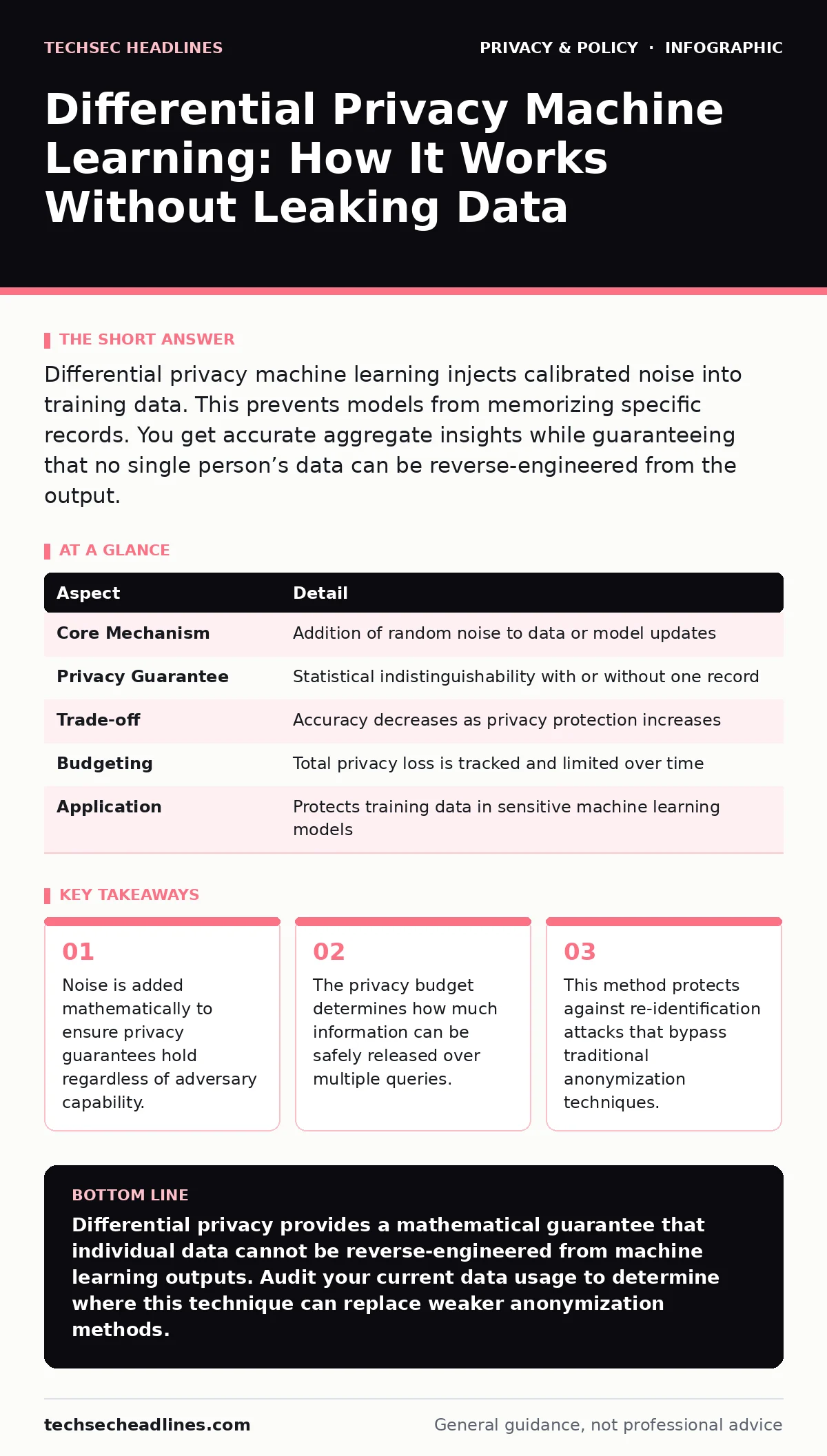
Differential privacy machine learning injects calibrated noise into training data. This prevents models from memorizing specific records. You get accurate aggregate insights while guaranteeing that no single person’s data can be reverse-engineered from the output.
What is Differential Privacy Machine Learning
Differential privacy machine learning is a mathematical framework that quantifies and limits the amount of information a model reveals about any single individual. It works by adding carefully calibrated random noise to the data or the gradients during the training process. This noise masks the contribution of any one record. The goal is to ensure that the output of a machine learning algorithm looks statistically similar whether or not any specific person’s data is included in the dataset.
Traditional anonymization methods like removing names or hashing emails fail because attackers can cross-reference other public datasets to re-identify individuals. Differential privacy does not rely on hiding identifiers. It relies on the mathematical impossibility of determining if a specific record influenced the result. This provides a strict guarantee rather than a best-effort attempt at obscurity.
| Aspect | Detail |
|---|---|
| Core Mechanism | Addition of random noise to data or model updates |
| Privacy Guarantee | Statistical indistinguishability with or without one record |
| Trade-off | Accuracy decreases as privacy protection increases |
| Budgeting | Total privacy loss is tracked and limited over time |
| Application | Protects training data in sensitive machine learning models |
How the Mechanism Works
The core engine of this approach is the Laplace mechanism or the Gaussian mechanism. These algorithms add noise drawn from specific probability distributions to the results of queries or the gradients used in training. The amount of noise depends on the sensitivity of the query. Sensitivity measures how much the output changes if one person’s data is swapped in or out. High-sensitivity queries require more noise to maintain the privacy guarantee.
In machine learning, this often happens through differentially private stochastic gradient descent. Instead of computing exact gradients for the entire dataset, the system samples mini-batches and adds noise to the gradients. It also clips the gradients to prevent any single example from having too much influence. The model learns the general trends in the data. It does not memorize the specific details of individual entries. This prevents membership inference attacks where an adversary tries to determine if a specific person was in the training set.
Who This Technology Affects
Data scientists and machine learning engineers must adjust their workflows to accommodate privacy constraints. They can no longer assume that raw data can be used freely for model improvement. They must calculate privacy budgets and select noise levels that balance utility with protection. This adds complexity to the model development lifecycle. It requires new tools and libraries that support private training operations.
End users benefit from reduced exposure to data breaches and profiling. When organizations use differential privacy, the risk of re-identification drops significantly. This is particularly relevant for sensitive sectors like healthcare, finance, and government. It allows these entities to share insights and build useful services without compromising individual confidentiality. Users gain trust knowing their data contributes to aggregate knowledge without being exposed.
Organizations face a hidden cost in model accuracy. Adding noise degrades the signal in the data. Models trained with strict privacy guarantees may perform worse than those trained on raw data. Organizations must decide if the privacy benefit outweighs the potential loss in predictive power. This trade-off requires careful evaluation for each specific use case.
Common Misconceptions About Privacy Guarantees
Many people confuse differential privacy with data encryption. Encryption protects data while it is stored or transmitted. It does not protect the insights derived from the data once it is decrypted and analyzed. Differential privacy protects the insights themselves. It ensures that the output of an analysis cannot be used to infer individual data points. The two methods serve different purposes and are often used together.
Another common error is assuming that differential privacy eliminates all privacy risks. It only limits the information leakage through the specific mechanism being protected. If other metadata is leaked through side channels, privacy can still be compromised. It does not protect against social engineering or physical security breaches. It is a specific mathematical guarantee for data release and model training.
People often think that adding noise ruins data utility. While noise reduces precision, it does not necessarily destroy the value of the data. For large datasets, the aggregate patterns remain clear even with significant noise. The key is managing the privacy budget. This budget tracks the cumulative privacy loss over multiple queries. Proper management allows for useful analysis while staying within safe bounds.
Integrating With Other Privacy Standards
Differential privacy complements other privacy frameworks rather than replacing them. It works well alongside end-to-end encryption to protect data in transit and at rest. While encryption secures the channel, differential privacy secures the content of the analysis. Using both creates a layered defense strategy. This approach is critical for systems that handle biometric data or other high-risk information types.
Regulatory bodies are increasingly recognizing differential privacy as a valid technical safeguard. It helps organizations comply with requirements for data minimization and purpose limitation. It provides a measurable way to demonstrate that personal data is not being exposed. This is useful when navigating complex digital privacy rights landscapes. It offers a concrete technical solution to vague legal requirements.
Organizations should also consider facial recognition risks when deploying AI systems. Differential privacy can mitigate the risk of identifying individuals from training data. It prevents the model from creating a detailed map of who is in the dataset. This reduces the potential for misuse of sensitive visual information. It is a proactive step toward ethical AI deployment.
See also: Biometric Data Meaning: How Your Body Becomes a Password
Practical Steps for Implementation
Start by auditing your data usage patterns. Identify which datasets contain sensitive personal information. Determine which models require this data for training. Calculate the sensitivity of the queries you plan to run. This involves understanding how much a single record can influence the output. High-sensitivity operations require more noise and stricter budgeting.
Select a privacy budget that aligns with your risk tolerance. A lower budget provides stronger privacy but reduces model accuracy. A higher budget allows for more precise models but increases leakage risk. Document this decision and justify it to stakeholders. Ensure that all team members understand the constraints. Training data cannot be used arbitrarily once the budget is set.
Use established libraries that implement differential privacy algorithms. Do not attempt to build custom noise mechanisms unless you have expert mathematical review. Standard implementations have been tested for correctness. They handle the complex calculations required for gradient clipping and noise addition. This reduces the risk of implementation errors that could compromise privacy.
What To Do About Privacy Trade-offs
You must accept that perfect privacy and perfect accuracy are mutually exclusive. Every decision to increase privacy involves a cost in model performance. Evaluate whether the loss in accuracy is acceptable for your use case. In some scenarios, a slightly less accurate model is preferable to a privacy breach. In others, the accuracy requirement is too high for differential privacy to be viable.
Communicate these trade-offs clearly to non-technical stakeholders. Explain that privacy is not a binary switch. It is a spectrum managed through mathematical controls. Provide examples of how the noise affects specific outputs. This helps build trust and sets realistic expectations. It prevents disappointment when models do not perform as well as raw-data counterparts.
Review your policies regularly. As data volumes grow, the impact of noise decreases. Larger datasets allow for more precise models under the same privacy constraints. Re-evaluate your privacy budgets and noise levels periodically. This ensures you are not over-protecting data unnecessarily. It also allows you to improve model quality as your data scale increases.
Key takeaways
- Noise is added mathematically to ensure privacy guarantees hold regardless of adversary capability.
- The privacy budget determines how much information can be safely released over multiple queries.
- This method protects against re-identification attacks that bypass traditional anonymization techniques.
Differential privacy provides a mathematical guarantee that individual data cannot be reverse-engineered from machine learning outputs. Audit your current data usage to determine where this technique can replace weaker anonymization methods.
Frequently asked questions
Does differential privacy hide my data from the company?
No, it protects the data during analysis and model training. The company still sees the raw data, but the outputs they release or use are protected by noise.
Can I use differential privacy with small datasets?
It is difficult. Small datasets have high sensitivity, requiring significant noise. This often destroys the utility of the model. It works best with large volumes of data.
How do I know if my model is differentially private?
You must implement specific algorithms like DP-SGD. Standard machine learning libraries do not provide this by default. You need to use specialized tools and track the privacy budget.
Is differential privacy compliant with GDPR?
It is considered a state-of-the-art technical measure. It helps demonstrate compliance with data protection principles. It is not a legal exemption but a strong technical safeguard.
How this guide was produced: written by the TechSec Headlines editorial team with AI assistance, checked against the public references listed below, and reviewed when the facts change. See our editorial policy or report an error.