
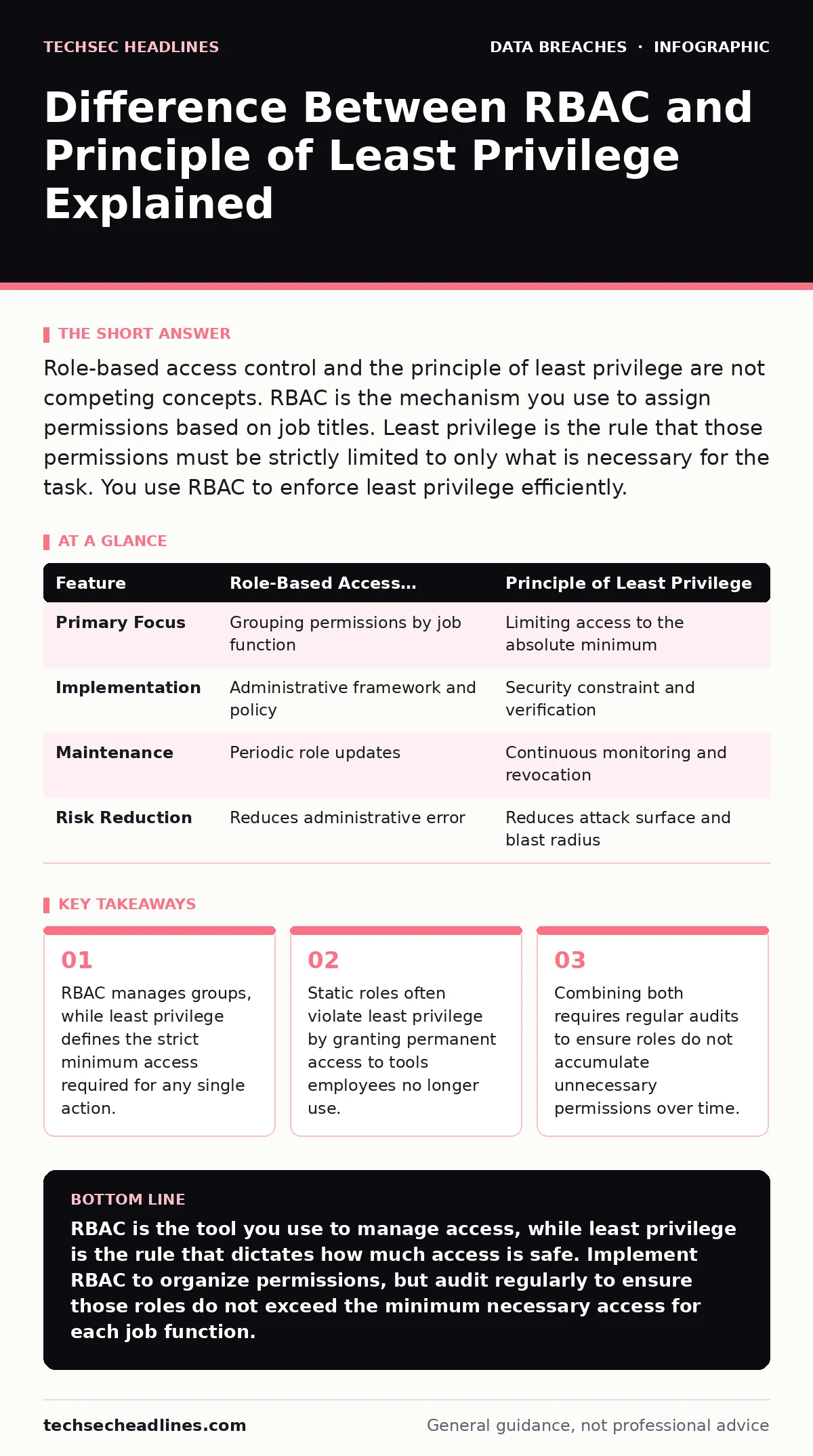
Role-based access control and the principle of least privilege are not competing concepts. RBAC is the mechanism you use to assign permissions based on job titles. Least privilege is the rule that those permissions must be strictly limited to only what is necessary for the task. You use RBAC to enforce least privilege efficiently.
What is the difference between RBAC and principle of least privilege
Role-based access control (RBAC) is an administrative framework, whereas the principle of least privilege is a security constraint. RBAC allows you to bundle permissions into roles like "Accountant" or "Developer." Least privilege demands that every account, whether human or machine, holds only the permissions necessary to complete its immediate tasks. RBAC helps you manage users at scale. Least privilege ensures that if an account is compromised, the attacker gains minimal access. You need RBAC to implement least privilege without manual chaos.
How does RBAC support least privilege
RBAC supports least privilege by removing the need to assign permissions to individual users manually. When you define a role, you specify the exact permissions that role requires. This prevents administrators from granting excessive access out of convenience. Imagine a support agent who needs to reset passwords. You create a "Support" role with only password reset capabilities. You do not grant database admin rights. This ensures the agent has enough access to work, but not enough to cause damage. RBAC acts as the delivery mechanism for least privilege.
Why static roles often violate least privilege
Static roles often violate least privilege because they assume job functions never change. Employees move between departments, take on new projects, or leave the organization. If their role permissions remain static, they retain access to systems they no longer need. This accumulation of permissions is called privilege creep. An employee who moved from finance to marketing might still hold access to financial ledgers. This creates unnecessary risk. Least privilege requires dynamic adjustment. Static roles provide a false sense of security because they look organized but contain hidden excess access.
| Feature | Role-Based Access Control (RBAC) | Principle of Least Privilege |
|---|---|---|
| Primary Focus | Grouping permissions by job function | Limiting access to the absolute minimum |
| Implementation | Administrative framework and policy | Security constraint and verification |
| Maintenance | Periodic role updates | Continuous monitoring and revocation |
| Risk Reduction | Reduces administrative error | Reduces attack surface and blast radius |
How to handle temporary access requests
Temporary access requests break the static nature of traditional RBAC. When an engineer needs server access for a one-time fix, granting that access permanently violates least privilege. You must use time-bound permissions. These permissions expire automatically after a set duration. This ensures that access is granted only when needed and revoked immediately after. Suppose a contractor needs access to a project folder for two weeks. You grant access for exactly 14 days. After that, the access disappears. This prevents the contractor from retaining access after the contract ends.
What is the hidden cost of strict least privilege
Strict least privilege creates friction for users who need to perform complex tasks. If a user must request permission for every minor action, productivity drops. This is the operational cost of security. You must balance security with usability. If the process to get access is too slow, users will find workarounds. They might share credentials or bypass security controls. This behavior is more dangerous than the original risk. You must design processes that are secure but also efficient. Automation helps reduce this friction by approving standard requests quickly.
See also: When Can Protected Health Information Be Disclosed Without Consent
How to audit roles for privilege creep
Auditing roles for privilege creep requires comparing actual usage against assigned permissions. You cannot rely on job titles alone. You must analyze logs to see which permissions are actually used. If a "Developer" role has access to production databases but never uses it, that permission should be removed. This process is called just-in-time access review. You remove permissions that are not actively used. This keeps roles lean and aligned with least privilege. Regular audits prevent the slow accumulation of unnecessary access that happens over time.
Where RBAC fails and ABAC succeeds
RBAC fails when access decisions require more context than just job title. Attribute-based access control (ABAC) uses attributes like location, time, and device health to make decisions. Suppose a user is a "Manager" but tries to access data from a foreign country. RBAC might allow this if the role permits it. ABAC can deny access based on the location attribute. This adds a layer of least privilege that RBAC cannot provide alone. You use ABAC when context matters. RBAC is too blunt for complex, dynamic environments. ABAC allows for finer granularity without creating thousands of roles.
How to prevent data extortion through access control
Data extortion often succeeds because attackers move laterally through the network. If one account has excessive privileges, the attacker can access sensitive data quickly. Least privilege limits this lateral movement. By ensuring each account has minimal access, you force the attacker to compromise multiple accounts to gather valuable data. This buys you time to detect and respond. You must also monitor for unusual access patterns. If an account suddenly tries to access unrelated systems, trigger an alert. This detection capability is part of a broader strategy against threats like data extortion.
What happens when least privilege is ignored
Ignoring least privilege leads to wider damage when breaches occur. If every user has admin rights, a single compromised credential gives the attacker full control. This is the worst-case scenario for any organization. You lose the ability to contain the incident. The attacker can delete logs, encrypt files, or steal data. This connects to risks like website defacement or public file share exposure. Proper access control limits the blast radius. It ensures that even if a breach happens, the impact is contained to a small segment of the system.
Key takeaways
- RBAC manages groups, while least privilege defines the strict minimum access required for any single action.
- Static roles often violate least privilege by granting permanent access to tools employees no longer use.
- Combining both requires regular audits to ensure roles do not accumulate unnecessary permissions over time.
RBAC is the tool you use to manage access, while least privilege is the rule that dictates how much access is safe. Implement RBAC to organize permissions, but audit regularly to ensure those roles do not exceed the minimum necessary access for each job function.
Frequently asked questions
Can I use RBAC without least privilege?
You can, but it is risky. RBAC without least privilege often leads to overly permissive roles that grant unnecessary access, increasing the attack surface if an account is compromised.
Is least privilege only for human users?
No, least privilege applies to service accounts and applications as well. Machine identities should have only the permissions needed to perform their specific automated tasks, not broad administrative rights.
How do I explain least privilege to non-technical staff?
Explain it as a safety measure. Just as you do not give everyone a master key to the building, you do not give every employee full access to all systems. It protects their data and the company's assets.
Does RBAC replace the need for multi-factor authentication?
No, RBAC and multi-factor authentication serve different purposes. RBAC controls what a user can do after logging in. Multi-factor authentication verifies that the user is who they claim to be. You need both for strong security.
How this guide was produced: written by the TechSec Headlines editorial team with AI assistance, checked against the public references listed below, and reviewed when the facts change. See our editorial policy or report an error.