
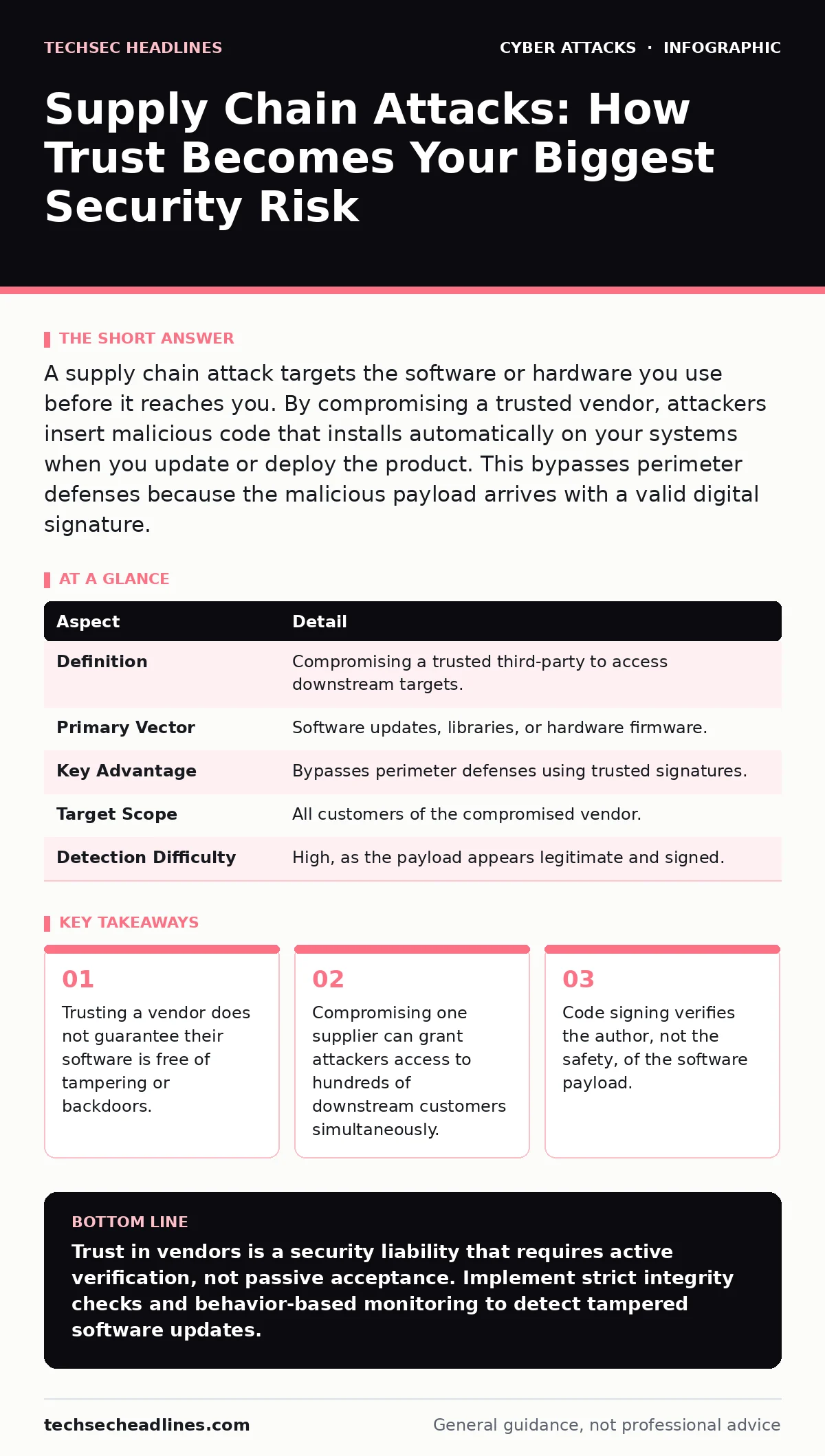
A supply chain attack targets the software or hardware you use before it reaches you. By compromising a trusted vendor, attackers insert malicious code that installs automatically on your systems when you update or deploy the product. This bypasses perimeter defenses because the malicious payload arrives with a valid digital signature.
The Broken Chain of Trust
Imagine you hire a reputable locksmith to change your home security system. You trust the locksmith because they have good reviews and proper licensing. You do not inspect every wire or circuit board they install. If the locksmith has been coerced by a thief to install a hidden backdoor in every system they deploy, your home is compromised despite your careful hiring process. The breach did not come from outside your walls; it came from inside the trusted relationship.
In cybersecurity, this dynamic is known as a supply chain attack. The attacker does not target you directly. Instead, they target the companies or developers that provide you with software, hardware, or services. By compromising a single node in the supply chain, the attacker can distribute malicious code to every customer of that node.
| Aspect | Detail |
|---|---|
| Definition | Compromising a trusted third-party to access downstream targets. |
| Primary Vector | Software updates, libraries, or hardware firmware. |
| Key Advantage | Bypasses perimeter defenses using trusted signatures. |
| Target Scope | All customers of the compromised vendor. |
| Detection Difficulty | High, as the payload appears legitimate and signed. |
How the Infection Spreads
The mechanism relies on the concept of trust delegation. When you install software from a vendor, your system trusts that vendor’s digital signature. A digital signature is a cryptographic proof that the software came from the claimed author and has not been altered. Attackers exploit this by gaining access to the vendor’s build environment or source code repository.
Once inside, they insert malicious code into the legitimate software. When the vendor releases an update, the malicious code is included. Because the update is signed with the vendor’s legitimate key, your security tools allow it to pass. The malware executes with the same permissions as the legitimate software. If the software runs with administrative rights, the attacker now has control over your system.
This method is efficient. Instead of finding a vulnerability in your specific firewall or email server, the attacker finds one vulnerability in the vendor’s system. They then leverage the vendor’s distribution channels to reach thousands of victims at once. The attack scales automatically with the vendor’s customer base.
Who Bears the Risk
The risk extends far beyond large enterprises. Any organization that relies on third-party software or hardware is a potential target. The attacker chooses the vendor based on how many victims they can reach, not just the size of the vendor. A small developer with a widely used open-source library can be a more attractive target than a large corporation with a niche product.
Your organization is affected if you use the compromised software. This includes commercial applications, open-source libraries, cloud services, and even physical hardware. If your network relies on a specific firewall brand, and that brand’s firmware is compromised, your entire network perimeter is at risk. The attack affects you regardless of how secure your own internal practices are.
The impact is often delayed. The malicious code may lie dormant for weeks or months before activating. This delay makes it difficult to correlate the breach with a specific update or event. By the time you notice unusual activity, the attacker may have already exfiltrated data or moved laterally across your network.
Common Forms of Compromise
Attackers use several methods to infiltrate the supply chain. Source code theft is one method. Attackers breach the vendor’s repository and modify the code directly. This is difficult to detect if the vendor has poor code review practices.
Another form is build environment compromise. The source code is clean, but the system that compiles the code is infected. The compiler inserts malicious instructions during the build process. This leaves the source code looking clean while the final executable is dangerous.
Dependency confusion is a newer tactic. Modern software relies on many external libraries. Attackers upload malicious versions of these libraries to public repositories. If your build system prioritizes internal repositories incorrectly, it may pull the malicious version instead of the legitimate one.
Hardware supply chain attacks involve physical tampering. Attackers modify chips or firmware during manufacturing or shipping. This is harder to execute but offers persistent access that is difficult to remove without replacing the hardware.
What People Usually Get Wrong
Many organizations believe that code signing is sufficient protection. This is a critical misunderstanding. Code signing ensures the software comes from the vendor and has not been changed since it was signed. It does not verify that the code is safe or free of malware. If the vendor’s signing key is stolen or the vendor is compromised, the signature remains valid.
Another common error is assuming that open-source software is safe because it is public. While visibility can help find bugs, most users do not audit the code of every library they use. They trust the maintainer. If the maintainer is coerced or hacked, the trust is broken. The sheer volume of dependencies in modern applications makes manual auditing impossible for most teams.
You might also assume that using a secure email gateway prevents these attacks. Secure email gateways filter malicious attachments and links, but they cannot inspect the integrity of a software update downloaded from a vendor’s website. The attack bypasses email entirely, arriving through legitimate update channels.
Reducing the Risk
You cannot eliminate supply chain risk, but you can reduce it. Start by minimizing your attack surface. Use only the software and libraries you absolutely need. Every additional dependency is another potential entry point for an attacker.
Implement strict integrity checks. Use tools that verify the hash of the software against a known good value before installation. If the hash changes, even slightly, the installation should fail. This detects tampering that occurs after the code was signed.
Monitor for unusual behavior. Since the malware arrives with a legitimate signature, traditional signature-based antivirus may miss it. Behavior-based detection looks for actions that are abnormal for the specific application. For example, an accounting application should not be trying to connect to a remote command server.
Regularly update your software, but verify the updates. Do not automate updates blindly. Ensure that the update process includes verification of the source and integrity. This adds a layer of defense against compromised update servers.
Consider the security posture of your vendors. Ask them about their development practices. Do they use security awareness training for their staff? Do they perform AI security testing to find vulnerabilities in their code? Their security practices directly impact your risk.
The Hidden Cost of Trust
The most unexpected consequence of supply chain attacks is the erosion of trust in digital signatures. As these attacks become more common, the assumption that a signed file is safe will continue to weaken. This forces organizations to adopt more complex verification methods, such as software bill of materials (SBOM) and continuous integrity monitoring.
The hidden cost is operational overhead. You must invest time and resources in verifying every component of your software stack. This slows down deployment and increases the complexity of your security operations. However, this cost is necessary. The alternative is accepting that your perimeter defenses are bypassed by the very tools you use to build your business.
Key takeaways
- Trusting a vendor does not guarantee their software is free of tampering or backdoors.
- Compromising one supplier can grant attackers access to hundreds of downstream customers simultaneously.
- Code signing verifies the author, not the safety, of the software payload.
- You must verify the integrity of dependencies, not just the final application.
Trust in vendors is a security liability that requires active verification, not passive acceptance. Implement strict integrity checks and behavior-based monitoring to detect tampered software updates.
Frequently asked questions
Can antivirus software stop supply chain attacks?
Traditional antivirus relies on known signatures, which may not detect newly inserted malware in legitimate updates. Behavior-based detection is more effective at identifying malicious actions performed by trusted applications.
How do I know if my software has been compromised?
Look for unexpected network connections, unusual resource usage, or changes in system files. Compare the current software hash against the original hash provided by the vendor to detect tampering.
Is open-source software more vulnerable to supply chain attacks?
Open-source software can be vulnerable if the maintainer’s account is compromised. However, the public nature of the code can also help the community detect malicious changes faster than in closed-source environments.
Do I need to audit every library I use?
While ideal, auditing every library is often impractical. Focus on minimizing dependencies and using automated tools to scan for known vulnerabilities and anomalies in your software supply chain.
How this guide was produced: written by the TechSec Headlines editorial team with AI assistance, checked against the public references listed below, and reviewed when the facts change. See our editorial policy or report an error.