Initial access brokers exploit human error and weak configuration. Stop buying their inventory by enforcing strict identity controls, segmenting networks, and verifying external links. These six fixes close the doors they use to resell access to ransomware groups.
Mistake 1: Treating passwords as the primary gatekeeper
Password-only authentication creates a single point of failure that brokers exploit with automated credential stuffing. You assume your users choose unique passwords, but reuse is common across personal and professional accounts. When a breach occurs elsewhere, brokers harvest those credentials and test them against your login portal. This method bypasses technical defenses because the authentication itself is valid. The system accepts the login as legitimate, granting full access to the account and its associated permissions.
Why it hurts: Credential theft grants immediate, authorized access to your environment. Brokers do not need to bypass firewalls or exploit software vulnerabilities. They simply log in as a real user. This access often includes email, file shares, and administrative tools. The damage scales with the privilege level of the compromised account.
The fix: Enforce multi-factor authentication (MFA) for every user and service. MFA requires a second form of verification, such as a hardware token or authenticator app, in addition to the password. This stops credential stuffing attacks because the attacker lacks the second factor. Review your identity provider settings to ensure MFA is mandatory, not optional. Disable legacy authentication protocols that do not support MFA.
Mistake 2: Leaving remote management ports exposed to the internet
Remote desktop protocol (RDP) and virtual network computing (VNC) ports provide direct control over machines. Exposing these ports to the public internet allows brokers to scan for open instances and brute-force login attempts. You might believe a strong password protects these services, but automated tools test millions of combinations daily. If a port is open, it is visible to anyone scanning the network space. Brokers prioritize these exposed services because they offer immediate, high-value access to internal systems.
Why it hurts: Direct exposure creates a large attack surface. Scanning tools identify open ports within seconds of exposure. Once a port is found, attackers attempt common username and password pairs. A successful login gives the broker full control of the machine. From there, they can install monitoring tools or move laterally to other systems. This access is often sold to ransomware operators who need a foothold inside the network.
The fix: Block remote management ports at the network perimeter. Use a virtual private network (VPN) or zero trust network access (ZTNA) solution to mediate remote connections. ZTNA verifies user identity and device health before granting access to specific applications. This approach hides your internal services from public scanning. Only authorized users with verified devices can reach the management interfaces.
Mistake 3: Ignoring phishing links in legitimate-looking emails
Phishing emails trick users into clicking malicious links or downloading infected attachments. Brokers use sophisticated templates that mimic trusted vendors or internal communications. You might rely on email filtering to block these messages, but filters are not perfect. Advanced phishing campaigns bypass filters by using clean domains and legitimate content. When a user clicks a link, they may be directed to a fake login page that harvests their credentials. This method exploits human trust rather than technical weaknesses.
Why it hurts: Credential harvesting via phishing provides brokers with valid login details. These credentials are often fresh and active, making them valuable on dark web markets. Once obtained, brokers can access email accounts to gather intelligence or send further phishing messages. This lateral movement expands the breach without triggering technical alerts. The initial compromise appears as normal user activity, delaying detection.
The fix: Train users to verify the sender’s domain and inspect URLs before clicking. Use email authentication protocols like DMARC, SPF, and DKIM to prevent spoofing. DMARC tells receiving servers how to handle emails that fail authentication checks. Implement link rewriting or sandboxing to analyze URLs before they reach the user. Regular phishing simulations help reinforce these habits and identify users who need additional training.
Mistake 4: Using shared administrative credentials
Shared accounts for administrative tasks make it impossible to track who performed an action. You might create a generic admin account for convenience, allowing multiple staff members to use the same login. This practice eliminates accountability and complicates incident response. If that account is compromised, the broker gains access to every system the account can touch. You cannot determine which user introduced the threat or which actions were malicious. This ambiguity allows attackers to operate with impunity.
Why it hurts: Shared credentials obscure the audit trail. When a breach occurs, you cannot isolate the compromised user. The broker can use the shared account to access sensitive data or modify system settings. Revoking access requires changing the password for everyone, disrupting operations. This disruption often leads to delayed response, giving the broker more time to establish persistence. The lack of individual accountability encourages careless security practices.
The fix: Assign unique credentials to every user, including administrators. Use privileged access management (PAM) solutions to control and monitor administrative sessions. PAM systems enforce just-in-time access, granting privileges only when needed and for a limited time. This approach reduces the window of opportunity for attackers. Audit logs will clearly show which user performed each action, aiding in detection and investigation.
Mistake 5: Failing to segment internal networks
Flat network architectures allow any connected device to communicate with any other device. You might assume that once an attacker is inside, they are contained by internal firewalls. However, without segmentation, the broker can move laterally with ease. A compromised workstation can access file servers, databases, and domain controllers. This unrestricted movement allows the attacker to escalate privileges and gather sensitive data. The entire network becomes a single point of failure.
Why it hurts: Lateral movement expands the scope of the breach. Brokers use this access to map the network and identify high-value targets. They can install backdoors on multiple systems, ensuring persistent access even if one machine is cleaned. This persistence is highly valuable to buyers who want long-term access for espionage or ransomware deployment. The lack of boundaries makes containment difficult and recovery time-consuming.
The fix: Implement network segmentation using virtual local area networks (VLANs) and firewall rules. Separate critical systems like databases and domain controllers from general user workstations. Apply the principle of least privilege, allowing only necessary traffic between segments. This limits the impact of a single compromise. If a broker gains access to one segment, they cannot easily move to others.
See also: end of life equipment: why old hardware breaks your security stack
Mistake 6: Neglecting software updates and patch management
Unpatched software contains known vulnerabilities that brokers can exploit with publicly available tools. You might delay updates to avoid potential compatibility issues or downtime. However, leaving systems unpatched is a known risk that attackers actively scan for. Brokers use automated tools to find and exploit these vulnerabilities, gaining initial access without user interaction. This method is reliable and does not rely on human error. The window of exposure grows with every day the patch is delayed.
Why it hurts: Known vulnerabilities are easy to exploit and widely documented. Brokers do not need advanced skills to use these exploits. They simply run automated tools that target unpatched systems. This access is often silent and undetected until the broker sells the foothold. The resulting compromise can lead to data theft, system disruption, or further lateral movement. The cost of patching is far lower than the cost of a breach.
The fix: Establish a regular patch management process that prioritizes critical security updates. Test patches in a non-production environment before deployment to ensure compatibility. Automate the update process where possible to reduce human error. Monitor vendor advisories for urgent security fixes. This proactive approach reduces the attack surface and limits the opportunities for brokers to gain entry.
Mistake 7: Overlooking third-party vendor access
Third-party vendors often require access to your systems for maintenance or support. You might grant them broad permissions to simplify their work. However, this access creates an additional entry point for brokers. If a vendor’s credentials are compromised, the broker can use them to access your network. This indirect attack vector bypasses your direct security controls. The vendor’s security posture becomes your responsibility.
Why it hurts: Vendor compromises are common and often go undetected. Brokers target smaller vendors with weaker security to gain access to larger organizations. Once inside, they can move laterally to your critical systems. The breach may appear to originate from a trusted partner, complicating detection and response. This indirect access undermines your security assumptions and expands your risk profile.
The fix: Restrict vendor access to the minimum necessary permissions. Use temporary credentials that expire after the maintenance window. Monitor vendor activity for unusual behavior. Require vendors to adhere to your security standards and undergo regular audits. This approach limits the damage if a vendor’s credentials are compromised. It also ensures that third-party access is controlled and accountable.
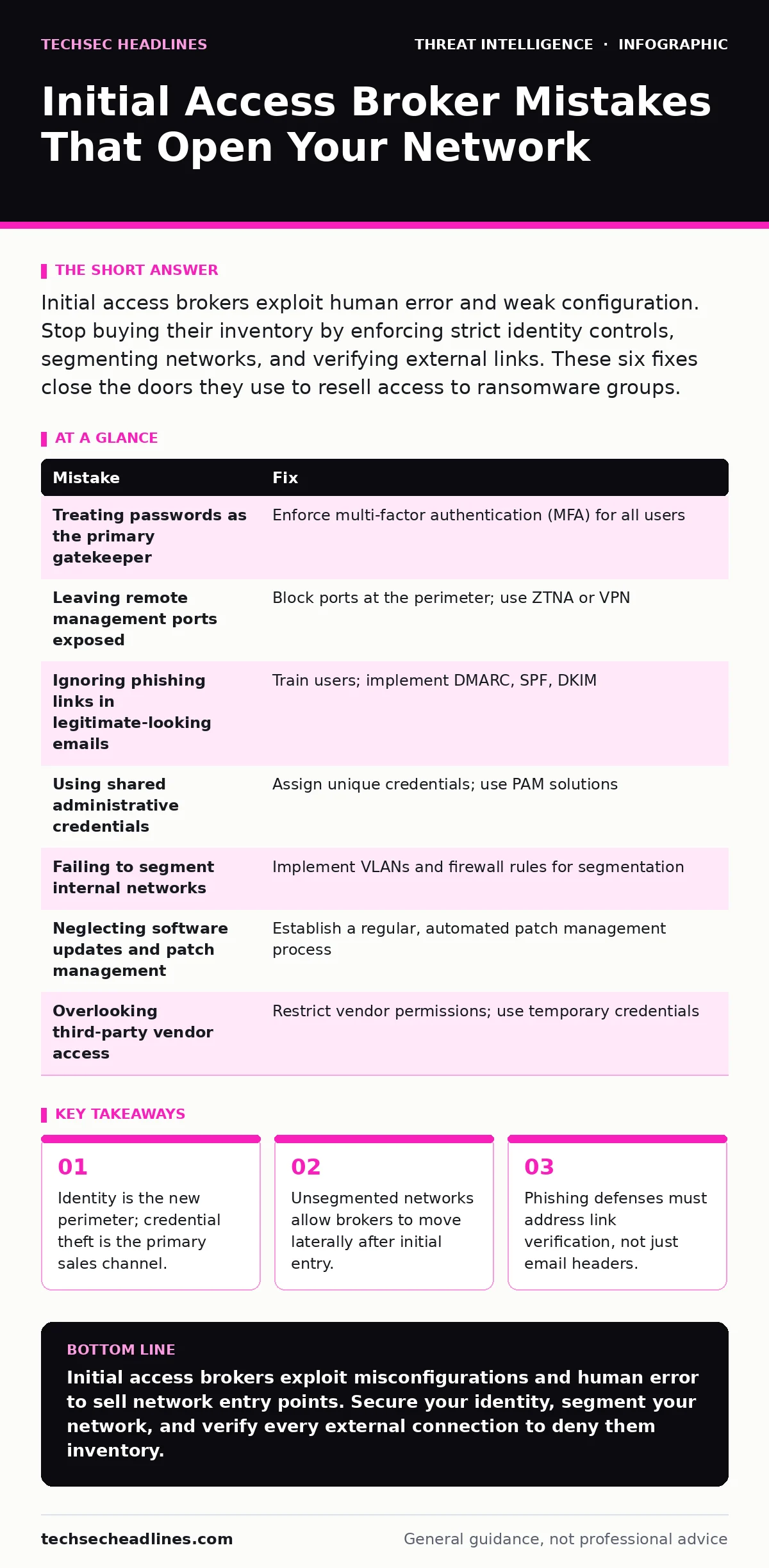
| Mistake | Fix |
|---|---|
| Treating passwords as the primary gatekeeper | Enforce multi-factor authentication (MFA) for all users |
| Leaving remote management ports exposed | Block ports at the perimeter; use ZTNA or VPN |
| Ignoring phishing links in legitimate-looking emails | Train users; implement DMARC, SPF, DKIM |
| Using shared administrative credentials | Assign unique credentials; use PAM solutions |
| Failing to segment internal networks | Implement VLANs and firewall rules for segmentation |
| Neglecting software updates and patch management | Establish a regular, automated patch management process |
| Overlooking third-party vendor access | Restrict vendor permissions; use temporary credentials |
Key takeaways
- Identity is the new perimeter; credential theft is the primary sales channel.
- Unsegmented networks allow brokers to move laterally after initial entry.
- Phishing defenses must address link verification, not just email headers.
Initial access brokers exploit misconfigurations and human error to sell network entry points. Secure your identity, segment your network, and verify every external connection to deny them inventory.
Frequently asked questions
How do initial access brokers find vulnerable targets?
They use automated scanning tools to identify exposed ports, unpatched software, and weak configurations. They also monitor dark web forums for leaked credentials.
Can multi-factor authentication stop all initial access attempts?
MFA significantly reduces the risk of credential-based attacks but does not protect against phishing or software exploits. It is one layer of a broader defense strategy.
What is the role of threat intelligence in preventing broker attacks?
Threat intelligence sharing helps organizations identify emerging tactics and indicators of compromise. This information allows you to adjust defenses before brokers exploit new vulnerabilities.
How long do brokers typically hold access before selling it?
Brokers may hold access for days or weeks to ensure stability and gather intelligence. This persistence makes detection difficult, as their activity often mimics normal user behavior.
How this guide was produced: written by the TechSec Headlines editorial team with AI assistance, checked against the public references listed below, and reviewed when the facts change. See our editorial policy or report an error.