
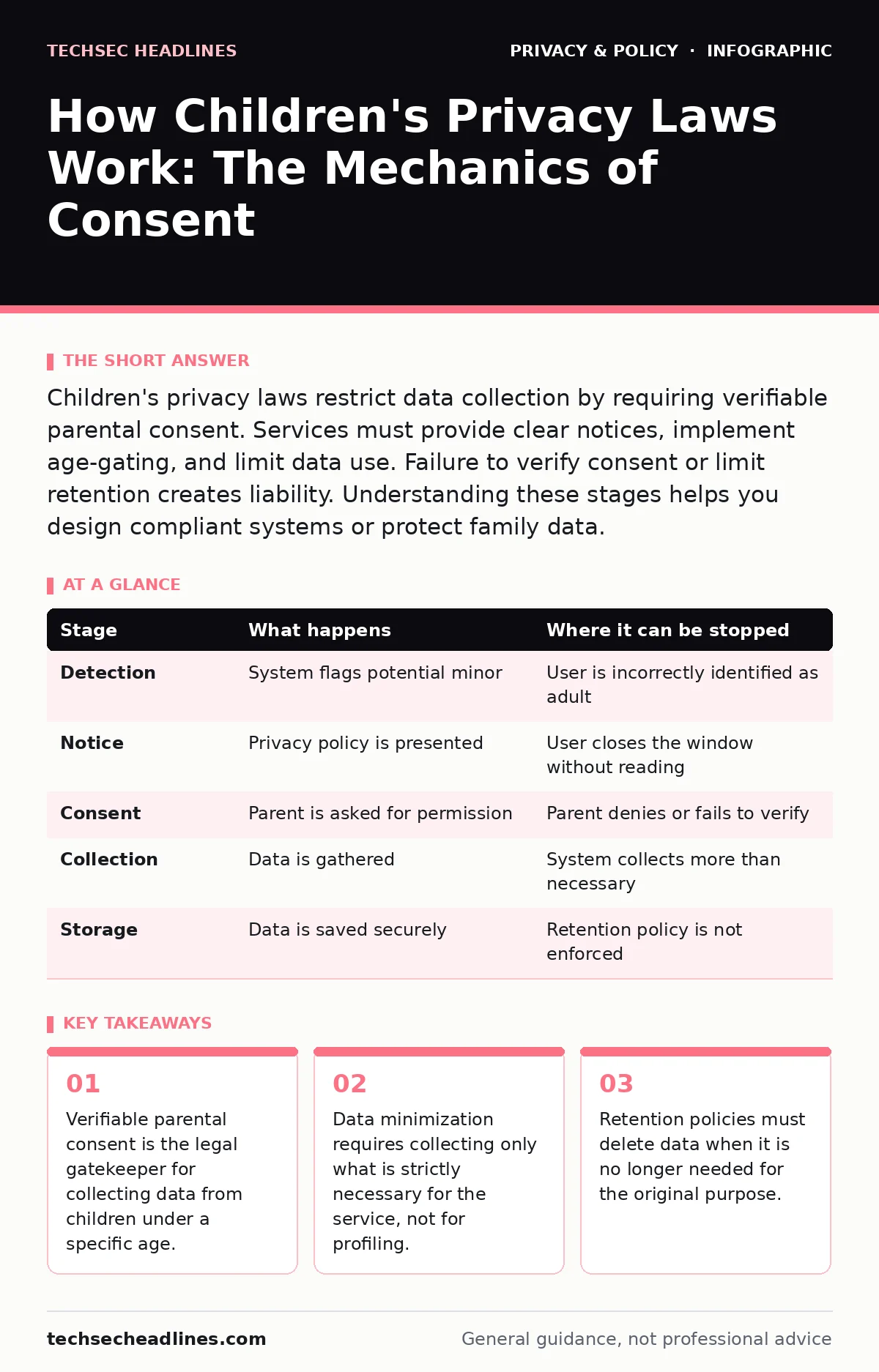
Children's privacy laws restrict data collection by requiring verifiable parental consent. Services must provide clear notices, implement age-gating, and limit data use. Failure to verify consent or limit retention creates liability. Understanding these stages helps you design compliant systems or protect family data.
The Legal Framework for Minors
Children's privacy laws operate on a simple premise: minors cannot legally consent to data processing. These regulations shift the responsibility to the service provider. You must prove that a parent or guardian authorized the collection. This is not a suggestion. It is a mandatory control.
The law distinguishes between general users and children. The age threshold varies by jurisdiction, but the mechanism remains similar. If the user is below the threshold, the service must pause data collection until verified consent is obtained. This creates a bottleneck in the onboarding flow.
Imagine you are building a gaming app. You cannot simply ask "Are you over 13?" and proceed. That question has no enforcement mechanism. You must verify the age. If the user claims to be older, you need a second step. This step is where most systems fail.
Stage 1: Age Detection and Gating
The first stage is determining if the user is a child. Services use self-reporting, which is unreliable. A child will lie to access content. Therefore, you need a method to filter users. Some services use indirect signals, such as the device type or the time of day. These are weak signals but can trigger additional checks.
If the system suspects a child, it must present a privacy notice. This notice must be in plain language. It cannot hide behind legal jargon. It must state what data is collected and why. If the notice is unclear, the consent is invalid.
This stage acts as a filter. It separates general users from those requiring special handling. You must log this determination. The log proves you attempted to identify the user's status. This documentation protects you during audits.
| Stage | What happens | Where it can be stopped |
|---|---|---|
| Detection | System flags potential minor | User is incorrectly identified as adult |
| Notice | Privacy policy is presented | User closes the window without reading |
| Consent | Parent is asked for permission | Parent denies or fails to verify |
| Collection | Data is gathered | System collects more than necessary |
| Storage | Data is saved securely | Retention policy is not enforced |
Stage 2: Verifiable Parental Consent
This is the core requirement. You must verify that the person consenting is actually the parent. A simple checkbox is not verification. The law requires a method that provides reasonable assurance. Common methods include credit card checks, government ID scans, or knowledge-based questions.
Each method has trade-offs. Credit card checks are intrusive. They require financial data. ID scans raise privacy concerns for the parent. Knowledge-based questions can be guessed. You must choose a method that balances security with user experience.
If verification fails, you cannot collect the data. You must block the account or limit functionality. This is a hard stop. There is no workaround. Skipping this step exposes the organization to significant penalties.
Stage 3: Data Minimization and Use
Once consent is granted, you can collect data. But you cannot collect everything. The principle of data minimization applies. You may only collect data necessary for the service. If the game does not need location data, do not ask for it.
This restriction prevents profiling. You cannot build a behavioral profile of a child for advertising purposes. The data must serve the immediate function. If you collect audio for voice chat, you cannot analyze it for sentiment.
Imagine a social platform. It allows children to post comments. It does not need to track their browsing history. Collecting that history violates the minimization rule. You must delete any data that falls outside the defined purpose.
Stage 4: Security and Retention
Collected data must be secured. Encryption at rest and in transit is standard. Access controls ensure only authorized staff can view the data. You must also define a retention period. Data should not be kept forever.
When the account is deleted, or the child ages out, the data must be erased. This is not optional. You need a process to purge records. Automated scripts can help, but they must be verified. Manual deletion is prone to error.
Failure to delete data creates liability. Even if the data is encrypted, holding it unnecessarily is a violation. You must document the deletion. Proof of erasure is as important as proof of collection.
See also: Shared AI chat links in search results and how to spot them · End-to-End Encryption Messenger Deleted Messages: What Actually Happens
Reading the Policy for Compliance
To apply these laws, read the privacy policy critically. Look for the consent mechanism. Is it verifiable? Look for the data list. Is it minimal? Look for the retention section. Is there a clear end date?
If the policy is vague, assume non-compliance. Ambiguity favors the regulator. You need clear, specific language. Do not rely on boilerplate text. Customize the policy to your actual practices.
This scrutiny applies to third-party services too. If you use an analytics tool, ensure it complies. You are responsible for their actions. Conduct vendor audits. Check their certifications. Verify their data handling practices.
Practical Application for Users
As a user, you can leverage these laws. Request access to your child's data. Services must provide a way to view and delete it. Use data subject access requests to audit what is held. This forces transparency.
Check the settings. Disable non-essential features. Turn off location tracking if not needed. Use email aliases to protect primary addresses. This reduces the surface area for data collection.
If a service refuses to delete data, escalate. Report the violation to the relevant authority. This enforcement is part of the ecosystem. It holds companies accountable.
The Hidden Costs of Compliance
Compliance is expensive. Building verification systems costs money. Storing data securely costs money. Deleting data requires engineering effort. These costs are passed to users.
Small organizations struggle with this. They may lack the resources to build robust systems. This creates a barrier to entry. Large companies have an advantage. They can absorb the costs.
This dynamic affects innovation. Startups may avoid children's markets. This reduces choice for families. It is a hidden cost of privacy protection. You must weigh the benefits against the market impact.
Conclusion of Mechanics
Children's privacy laws are mechanical. They require specific steps. Detection, verification, minimization, security, and deletion. Each step has a purpose. Each step has a failure mode.
Understanding these mechanics helps you navigate the landscape. Whether you are building a service or using one, know the rules. Demand verification. Demand minimization. Demand deletion.
This framework protects the vulnerable. It ensures that data is not exploited. It creates a safer digital environment. But it requires vigilance. The law is only as good as its enforcement.
Key takeaways
- Verifiable parental consent is the legal gatekeeper for collecting data from children under a specific age.
- Data minimization requires collecting only what is strictly necessary for the service, not for profiling.
- Retention policies must delete data when it is no longer needed for the original purpose.
Frequently asked questions
What happens if a child lies about their age?
The service is still liable if it collects data without verified parental consent. Self-reporting is not a defense.
Can I use facial recognition to verify age?
It is technically possible but raises significant privacy risks. Many jurisdictions restrict biometric data collection from minors.
How long must companies keep consent records?
There is no universal standard. However, records must be kept long enough to prove compliance during an audit.
Do these laws apply to schools?
Yes, educational institutions must also comply. They must protect student data and obtain proper consent.
How this guide was produced: written by the TechSec Headlines editorial team with AI assistance, checked against the public references listed below, and reviewed when the facts change. See our editorial policy or report an error.