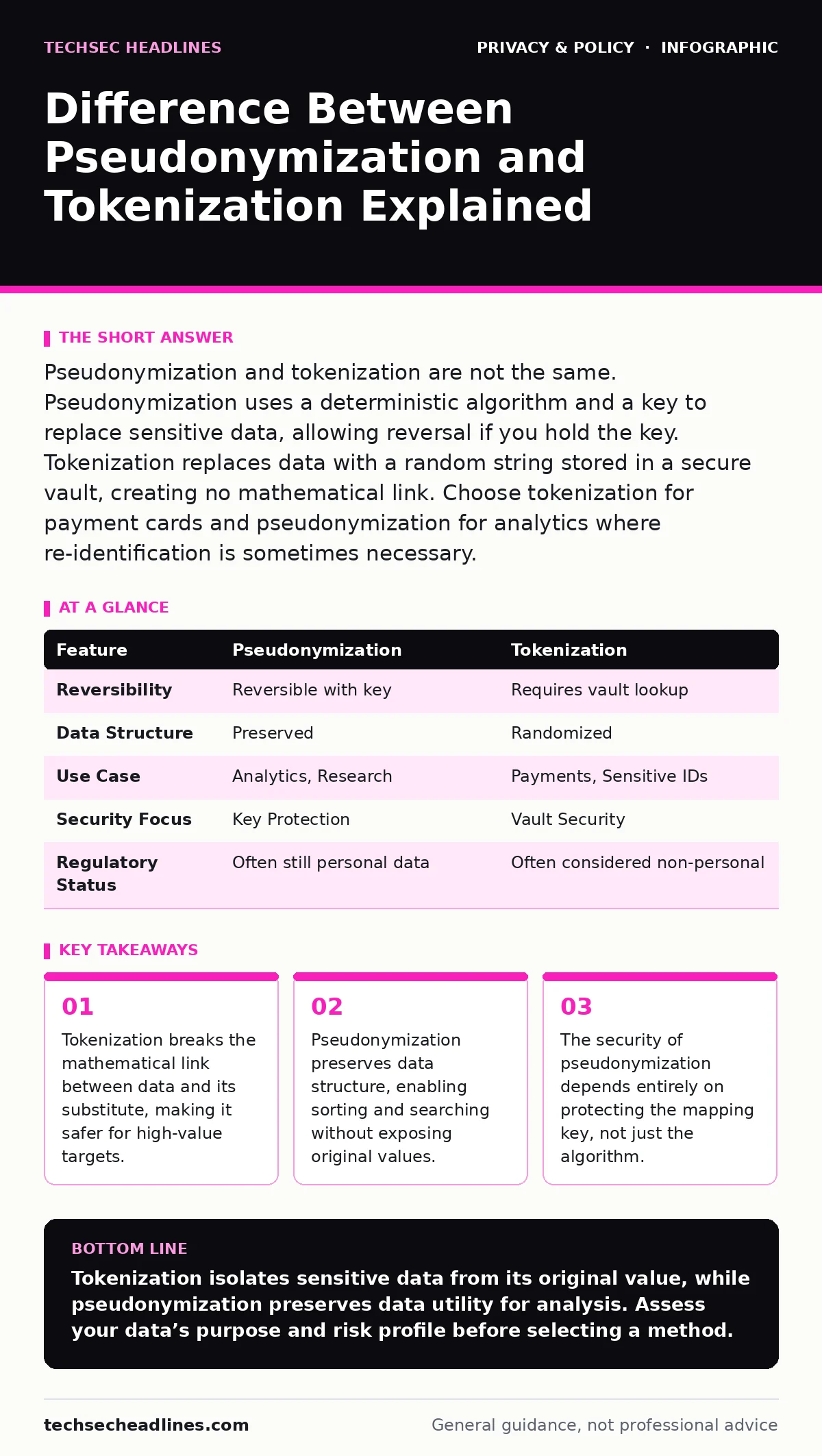
Pseudonymization and tokenization are not the same. Pseudonymization uses a deterministic algorithm and a key to replace sensitive data, allowing reversal if you hold the key. Tokenization replaces data with a random string stored in a secure vault, creating no mathematical link. Choose tokenization for payment cards and pseudonymization for analytics where re-identification is sometimes necessary.
What is the difference between pseudonymization and tokenization?
Pseudonymization replaces sensitive data with artificial identifiers, while tokenization substitutes data with random strings stored in a secure vault. Pseudonymization maintains a deterministic relationship between the original data and the pseudonym. You can reverse pseudonymization if you possess the key or algorithm. Tokenization removes any mathematical relationship. The token itself reveals nothing about the original data. You must query a secure token vault to retrieve the original value. This fundamental distinction determines which method fits your security architecture.
When should you use tokenization over pseudonymization?
Use tokenization when you handle high-value data like payment card numbers or social security numbers. Tokenization ensures that even if an attacker steals the database, the stolen tokens are useless without access to the token vault. The vault becomes the single point of failure. You must secure the vault with strict access controls and monitoring. Pseudonymization is less suitable here because the deterministic nature allows statistical attacks if the key is compromised. Tokenization adds a layer of isolation that pseudonymization lacks. This isolation is critical for compliance with strict payment security standards.
How does pseudonymization support data analytics?
Pseudonymization preserves the structure and format of the original data. You can sort, filter, and join pseudonymized datasets without reversing the process. This capability is vital for business intelligence and machine learning models. Imagine you need to analyze customer purchasing patterns without exposing names. Pseudonymization allows you to track individual behavior across transactions. The data remains useful for computation. Tokenization produces random strings that break sorting and joining operations. You cannot analyze tokenized data effectively unless you detokenize it first. Detokenization exposes the original data, defeating the purpose of privacy-preserving analysis.
What are the risks of relying on pseudonymization?
Pseudonymization security relies entirely on the protection of the mapping key. If an attacker obtains both the pseudonymized data and the key, they can re-identify individuals. This risk increases when pseudonymized data is combined with other datasets. Linkage attacks can reveal identities by correlating pseudonyms with external information.
Pseudonymization is often considered a security measure rather than full anonymization. Regulatory frameworks may still treat pseudonymized data as personal data. You must implement strong key management practices. Rotating keys and limiting access are necessary steps. Without these controls, pseudonymization offers little protection against determined adversaries.
| Feature | Pseudonymization | Tokenization |
|---|---|---|
| Reversibility | Reversible with key | Requires vault lookup |
| Data Structure | Preserved | Randomized |
| Use Case | Analytics, Research | Payments, Sensitive IDs |
| Security Focus | Key Protection | Vault Security |
| Regulatory Status | Often still personal data | Often considered non-personal |
Does pseudonymization meet privacy law requirements?
Pseudonymization helps organizations comply with data protection regulations. It reduces the risk associated with data breaches by limiting exposure. However, it does not automatically exempt data from privacy laws. Many frameworks still classify pseudonymized data as personal data. The ability to re-identify individuals keeps the data within the scope of regulation.
You must still implement appropriate safeguards. These safeguards include access controls, encryption, and audit logs. Understanding the specific legal definition in your jurisdiction is necessary. Some regulations provide reduced liability for pseudonymized data if re-identification is impossible. This nuance requires careful legal review.
How do you secure the mapping mechanism?
The mapping mechanism is the weakest link in pseudonymization. For pseudonymization, this is the key. For tokenization, this is the vault. You must store keys and vaults separately from the data. Network segmentation isolates the mapping mechanism from production systems. Access to the mechanism should require multi-factor authentication. Logging all access attempts creates an audit trail. Regular rotation of keys prevents long-term exposure. If a key is compromised, you must re-pseudonymize the affected data. This process is resource-intensive but necessary. Neglecting key security renders the entire pseudonymization effort ineffective.
What happens when systems integrate?
Integration between systems often breaks pseudonymization consistency. Different systems may use different keys or algorithms. This fragmentation prevents data linkage across platforms. You must establish a centralized identity resolution process. This process maps pseudonyms from one system to another without exposing original data.
Standardized protocols help maintain consistency. However, complexity increases with each integration point. Each integration introduces new attack surfaces. You must evaluate the trust level of each connected system. Untrusted systems should receive tokenized data instead of pseudonymized data. This approach limits the value of data if an integration point is compromised.
Why do organizations confuse these techniques?
Organizations often confuse pseudonymization and tokenization due to marketing terminology. Vendors may use these terms interchangeably to sell solutions. This confusion leads to inadequate security controls. Implementing pseudonymization where tokenization is needed creates unnecessary risk. Conversely, using tokenization for analytics creates operational friction. Understanding the technical distinction is necessary for effective procurement. You must demand clear documentation from vendors. Documentation should specify whether the method is deterministic or random. It should also explain the reversal mechanism. Clarity in requirements prevents costly security missteps.
How does this relate to other privacy tools?
Pseudonymization and tokenization work alongside other privacy technologies. End-to-end encryption protects data in transit and at rest. DNS over HTTPS prevents network-level surveillance of domain queries. Email aliases provide a layer of indirection for communication. These tools address different vectors of exposure. Combining them creates a defense-in-depth strategy.
For example, you might pseudonymize data before encrypting it for storage. You might use tokenization for payment processing while employing end-to-end encryption for transmission. Each tool has specific strengths and limitations. Selecting the right combination depends on your threat model and data flow. Understanding digital privacy rights helps you prioritize which data requires which protection.
Key takeaways
- Tokenization breaks the mathematical link between data and its substitute, making it safer for high-value targets.
- Pseudonymization preserves data structure, enabling sorting and searching without exposing original values.
- The security of pseudonymization depends entirely on protecting the mapping key, not just the algorithm.
Tokenization isolates sensitive data from its original value, while pseudonymization preserves data utility for analysis. Assess your data’s purpose and risk profile before selecting a method.
Frequently asked questions
Can I use pseudonymization for payment card data?
No, payment card industry standards generally require tokenization. Pseudonymization does not provide sufficient isolation for high-value financial data.
Is tokenized data considered personal data?
If the token cannot be reversed without additional information stored separately, it may not be considered personal data under some regulations. Check local laws.
How often should I rotate pseudonymization keys?
Rotate keys regularly, such as annually or upon any suspected compromise. Rotation limits the window of exposure if a key is stolen.
Does pseudonymization protect against insider threats?
Only if access to the mapping key is strictly controlled. Insiders with key access can re-identify data, negating the protection.
How this guide was produced: written by the TechSec Headlines editorial team with AI assistance, checked against the public references listed below, and reviewed when the facts change. See our editorial policy or report an error.