
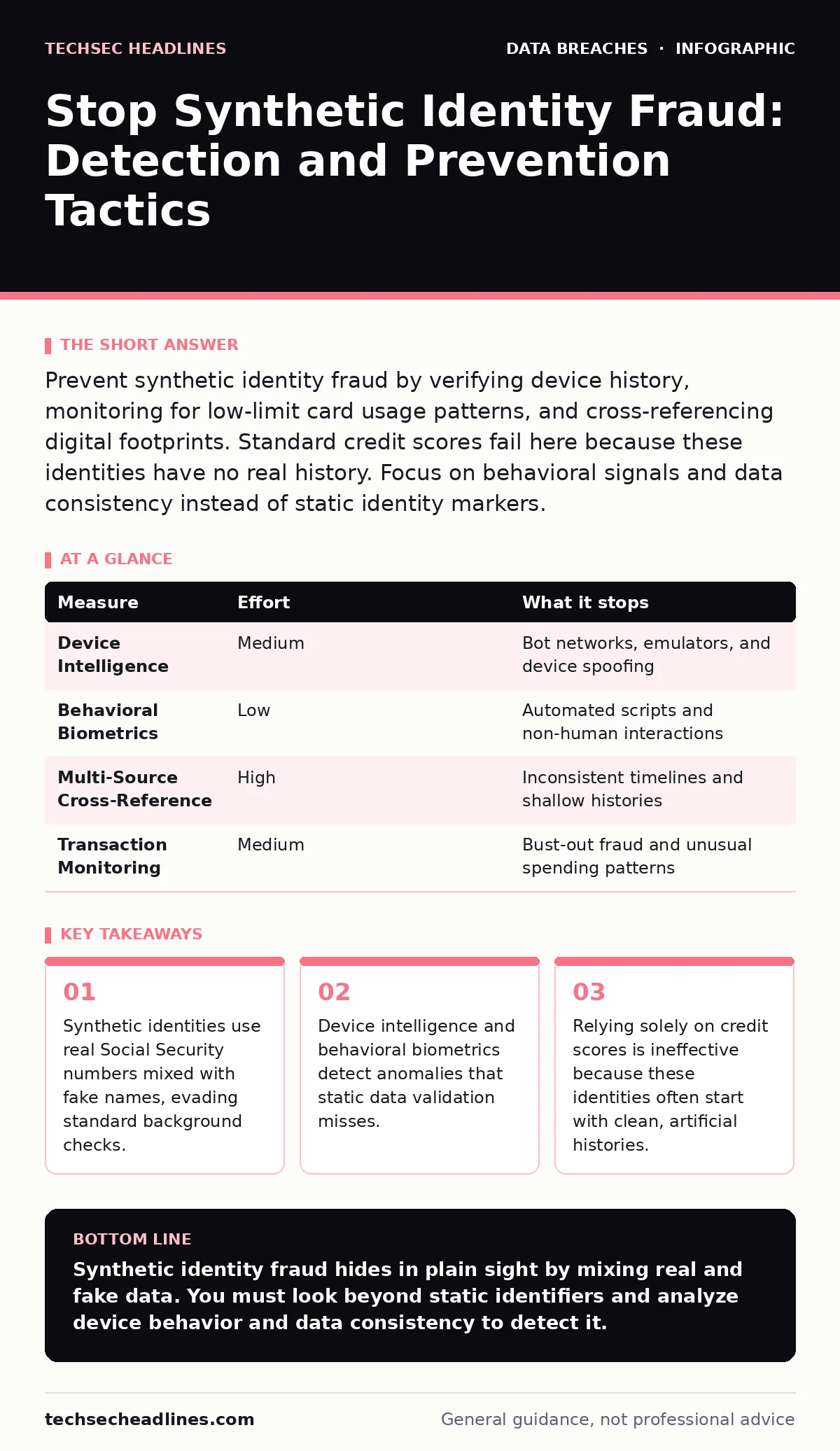
Prevent synthetic identity fraud by verifying device history, monitoring for low-limit card usage patterns, and cross-referencing digital footprints. Standard credit scores fail here because these identities have no real history. Focus on behavioral signals and data consistency instead of static identity markers.
The Anatomy of a Constructed Persona
Synthetic identity fraud differs from traditional identity theft. In identity theft, a criminal assumes an existing person’s life. In synthetic identity fraud, the attacker creates a new person. This person does not exist. The attacker combines a real identifier, such as a valid Social Security number or tax ID, with fabricated details like a false name, address, or date of birth.
This hybrid approach creates a ghost. The real owner of the Social Security number may never know their data was stolen. The synthetic identity builds credit over time. It applies for small loans. It makes small payments to establish a history. Once the credit profile looks legitimate, the attacker executes a large purchase or cash-out transaction. This is known as "bust-out" fraud.
Because the identity is partially real, standard verification tools often pass it. The Social Security number matches a real record. The name might be plausible. The address might be vacant but valid. This makes detection difficult for systems that rely on exact matches against government databases.
Why Traditional Verification Fails
Most organizations rely on identity proofing methods that assume the subject exists. These methods check if a name matches a Social Security number. They check if an address matches a phone number. For a synthetic identity, these checks often succeed. The attacker has carefully curated data points that align.
The failure point is the lack of depth. A synthetic identity has a shallow digital footprint. It lacks the noise of a real life. Real people have inconsistencies. They change jobs. They move houses. They have old accounts, dormant subscriptions, and varied transaction histories. A synthetic identity is too clean. It appears on paper but lacks the chaotic trail of human existence.
This is why credit scores are a poor defense. A synthetic identity can generate a high credit score by paying small balances on time. The score reflects repayment behavior, not identity validity. The system sees a good payer. It does not see that the payer is a construct. This creates a false sense of security for lenders and banks.
The Role of Device Intelligence
One of the most effective ways to spot a synthetic identity is to look at the device used to apply. Device intelligence analyzes the hardware and software environment of the user. It checks the device ID, the operating system, and the browser fingerprint. It looks for signs of emulators, rootkits, or virtual machines.
Attacks often originate from devices that do not match the claimed identity. A user claiming to be in a rural town might be connecting from an IP address in a dense urban center. The device might be new, with no prior history. Real users have established device histories. They have apps installed, cookies stored, and location data that spans months or years.
By tracking device behavior, you can identify anomalies. A device that has never made a transaction before suddenly applies for credit is a red flag. A device that switches identities frequently is another. This method does not rely on the user providing correct data. It relies on the physical reality of the hardware. It is harder for an attacker to fake a consistent device history than it is to fake a name.
Behavioral Biometrics and Usage Patterns
Behavioral biometrics track how a user interacts with a system. This includes typing speed, mouse movement, and touch pressure. These patterns are unique to individuals. They are difficult to replicate at scale. Synthetic identities are often managed by bots or fraud rings using scripts. These scripts interact with forms in a mechanical way.
Look for interactions that are too perfect or too fast. A human user hesitates. They correct typos. They scroll. A bot fills fields instantly. It submits forms with mathematical precision. By analyzing these micro-behaviors, you can distinguish between a human and an automated process. This is particularly useful during the application phase.
Once an account is open, monitor usage patterns. Synthetic identities often exhibit specific spending behaviors. They may only use the card for online purchases. They may avoid cash withdrawals. They might make transactions at odd hours. Deviations from normal user behavior should trigger further review. This is not about blocking users. It is about flagging inconsistencies for manual inspection.
Data Consistency and Cross-Referencing
Cross-referencing data sources is a critical step. Do not rely on a single database. Check the applicant’s information against multiple independent sources. This includes utility records, employment verification, and public records. Look for consistency in timelines.
For example, if an applicant claims to have lived at an address for five years, check utility bills or lease agreements for that period. If the data is missing or inconsistent, flag it. Synthetic identities often have gaps in their history. They may have a recent address but no prior residence. They may have a job but no tax history.
This process requires access to diverse data feeds. It is more expensive than a simple credit check. However, it is far more effective. The cost of a fraud loss outweighs the cost of additional verification. You are looking for the absence of a digital trail. A real person leaves traces everywhere. A synthetic person leaves none.
| Measure | Effort | What it stops |
|---|---|---|
| Device Intelligence | Medium | Bot networks, emulators, and device spoofing |
| Behavioral Biometrics | Low | Automated scripts and non-human interactions |
| Multi-Source Cross-Reference | High | Inconsistent timelines and shallow histories |
| Transaction Monitoring | Medium | Bust-out fraud and unusual spending patterns |
See also: Biometric Data Meaning: How Your Body Becomes a Password · Emergency Stops for AI Systems: Definition, Purpose and Implementation
What Does Not Work
Many organizations invest in measures that provide a false sense of security. One common mistake is relying on static data validation. Checking if a Social Security number is valid is necessary but not sufficient. It does not prove the person is real. It only proves the number exists.
Another ineffective measure is basic CAPTCHA challenges. Advanced fraud rings use sophisticated bots that can bypass simple CAPTCHAs. They may even use human farms to solve them. This adds friction for legitimate users but does not stop determined attackers.
Email verification is also weak. Attackers can create disposable email addresses or compromise real ones. Verifying an email address does not verify the person behind it. It only verifies that the email is active. This is a low barrier to entry for fraudsters.
Prioritizing Your Defense Strategy
To prevent synthetic identity fraud, you must layer your defenses. Start with quick wins. Implement device intelligence and behavioral biometrics. These tools are automated and provide immediate value. They stop the low-effort attacks that make up the bulk of fraud attempts.
Next, enhance your data verification. Integrate multiple data sources. Look for inconsistencies in timelines and histories. This requires more setup but significantly reduces risk. Finally, monitor ongoing behavior. Use machine learning to detect anomalies in transaction patterns. This catches the fraudsters who have passed the initial checks.
This approach is not about blocking all fraud. It is about raising the cost for attackers. Make it harder for them to create and use synthetic identities. Force them to spend more time and resources. This reduces the volume of attacks and protects your business.
Immediate Action Steps
You can start improving your defenses today. Do not wait for a major overhaul. Small changes can have a big impact. Focus on the areas where you have the most control. Review your current verification methods. Identify where they rely on static data. Replace those with dynamic checks.
Monitor your accounts for unusual activity. Look for small transactions that build credit. These are the building blocks of synthetic identities. Flag them for review. Train your staff to recognize the signs. Educate them on the difference between identity theft and synthetic fraud.
Finally, update your policies. Ensure that your fraud prevention strategy includes synthetic identity risks. Many organizations ignore this threat because it is less visible. It is time to change that. By taking these steps, you reduce your exposure and protect your customers.
- Implement device fingerprinting on all new account applications.
- Review transaction monitoring rules for low-limit, high-frequency patterns.
- Update employee training to include synthetic identity red flags.
Key takeaways
- Synthetic identities use real Social Security numbers mixed with fake names, evading standard background checks.
- Device intelligence and behavioral biometrics detect anomalies that static data validation misses.
- Relying solely on credit scores is ineffective because these identities often start with clean, artificial histories.
Synthetic identity fraud hides in plain sight by mixing real and fake data. You must look beyond static identifiers and analyze device behavior and data consistency to detect it.
Frequently asked questions
How do I know if I am a victim of synthetic identity fraud?
You may notice unauthorized accounts or credit inquiries on your report. However, because the identity is synthetic, the damage may not be directly linked to you. Monitor your credit reports for unfamiliar accounts.
Can AI prevent synthetic identity fraud?
AI can help by detecting patterns and anomalies that humans miss. However, it is not a silver bullet. It requires high-quality data and continuous training. It should be part of a layered defense strategy.
What is the difference between synthetic identity fraud and identity theft?
Identity theft uses an existing person’s identity. Synthetic identity fraud creates a new, fake identity using some real data. The former harms the victim directly. The latter creates a new entity that may never be linked to the data source.
Should I freeze my credit to prevent this?
Freezing your credit helps prevent new accounts from being opened in your name. However, it does not stop the creation of synthetic identities using your data. It is a protective measure but not a complete solution.
How this guide was produced: written by the TechSec Headlines editorial team with AI assistance, checked against the public references listed below, and reviewed when the facts change. See our editorial policy or report an error.