
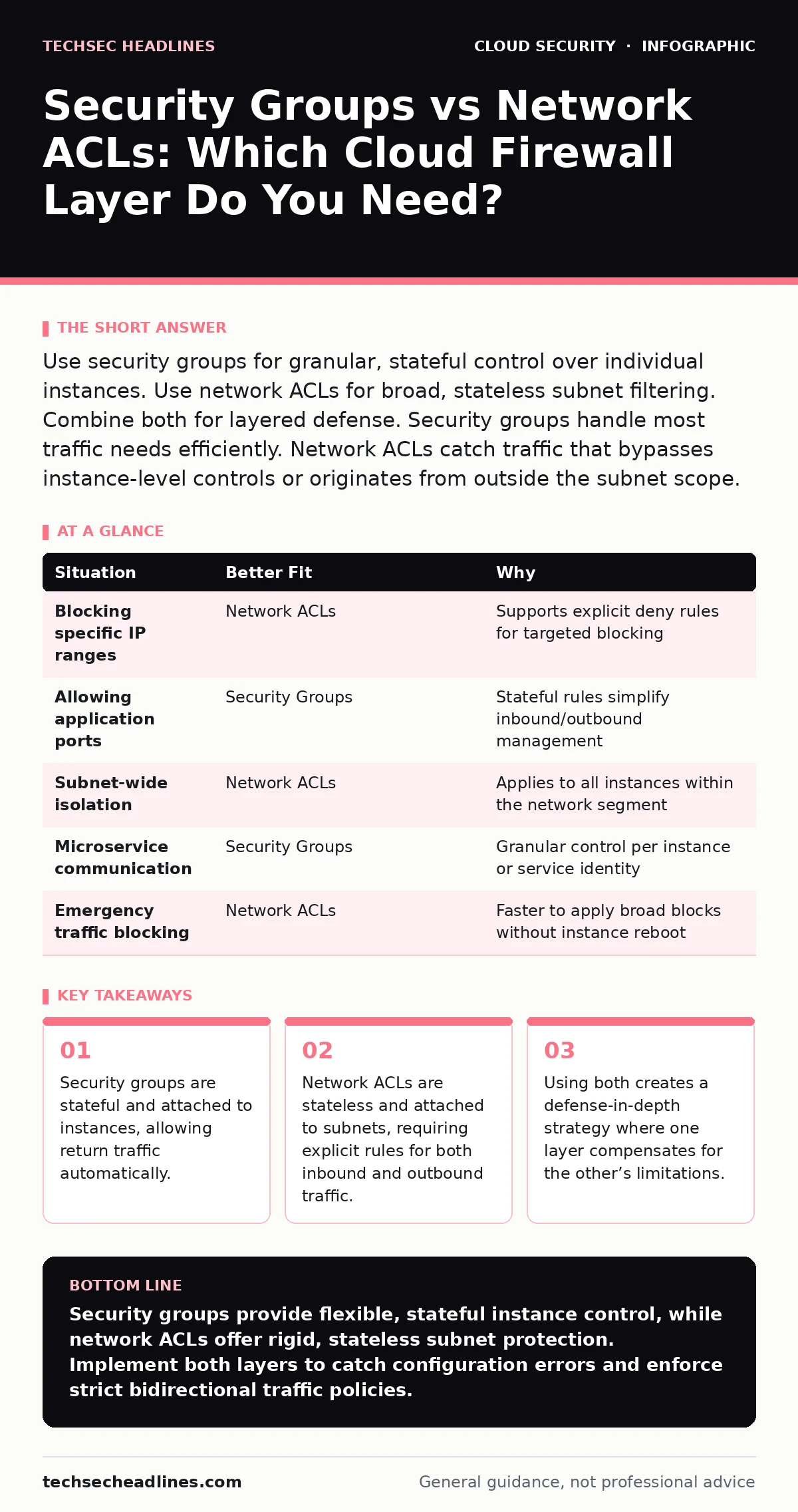
Use security groups for granular, stateful control over individual instances. Use network ACLs for broad, stateless subnet filtering. Combine both for layered defense. Security groups handle most traffic needs efficiently. Network ACLs catch traffic that bypasses instance-level controls or originates from outside the subnet scope.
Do You Need Instance-Level or Subnet-Level Control?
Security groups operate at the instance level, meaning they attach directly to virtual machines, containers, or other compute resources. You define rules for specific workloads regardless of their network location. Network ACLs operate at the subnet level, applying to all traffic entering or leaving that entire network segment. You choose based on whether you need fine-grained control for a single server or broad policies for a group of resources. Instance-level control suits microservices architectures where each component has unique access needs. Subnet-level control suits segregated environments where entire tiers share identical security requirements.
Should Traffic Rules Be Stateful or Stateless?
Security groups are stateful, which means they automatically allow return traffic for established connections. If you permit an inbound request, the response is allowed without a separate outbound rule. Network ACLs are stateless, treating each packet independently. You must explicitly define rules for both inbound and outbound traffic, even for simple request-response patterns. Stateless rules provide visibility into all traffic directions but require twice the configuration effort. Stateful rules reduce management overhead but can hide outbound data exfiltration if you only monitor inbound rules. Choose stateful for simplicity and stateless for strict bidirectional auditing.
How Complex Is Your Rule Management?
Security groups support allow rules only. You cannot create deny rules within a security group. This limitation forces you to whitelist every permitted connection, which simplifies auditing but complicates blocking specific threats. Network ACLs support both allow and deny rules. You can block specific IP ranges or protocols while allowing everything else. This flexibility makes network ACLs ideal for blocking known malicious sources at the subnet edge. However, managing deny rules requires careful ordering, as the first matching rule stops evaluation. Complex rule sets in network ACLs become difficult to troubleshoot compared to the straightforward allow-list model of security groups.
Which Layer Catches Misconfigured Applications?
Imagine an application developer accidentally opens a database port to the public internet. A security group misconfiguration might allow this traffic if the instance rule permits it. A network ACL can block this traffic at the subnet boundary, preventing the exposure entirely. Network ACLs act as a safety net for application-level mistakes. They protect against errors in security group configurations or application code that listens on unexpected ports. This layer is critical for cloud migration security, where legacy applications may have insecure defaults. Relying solely on security groups leaves you vulnerable to configuration drift and human error at the instance level.
| Situation | Better Fit | Why |
|---|---|---|
| Blocking specific IP ranges | Network ACLs | Supports explicit deny rules for targeted blocking |
| Allowing application ports | Security Groups | Stateful rules simplify inbound/outbound management |
| Subnet-wide isolation | Network ACLs | Applies to all instances within the network segment |
| Microservice communication | Security Groups | Granular control per instance or service identity |
| Emergency traffic blocking | Network ACLs | Faster to apply broad blocks without instance reboot |
When Do You Use Both Layers?
Using both security groups and network ACLs creates a defense-in-depth strategy. Security groups handle the majority of traffic filtering with minimal configuration. Network ACLs provide a secondary layer for broad subnet policies and emergency blocking. This combination ensures that a misconfiguration in one layer does not compromise the entire environment.
You should always restrict security groups to the least privilege necessary. Then, use network ACLs to enforce organizational policies, such as blocking traffic from untrusted regions or enforcing strict outbound controls. This approach aligns with cloud guardrails that enforce consistent security standards across multiple teams.
See also: Data Residency Laws: How to Keep Data in the Right Jurisdiction · What Does DevSecOps Stand For: Practical Security in Code
How Do You Avoid Common Configuration Mistakes?
A common mistake is assuming network ACLs provide stateful filtering. You must remember to add outbound rules for every inbound rule you create. Another error is using security groups as the only control for sensitive data. Always verify that network ACLs block unnecessary outbound traffic to prevent data exfiltration. Regularly audit both layers to ensure rules remain valid as your infrastructure grows.
Check for open security groups that allow unrestricted access from any IP address. Review exposed storage buckets to ensure they are not accessible through misconfigured network paths. Combining these checks with DevSecOps practices ensures security rules are validated before deployment.
Key takeaways
- Security groups are stateful and attached to instances, allowing return traffic automatically.
- Network ACLs are stateless and attached to subnets, requiring explicit rules for both inbound and outbound traffic.
- Using both creates a defense-in-depth strategy where one layer compensates for the other’s limitations.
Security groups provide flexible, stateful instance control, while network ACLs offer rigid, stateless subnet protection. Implement both layers to catch configuration errors and enforce strict bidirectional traffic policies.
Frequently asked questions
Can I use network ACLs to replace security groups?
No, network ACLs lack stateful tracking and instance-level granularity. They are too broad for fine-grained application control and require manual outbound rule management.
Do network ACLs inspect packet contents?
No, both security groups and network ACLs operate at the network layer. They filter based on IP addresses, ports
How this guide was produced: written by the TechSec Headlines editorial team with AI assistance, checked against the public references listed below, and reviewed when the facts change. See our editorial policy or report an error.