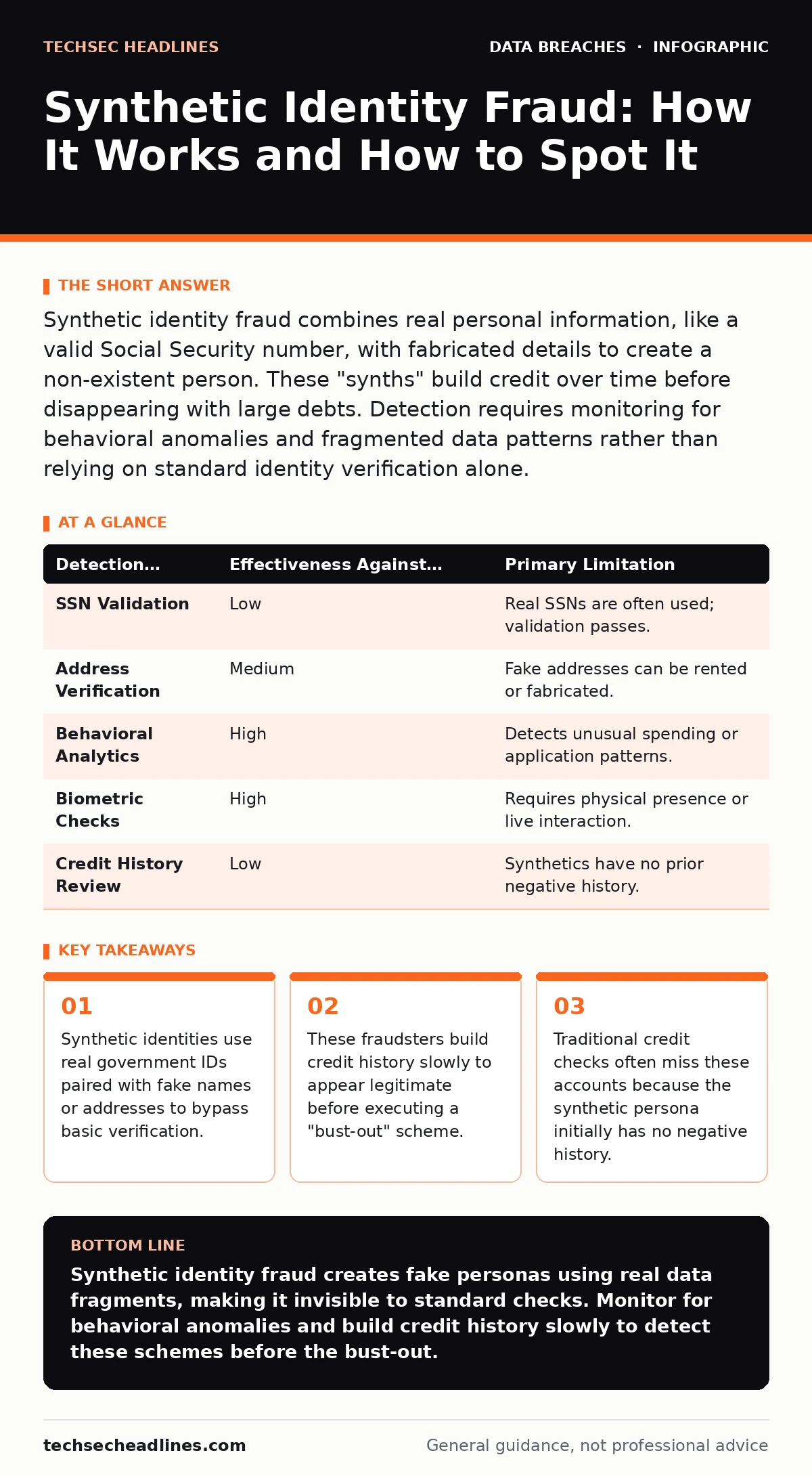
Synthetic identity fraud combines real personal information, like a valid Social Security number, with fabricated details to create a non-existent person. These "synths" build credit over time before disappearing with large debts. Detection requires monitoring for behavioral anomalies and fragmented data patterns rather than relying on standard identity verification alone.
What is synthetic identity fraud?
Synthetic identity fraud occurs when criminals combine real and fabricated information to create a persona that does not exist in reality. Unlike stolen identity theft, which targets a specific living person, this method creates a new entity from scratch. The fraudster might use a real Social Security number belonging to a child or an inactive account, but attach a completely different name and address. This hybrid identity allows the criminal to operate without immediately alerting the victim whose real data was partially used.
How do criminals build these fake identities?
Fraudsters gather real data from breaches or dark web markets, then pair it with invented details like a fake name, phone number, and address. They start small by applying for low-limit credit cards or prepaid accounts to establish a digital footprint. Over months or years, they make small payments to build a positive credit history. This patient approach creates a "warm" identity that looks legitimate to automated underwriting systems. The goal is to make the synthetic person appear financially responsible before the final theft.
Why is it harder to detect than stolen identity?
Traditional fraud detection relies on spotting negative signals, such as a sudden large purchase on a known account. Synthetic identities have no prior negative history because they are new to the credit system. They often appear as pristine, low-risk customers until the moment they default. Furthermore, because the real data component (like a Social Security number) may belong to someone who never applied for credit, there is no existing financial profile to contradict the new application. This lack of conflict makes the synthetic identity invisible to standard matching algorithms.
What is the "bust-out" phase?
The bust-out is the final stage where the criminal extracts maximum value from the synthetic identity. After establishing sufficient credit limits and a history of on-time payments, the fraudster applies for high-value goods, large loans, or premium services. They then immediately default on all obligations, leaving the financial institution with uncollectible debt. The synthetic identity is then abandoned, and the criminal moves on to build another persona. This sudden shift from good standing to total default is the primary indicator of the scheme.
How does this differ from tax identity theft?
Tax identity theft involves using a real person’s data to file a false tax return and steal their refund. Synthetic identity fraud uses fragmented data to create a new persona for financial gain, not to intercept government payments. While both involve identity misuse, the mechanisms and targets differ significantly. Tax fraud relies on timing and government processing windows, whereas synthetic fraud relies on long-term credit building. Understanding the difference helps you recognize that protecting against one does not automatically protect against the other. See our guide on tax identity theft for specific safeguards on that front.
What role does AI play in detection?
Artificial intelligence helps detect synthetic identities by analyzing behavioral patterns rather than just static data points. Machine learning models can spot anomalies, such as an address that appears in multiple unrelated credit applications or a phone number linked to numerous new accounts. These systems evaluate the consistency of the entire application profile against global data sets. However, AI is only as good as the data it is trained on. If the training data lacks examples of sophisticated synthetic fraud, the model may miss novel attack patterns. Proper AI vendor assessments are necessary to ensure the tools actually detect these specific threats.
Why do standard KYC checks fail?
Know Your Customer (KYC) checks typically verify that a person matches a government-issued ID. If a criminal uses a real Social Security number and a fabricated but plausible name, basic KYC may pass. The system confirms the ID exists, not that the person presenting it is the true owner. Without additional biometric verification or deep historical analysis, the synthetic persona slips through. This is why relying solely on document verification is insufficient for high-risk accounts. You must layer these checks with behavioral analysis and device fingerprinting.
How can organizations improve their defenses?
Organizations must move beyond static data matching to dynamic behavioral monitoring. This includes tracking how an account is used over time, not just how it was opened. Look for inconsistencies between stated income and spending patterns, or rapid changes in contact information. Implementing multi-factor authentication that binds the identity to a specific device can also help. However, no single measure stops all fraud. A layered approach that combines data verification, behavioral analytics, and human review provides the best defense. For related security practices, consider reviewing cloud guardrails and access key rotation protocols.
| Detection Method | Effectiveness Against Synthetics | Primary Limitation |
|---|---|---|
| SSN Validation | Low | Real SSNs are often used; validation passes. |
| Address Verification | Medium | Fake addresses can be rented or fabricated. |
| Behavioral Analytics | High | Detects unusual spending or application patterns. |
| Biometric Checks | High | Requires physical presence or live interaction. |
| Credit History Review | Low | Synthetics have no prior negative history. |
What is the hidden cost of false positives?
Aggressive fraud detection can block legitimate customers, leading to lost revenue and damaged trust. If your system flags a young person with a thin credit file as synthetic, you may deny them a necessary financial product. Balancing security with customer experience is difficult. Over-tightening controls increases operational costs for manual reviews. You must tune your detection thresholds to minimize friction for genuine users while catching sophisticated fraud. This trade-off requires continuous adjustment and careful analysis of your specific customer base.
Can this happen to individuals?
Yes, though the impact is often delayed. If your Social Security number is used in a synthetic identity, you may not notice until you apply for credit and are denied. The fraudster’s activity creates a messy credit report that does not match your actual financial behavior. You must dispute the fraudulent accounts with credit bureaus, a process that can take months. Regularly reviewing your credit reports is the best way to catch this early. Be aware that this is distinct from SIM swap fraud, which targets account takeover rather than identity creation.
Key takeaways
- Synthetic identities use real government IDs paired with fake names or addresses to bypass basic verification.
- These fraudsters build credit history slowly to appear legitimate before executing a "bust-out" scheme.
- Traditional credit checks often miss these accounts because the synthetic persona initially has no negative history.
Synthetic identity fraud creates fake personas using real data fragments, making it invisible to standard checks. Monitor for behavioral anomalies and build credit history slowly to detect these schemes before the bust-out.
Frequently asked questions
How long does it take to build a synthetic identity?
It typically takes six months to two years to establish enough credit history to pass automated underwriting systems.
Can I remove a synthetic identity from my credit report?
Yes, you must dispute the fraudulent accounts with the credit bureaus and provide evidence that you did not open them.
Does having a credit freeze stop this?
A credit freeze prevents new accounts from being opened, but it does not stop criminals from using your data to build an identity elsewhere.
What is the difference between a synth and a mule?
A synthetic identity is a fake person created by fraudsters. A money mule is a real person used to launder money, often unknowingly.
How this guide was produced: written by the TechSec Headlines editorial team with AI assistance, checked against the public references listed below, and reviewed when the facts change. See our editorial policy or report an error.