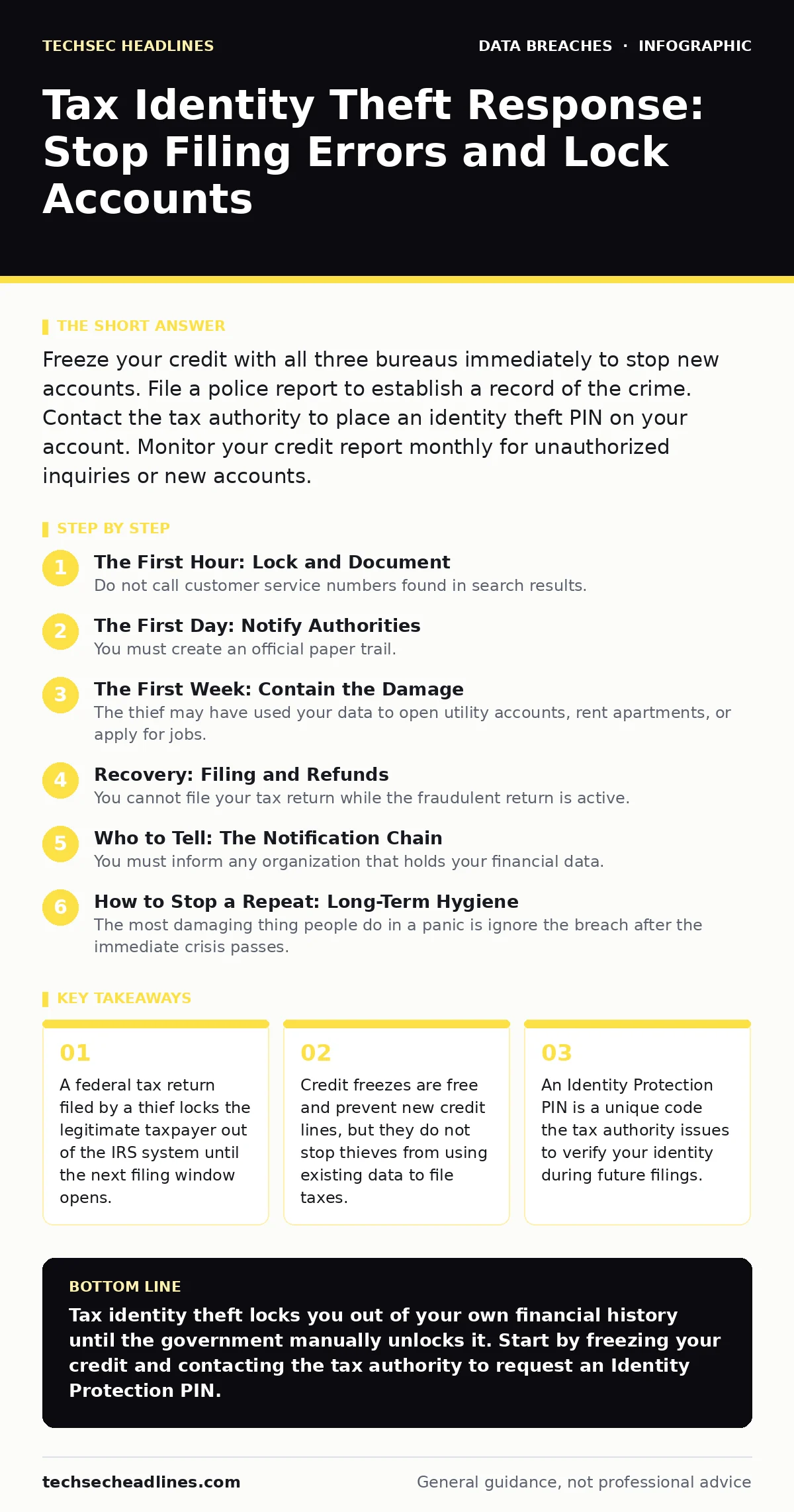
Freeze your credit with all three bureaus immediately to stop new accounts. File a police report to establish a record of the crime. Contact the tax authority to place an identity theft PIN on your account. Monitor your credit report monthly for unauthorized inquiries or new accounts.
The First Hour: Lock and Document
Imagine you receive a notice that your tax return was rejected because another return was already filed using your Social Security number. This is not a glitch. It is a confirmed compromise. Your first goal is to prevent the thief from opening new credit lines or draining existing ones.
- Freeze your credit. Contact Equifax, Experian, and TransUnion. A credit freeze, also known as a security freeze, prevents creditors from accessing your credit report. Without access, they cannot approve new accounts. This is free by federal law.
- Place a fraud alert. If you cannot freeze immediately, place an initial fraud alert. This lasts one year and forces creditors to verify your identity before issuing new credit.
- Secure your email. Thieves often use compromised email to reset passwords for financial accounts. Change your email password and enable multi-factor authentication. Use an authenticator app, not SMS, to avoid SIM swap fraud.
- Freeze credit with all three major bureaus
- Enable multi-factor authentication on primary email
- Save the confirmation numbers from each bureau
The First Day: Notify Authorities
You must create an official paper trail. Without a police report, financial institutions and government agencies may treat your claims as disputes rather than crimes. This delays refunds and complicates account recovery.
Contact your local police department. File a report for identity theft. Provide them with the details you have: the date you discovered the breach, any suspicious notices, and your personal information. Get a copy of the report or the report number.
Next, contact the tax authority. In the United States, this is the IRS. Call the identity theft hotline. Be prepared to wait on hold. Have your personal information ready. Explain that you discovered a fraudulent return. Ask them to place an Identity Protection PIN on your account. This is a six-digit code you must include when filing your legitimate return. It proves you are the account owner.
The First Week: Contain the Damage
The thief may have used your data to open utility accounts, rent apartments, or apply for jobs. These actions do not always show up on a standard credit report. You need to look beyond the big three bureaus.
Look for inquiries you do not recognize. An inquiry occurs when a lender checks your credit. Even a soft inquiry from a company you never contacted is a red flag. Dispute any unauthorized inquiries immediately.
Check your bank statements and credit card balances. Look for small test transactions. Thieves often test cards with small purchases before making large withdrawals. If you see unauthorized activity, close the account and request a new number. Do not just change the PIN. The old card is compromised.
If you have a digital footprint of the breach, consider how it happened. Was it a phishing email? A data leak from a company you use? Understanding the entry point helps you stop the next attempt. For example, if your credentials were stolen from a public file share exposure, changing that one password is not enough. You must rotate access keys for any service that used those credentials.
Recovery: Filing and Refunds
You cannot file your tax return while the fraudulent return is active. The tax authority’s system will reject your filing with an error message stating that a return was already processed. This is a hard lock. You must wait for the tax authority to resolve the duplicate.
This process can take months. During this time, you may lose access to your tax transcripts. Transcripts are detailed records of your tax filings. Some lenders and landlords require these for verification. If you are denied credit or housing because of this lock, provide them with your police report and the IRS Identity Theft Report form.
Once the tax authority clears the fraudulent return, you can file your legitimate return. Include the Identity Protection PIN if you obtained one. If you are owed a refund, expect a delay. The agency will review your return more closely to ensure no further fraud has occurred. This is called a "soft" hold. It is not a penalty. It is a verification step.
Who to Tell: The Notification Chain
You must inform any organization that holds your financial data. This is not just about banks. It includes any service that uses your Social Security number or date of birth for verification.
- Banks and Credit Unions: Alert them to potential fraud. Ask them to monitor for unusual activity. Some institutions offer fraud protection services that alert you to specific triggers, like a change of address.
- Employers: Your employer reports your income to the tax authority using your Social Security number. If the thief files a return claiming excessive deductions, it may trigger an audit. Inform your HR department. They can provide pay stubs and W-2 forms to prove your income.
- Medical Providers: Tax identity theft often comes with medical identity theft. Thieves use your insurance information to bill for services you did not receive. Check your Explanation of Benefits (EOB) statements. If you see services you did not receive, contact the provider and your insurer.
See also: Stop Public File Share Exposure: 7 Mistakes That Leak Data
How to Stop a Repeat: Long-Term Hygiene
The most damaging thing people do in a panic is ignore the breach after the immediate crisis passes. They reset their passwords and move on. The thief still has your data. They will try again.
You must change your security posture. Use a password manager to generate unique, complex passwords for every account. Reusing passwords is the easiest way for thieves to move from one compromised site to another. If one site suffers a data breach, your accounts on other sites are at risk.
Consider a credit monitoring service. These services alert you to changes in your credit file or if your personal information appears on the dark web. While they do not prevent theft, they provide early warning. Early warning gives you time to freeze your credit before the thief opens an account.
Finally, review your privacy settings. Limit the amount of personal information you share on social media. Thieves use this information to answer security questions. If your mother’s maiden name is in your childhood photos, it is not a secret. Use a password manager to store fake answers for security questions.
Understanding the Mechanism
Tax identity theft works because the tax system relies on a single identifier: your Social Security number. Unlike banking, which uses multiple factors, the tax system often accepts a return based on this number and basic demographic data. This makes it a low-hurdle target for criminals.
The thief does not need your bank account number to steal your refund. They need your name, Social Security number, and date of birth. They file a return claiming a refund to a bank account they control. The tax authority processes it because the data matches. By the time you try to file, the system rejects you.
This is why credit freezes are not enough. A freeze stops new credit, but it does not stop someone from using your existing data to file a tax return. You need both a freeze and an Identity Protection PIN. The freeze protects your future credit. The PIN protects your past and present tax data.
Key takeaways
- A federal tax return filed by a thief locks the legitimate taxpayer out of the IRS system until the next filing window opens.
- Credit freezes are free and prevent new credit lines, but they do not stop thieves from using existing data to file taxes.
- An Identity Protection PIN is a unique code the tax authority issues to verify your identity during future filings.
Tax identity theft locks you out of your own financial history until the government manually unlocks it. Start by freezing your credit and contacting the tax authority to request an Identity Protection PIN.
Frequently asked questions
Can I file my taxes online if my identity is stolen?
No, the system will reject your filing if a fraudulent return was already processed. You must wait for the tax authority to clear the duplicate and may need to file by mail with your Identity Protection PIN.
How long does it take to resolve tax identity theft?
Resolution times vary, but it often takes several months. The tax authority must investigate the fraudulent return, close the case, and then allow you to file your legitimate return.
Is an Identity Protection PIN mandatory?
No, but it is highly recommended for victims. It is a unique code that verifies your identity when you file, preventing others from filing under your name.
Does credit monitoring prevent tax identity theft?
No, credit monitoring alerts you to changes in your credit file. It does not prevent thieves from using your Social Security number to file taxes. You need a credit freeze and an IRS PIN for full protection.
How this guide was produced: written by the TechSec Headlines editorial team with AI assistance, checked against the public references listed below, and reviewed when the facts change. See our editorial policy or report an error.