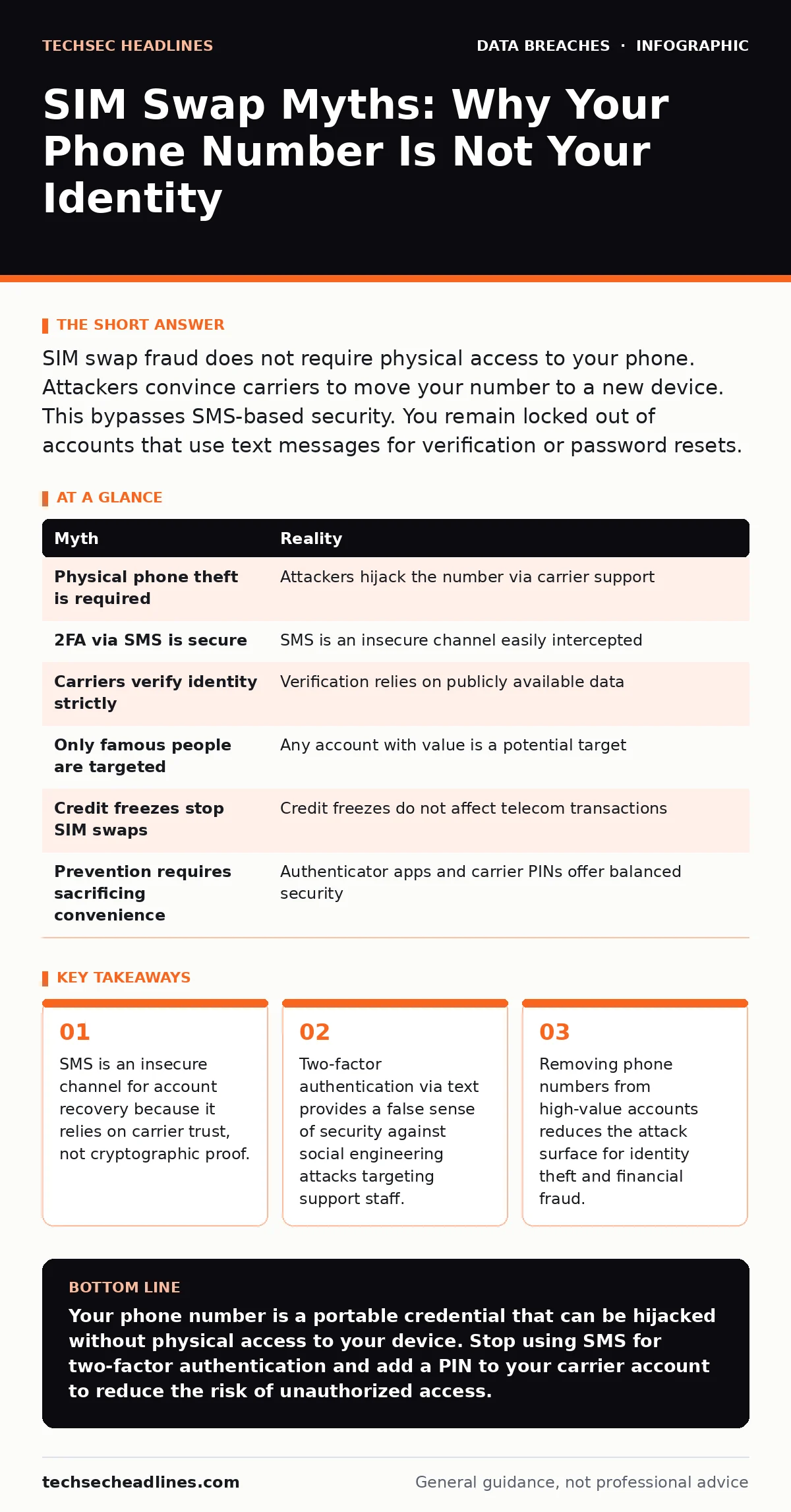
SIM swap fraud does not require physical access to your phone. Attackers convince carriers to move your number to a new device. This bypasses SMS-based security. You remain locked out of accounts that use text messages for verification or password resets.
Myth: I Need My Phone Stolen to Lose Access
Reality: Physical possession of your device is irrelevant to this attack. The fraud targets the relationship between you and your mobile carrier, not the hardware in your pocket. Attackers gather personal data from public sources to impersonate you when calling customer support. They convince an agent that they are the account holder and request a SIM swap.
This process moves your phone number to a new SIM card in a device controlled by the attacker. Your original phone loses signal because the network now routes calls and texts to the new device. You are locked out of your communications channel without ever losing your physical phone. This vulnerability exists because carriers prioritize customer convenience over strict identity verification.
Myth: Two-Factor Authentication Protects Me Completely
Reality: Two-factor authentication adds a layer of security, but the method matters. If you use SMS codes as your second factor, you are using the very channel the attacker has hijacked. The attacker receives the verification code on their device, bypassing your password entirely. This turns a security feature into a backdoor.
True two-factor authentication requires an app that generates time-based one-time passwords or a hardware security key. These methods do not rely on the mobile network to deliver credentials. They remain secure even if your phone number is ported to another provider. Relying on SMS for high-value accounts creates a single point of failure that social engineering can exploit.
Myth: Carriers Verify Identity Rigorously Before Swapping SIMs
Reality: Carrier support agents are trained to resolve issues quickly, not to conduct forensic identity checks. Many verification questions have answers available in public records or through data breaches. A mother’s maiden name, a previous address, or a date of birth can often be found online. Agents may ask for the last four digits of your account number, which can be guessed or found on old bills.
Some carriers allow SIM swaps with minimal verification if the caller claims their phone was lost. This frictionless process benefits legitimate customers who need quick replacements but leaves the door open for fraud. The system assumes the caller is who they claim to be, which is a dangerous assumption in an era of abundant personal data.
Myth: Only High-Profile Targets Are at Risk
Reality: Attackers often use automated tools to scan for accounts with weak security before targeting them. You do not need to be a celebrity or executive to be a victim. Anyone with a bank account, cryptocurrency wallet, or social media presence is a potential target. The goal is often financial gain through password resets on banking or trading platforms.
Attackers may also use your account to spread spam or conduct further fraud against your contacts. The cost of attempting a SIM swap is low compared to the potential payout. This makes it a scalable attack method. Your digital footprint, not your public profile, determines your risk level. If you have linked your phone number to financial services, you are in the crosshairs.
Myth: Freezing My Credit Stops SIM Swaps
Reality: Credit freezes protect your financial identity from new account openings, but they do not secure your mobile service. A SIM swap is a telecommunications transaction, not a credit application. Carriers do not check credit bureaus when processing a SIM replacement. They check internal records and rely on self-reported identity details.
Freezing your credit is a vital step for preventing synthetic identity fraud, but it does not stop an attacker from porting your phone number. You need separate protections for your mobile account. These include PINs on your carrier account and avoiding SMS for sensitive verifications. Treating your phone number as a financial credential requires different safeguards than treating it as a communication tool.
See also: Mobile App Permission Abuse: How Apps Steal Data Beyond Your Consent
Myth: I Can’t Prevent It Without Losing Convenience
Reality: You can maintain convenience while significantly reducing risk by changing how you authenticate. Moving to an authenticator app eliminates the need for SMS codes without requiring you to carry extra hardware. These apps generate codes locally on your device, independent of the mobile network. You can also set a specific PIN with your carrier that must be provided before any account changes are made.
This adds a barrier that social engineering cannot easily bypass. While no measure is perfect, these steps raise the effort required for an attacker. The trade-off is a slight increase in setup complexity for a major reduction in vulnerability. This approach balances security with the practical need to access your accounts.
| Myth | Reality |
|---|---|
| Physical phone theft is required | Attackers hijack the number via carrier support |
| 2FA via SMS is secure | SMS is an insecure channel easily intercepted |
| Carriers verify identity strictly | Verification relies on publicly available data |
| Only famous people are targeted | Any account with value is a potential target |
| Credit freezes stop SIM swaps | Credit freezes do not affect telecom transactions |
| Prevention requires sacrificing convenience | Authenticator apps and carrier PINs offer balanced security |
Myth: Once Swapped, I Am Permanently Locked Out
Reality: SIM swaps are reversible, but the window for damage is short. As soon as you notice your phone has lost signal, contact your carrier. Explain that you suspect a fraudulent SIM swap. They can deactivate the new SIM and restore service to your original device. However, attackers often move quickly to reset passwords and transfer funds.
The race is between you and the attacker. Having backup access methods for critical accounts allows you to regain control even if your phone is offline. Informing your bank and financial institutions immediately can help freeze transactions. The key is rapid detection and response. Waiting for the carrier to notice the issue on their own is not a viable strategy.
Key takeaways
- SMS is an insecure channel for account recovery because it relies on carrier trust, not cryptographic proof.
- Two-factor authentication via text provides a false sense of security against social engineering attacks targeting support staff.
- Removing phone numbers from high-value accounts reduces the attack surface for identity theft and financial fraud.
Your phone number is a portable credential that can be hijacked without physical access to your device. Stop using SMS for two-factor authentication and add a PIN to your carrier account to reduce the risk of unauthorized access.
Frequently asked questions
How do I know if my SIM has been swapped?
Your phone will lose all cellular service and Wi-Fi calling may stop working. You will not receive calls or texts, and your device will likely show "No Service" or "Emergency Calls Only" despite being in a coverage area.
Can I use the same authenticator app for all my accounts?
Yes, most authenticator apps support multiple accounts. You can scan different QR codes for each service and manage them within a single application. Ensure you back up the app’s configuration securely.
What should I do if I suspect a swap is in progress?
Immediately try to call your carrier from a different phone. If you cannot reach them, contact your bank and other critical accounts to alert them of potential unauthorized access. Change passwords on any account that allows non-SMS recovery.
Does switching to a new carrier prevent this?
No, the risk exists with any carrier that offers SIM swap services. The vulnerability lies in the verification process, not the provider. Apply the same security measures regardless of which carrier you use.
How this guide was produced: written by the TechSec Headlines editorial team with AI assistance, checked against the public references listed below, and reviewed when the facts change. See our editorial policy or report an error.