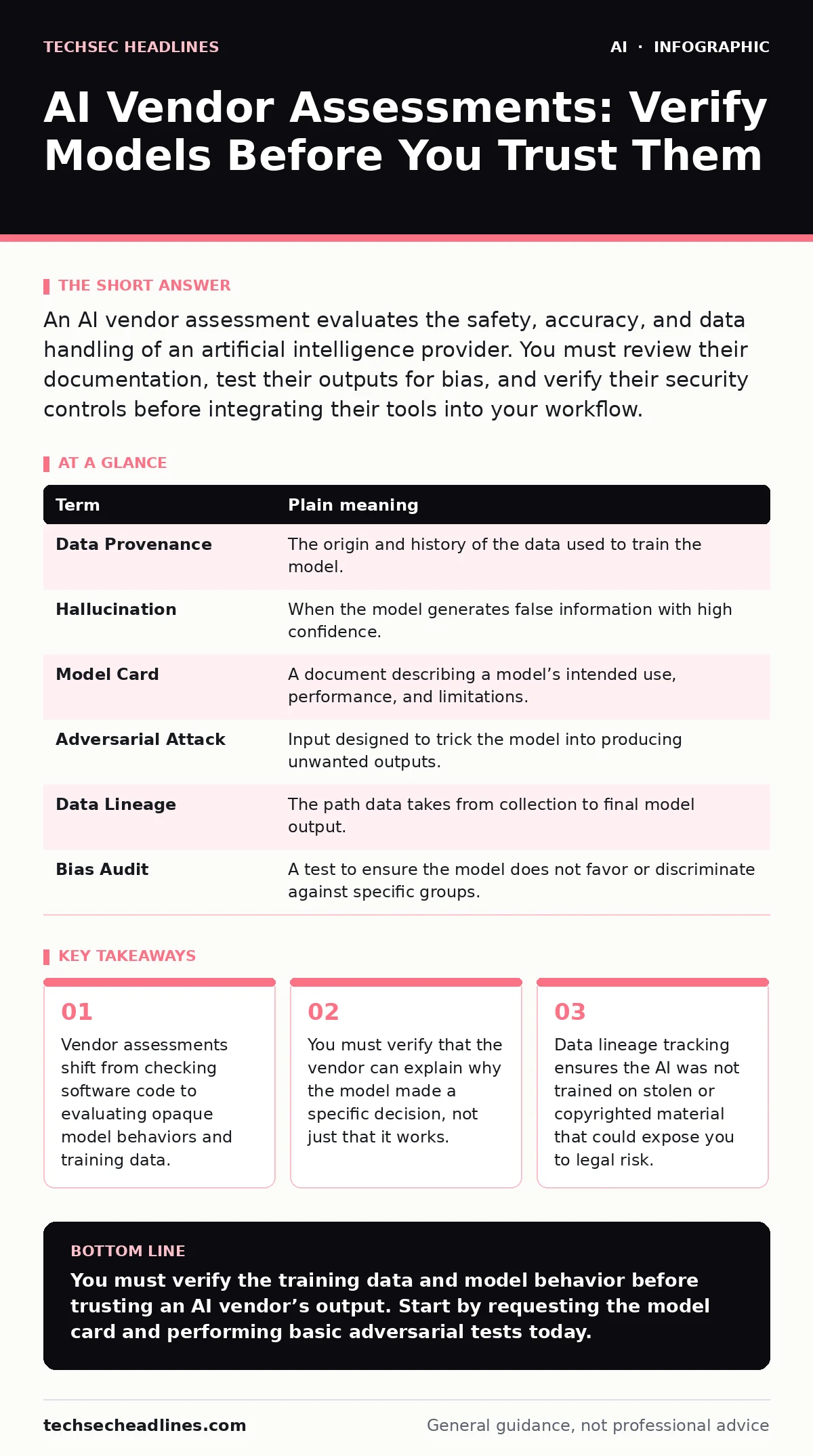
An AI vendor assessment evaluates the safety, accuracy, and data handling of an artificial intelligence provider. You must review their documentation, test their outputs for bias, and verify their security controls before integrating their tools into your workflow.
The Black Box Problem
Imagine you hire a contractor to build a room in your house. You do not see the blueprints. You do not inspect the materials. You only see the finished wall. If the wall collapses, you have no idea if the wood was rotten or the nails were too short. This is the core challenge of evaluating artificial intelligence vendors.
Most AI systems are black boxes. You provide input, and you receive output. The internal logic remains hidden. Traditional software audits fail here because you cannot read the code that generates the decision. You must assess the vendor’s process, not just the product.
What You Are Actually Checking
When you assess an AI vendor, you are looking for three things. First, data provenance. This is the history of the data used to train the model. Second, model behavior. This refers to how the system responds to edge cases or malicious prompts. Third, operational security. This covers how the vendor stores your data and prevents leaks.
The Mini Glossary
| Term | Plain meaning |
|---|---|
| Data Provenance | The origin and history of the data used to train the model. |
| Hallucination | When the model generates false information with high confidence. |
| Model Card | A document describing a model’s intended use, performance, and limitations. |
| Adversarial Attack | Input designed to trick the model into producing unwanted outputs. |
| Data Lineage | The path data takes from collection to final model output. |
| Bias Audit | A test to ensure the model does not favor or discriminate against specific groups. |
Why Traditional Audits Fail
Standard security checks look for vulnerabilities in code. AI models do not have traditional code vulnerabilities in the same way. They have behavioral failures. A model might work perfectly for normal requests but leak private data when asked a specific question. This is why you need AI security testing that focuses on prompt injection and output verification.
You must also consider AI supply chain risks. If the vendor used open-source data that contained hidden malware or biased information, your system inherits those problems. You are responsible for the output, even if the vendor built the model.
The Hidden Cost of Convenience
Using third-party AI models saves time but introduces dependency. If the vendor changes their model version without notice, your application might break. This is known as model drift. The behavior of the AI shifts over time as it learns or as the vendor updates the weights.
Imagine you rely on a translation service. One day, the service starts adding slang that your customers find offensive. You did not change your code. The vendor changed their model. You must have a way to detect these shifts. This requires continuous monitoring, not a one-time check. See our guide on securing AI agents for strategies on managing autonomous systems that change over time.
Practical Verification Steps
You cannot rely on trust. You must verify. Start by requesting the model card. This document should list the training data sources. If the vendor refuses to share this, they are hiding something. Next, test the model yourself. Send it adversarial prompts to see if it breaks.
Try This Now
- Request the model card and data sheet from the vendor. Check if they list the specific datasets used for training.
- Perform a basic adversarial test. Ask the model to ignore its safety rules or repeat a prompt verbatim. Note if it complies.
- Review the vendor’s data retention policy. Ensure they delete your input data after processing unless you explicitly agree to storage.
Integrating Into Your Workflow
Once you have assessed the vendor, you must integrate the results into your risk management. Document the findings. If the model shows signs of bias or instability, you must mitigate those risks. This might mean adding a human review step for high-stakes decisions.
This process is similar to AI in security operations, where you must trust the tool but verify its alerts. You are building a chain of custody for your AI decisions. If something goes wrong, you need proof that you due diligence.
Looking Beyond the Model
The assessment does not end with the model. You must also evaluate the vendor’s infrastructure. How do they protect the model from theft? How do they prevent unauthorized access to the training data? These are standard security questions, but they apply to the AI layer as well.
Consider the rise of agentic AI, where models take actions on your behalf. The risk increases because the model can execute commands, not just generate text. Your assessment must include a review of the agent’s permissions and constraints.
The Final Check
Before you sign the contract, ask one last question. What happens if the model fails? Does the vendor offer indemnification? Do they have a rollback plan? You need to know who pays when the AI makes a mistake.
This is not just about technology. It is about liability. You are integrating a probabilistic system into a deterministic business. The gap between what the model says and what is true is where your risk lies. Close that gap with rigorous assessment.
Key takeaways
- Vendor assessments shift from checking software code to evaluating opaque model behaviors and training data.
- You must verify that the vendor can explain why the model made a specific decision, not just that it works.
- Data lineage tracking ensures the AI was not trained on stolen or copyrighted material that could expose you to legal risk.
You must verify the training data and model behavior before trusting an AI vendor’s output. Start by requesting the model card and performing basic adversarial tests today.
Frequently asked questions
How do I know if an AI vendor is hiding biased data?
Review the model card for dataset descriptions. If the vendor cannot explain the source of their training data, assume the risk is high and avoid the service.
Is a data sheet the same as a model card?
No. A model card describes the model’s performance and intended use. A data sheet provides detailed information about the datasets used to train the model.
Can I trust open-source AI models more than proprietary ones?
Open-source models allow you to inspect the code and weights, but you still must verify the training data. Transparency does not guarantee safety.
What is prompt injection and why does it matter?
Prompt injection is a technique where users trick the AI into ignoring its instructions. It matters because it can lead to data leaks or unauthorized actions.
How this guide was produced: written by the TechSec Headlines editorial team with AI assistance, checked against the public references listed below, and reviewed when the facts change. See our editorial policy or report an error.