
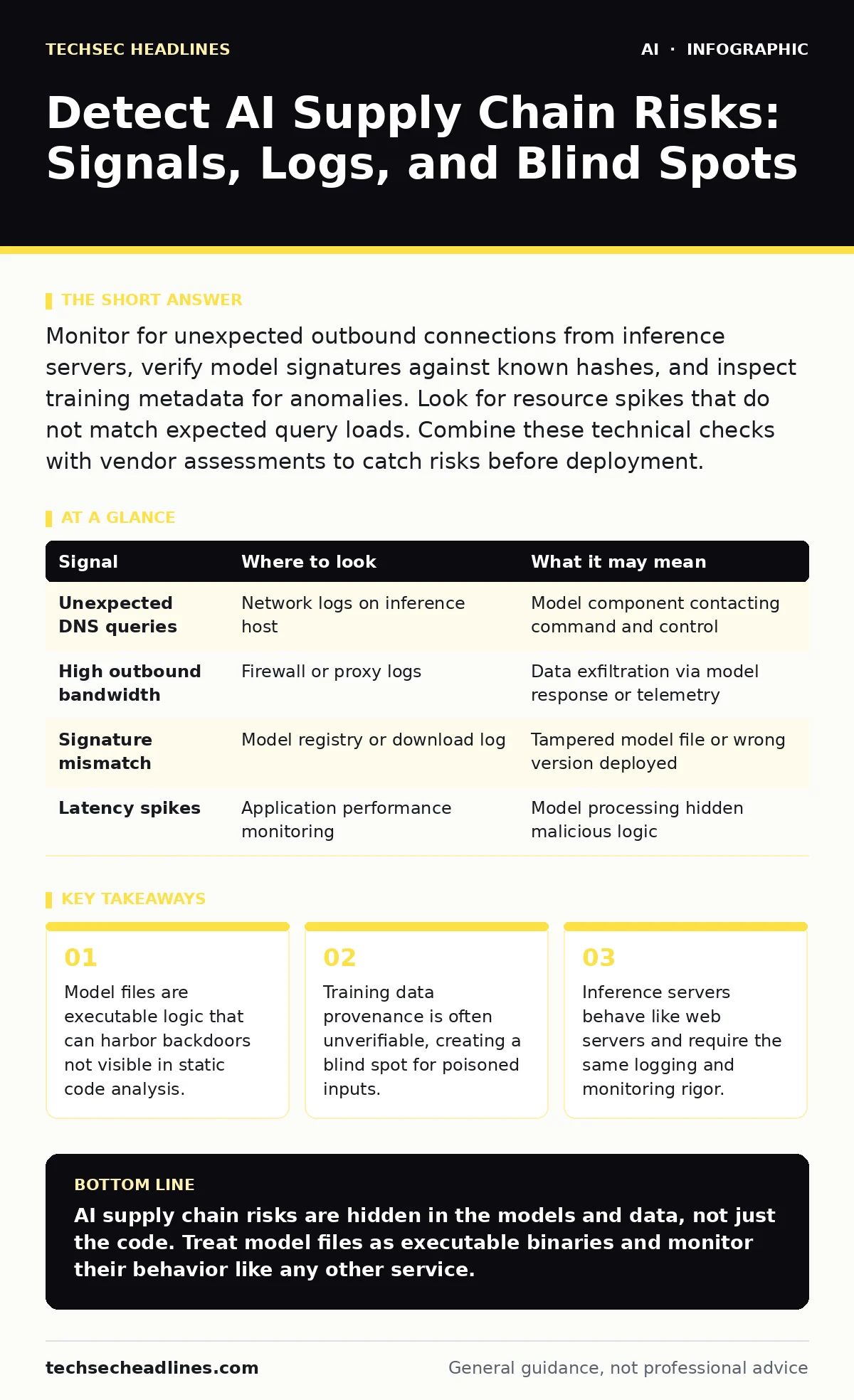
Monitor for unexpected outbound connections from inference servers, verify model signatures against known hashes, and inspect training metadata for anomalies. Look for resource spikes that do not match expected query loads. Combine these technical checks with vendor assessments to catch risks before deployment.
Model Integrity and Signature Verification
When you download a pre-trained model, you are importing a compiled artifact. Unlike source code, you cannot easily read the logic inside a neural network. This opacity creates a trust problem. If the source is compromised, the model itself becomes a vector for attack.
You must treat model weights like software binaries. Verify the cryptographic signature of every file you pull from a registry. If the signature does not match the publisher’s key, reject the file. Many teams skip this step because they trust the public repository. That trust is misplaced.
This could indicate a backdoor. A backdoor is a hidden trigger that causes the model to behave differently when a specific input pattern is present. Without signature verification, you have no proof of origin.
Inference Server Network Traffic
Inference servers run the model and answer queries. They often need to connect to external services for telemetry, updates, or additional data. This connectivity is a risk. If an attacker compromises the model, the server might exfiltrate sensitive data.
Monitor outbound traffic from your inference endpoints. Look for connections to unfamiliar domains or IP addresses. Standard web application firewalls may not inspect traffic to AI-specific ports or protocols. You need dedicated network monitoring for these services.
Check for data leaks in the logs. If the server sends more data out than it receives in queries, investigate. Normal inference returns a prediction, not a copy of the input. Large outbound payloads suggest the model or its wrapper is sending data elsewhere.
| Signal | Where to look | What it may mean |
|---|---|---|
| Unexpected DNS queries | Network logs on inference host | Model component contacting command and control |
| High outbound bandwidth | Firewall or proxy logs | Data exfiltration via model response or telemetry |
| Signature mismatch | Model registry or download log | Tampered model file or wrong version deployed |
| Latency spikes | Application performance monitoring | Model processing hidden malicious logic |
Training Data Provenance
The data used to train a model shapes its behavior. If that data contains poisoned samples, the model will learn incorrect associations. This is known as data poisoning. It is hard to detect after training because the model’s weights look normal.
You cannot always verify the training data. Many public datasets are aggregates of web content. You must assess the risk based on the source. If you use a commercial model, ask for the data lineage. If the vendor cannot provide it, assume the data is unverified.
For custom models, maintain a strict chain of custody. Log every dataset used. Hash the data files before training. If a hash changes later, you know the data was altered. This prevents accidental or malicious injection of bad samples during the training phase.
Resource Usage Anomalies
Models consume compute resources. A compromised model might use more memory or CPU than expected. This happens if the attacker injects code that runs alongside the inference logic.
Monitor resource usage over time. Establish a baseline for normal queries. If a simple query consumes disproportionate resources, flag it. This could indicate a model inversion attack. In this attack, an input is crafted to force the model to reveal sensitive training data.
Also watch for memory leaks. If memory usage grows steadily without release, the model or its container may be unstable. This is not always malicious, but it indicates a flaw that could be exploited. Restarting the service hides the symptom but not the cause.
Dependency and Library Risks
AI models rely on complex software stacks. Libraries for tensor operations, data processing, and deployment are common targets. These libraries often have their own dependencies. A vulnerability in a deep dependency can compromise the entire model.
Scan your AI dependencies for known vulnerabilities. Use software composition analysis tools. These tools map your dependencies and check them against vulnerability databases. Do not rely on manual checks. The supply chain is too deep.
Imagine a library update that introduces a subtle bug. It might not break the model immediately. It could only trigger under specific conditions. Regular scanning helps catch these issues before they reach production. Keep your dependencies updated, but verify updates before applying them.
Blind Spots in Detection
Standard security tools often miss AI-specific risks. They look for known malware signatures or suspicious network patterns. AI attacks are often novel. They do not match existing signatures.
One blind spot is the model itself. Antivirus scans check files for known bad patterns. They do not understand neural network weights. A malicious model will pass antivirus checks. You need specialized tools that analyze model behavior.
Another blind spot is the prompt. Attackers can use prompt injection to trick the model. This happens at the application layer, not the network layer. Your web application firewall may not see the malicious intent in the text. You need input validation specific to AI prompts.
Operationalizing Detection
You need a process, not just tools. Integrate AI risk detection into your deployment pipeline. Every model should be scanned and verified before it goes live.
Assign ownership of AI assets. Someone must be responsible for the model’s security. This person monitors logs, updates dependencies, and reviews vendor assessments. Without ownership, risks accumulate.
Review your incident response plans. Do they cover AI incidents? If a model starts leaking data, what is the kill switch? You need a way to take the model offline quickly. Test this process regularly.
Key takeaways
- Model files are executable logic that can harbor backdoors not visible in static code analysis.
- Training data provenance is often unverifiable, creating a blind spot for poisoned inputs.
- Inference servers behave like web servers and require the same logging and monitoring rigor.
AI supply chain risks are hidden in the models and data, not just the code. Treat model files as executable binaries and monitor their behavior like any other service.
Frequently asked questions
Can standard antivirus detect malicious AI models?
No, standard antivirus scans for known file signatures and does not analyze neural network weights or behavior.
How do I know if my training data is poisoned?
You often cannot know for sure. Verify data hashes and source provenance, and monitor model performance for unexpected drops.
Is it safe to use open-source models?
Open-source models carry higher risk because anyone can contribute. Verify signatures and scan for vulnerabilities before use.
What is the first step in AI supply chain security?
Inventory all AI assets and their dependencies, then establish baseline metrics for network and resource usage.
How this guide was produced: written by the TechSec Headlines editorial team with AI assistance, checked against the public references listed below, and reviewed when the facts change. See our editorial policy or report an error.