
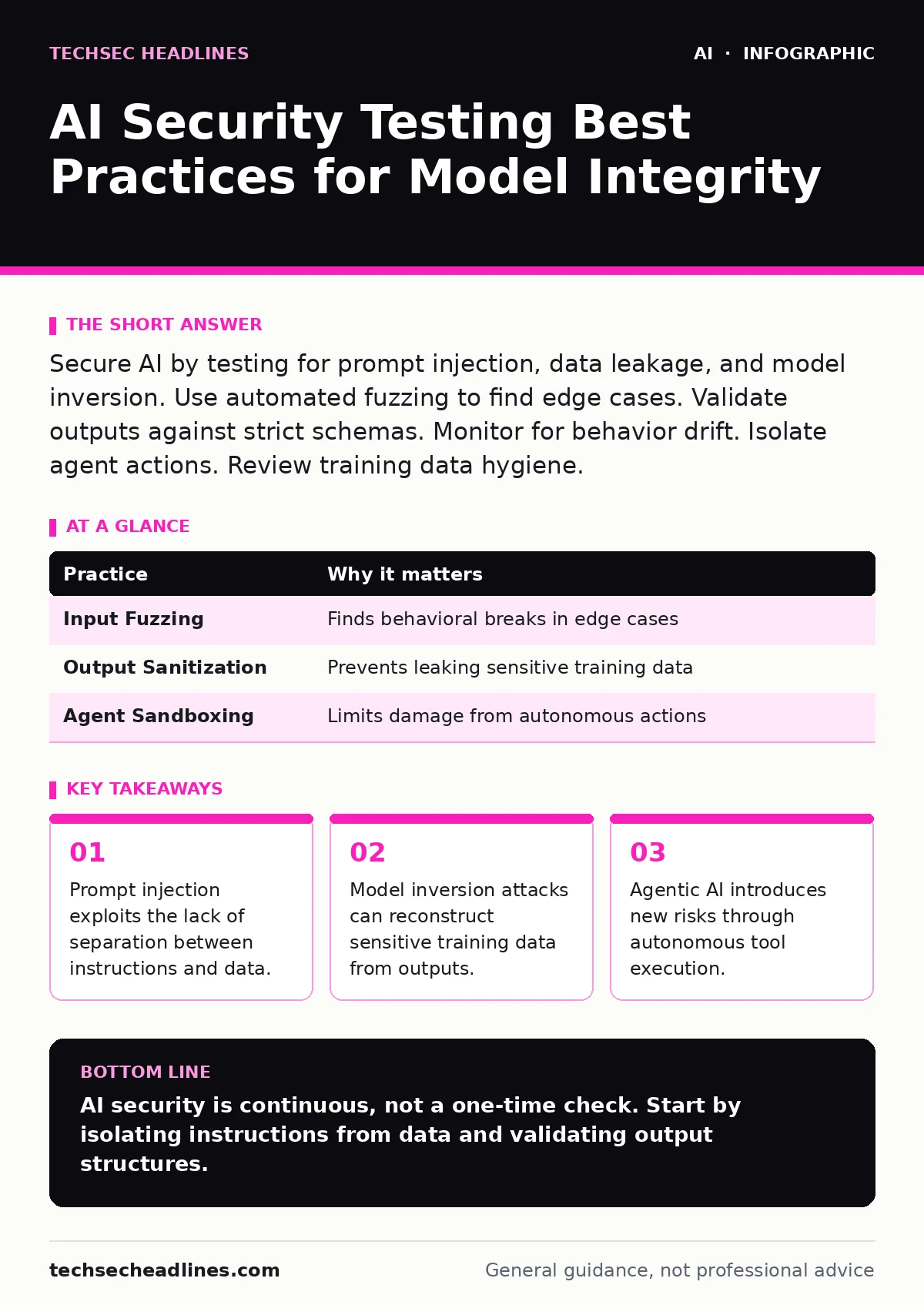
Secure AI by testing for prompt injection, data leakage, and model inversion. Use automated fuzzing to find edge cases. Validate outputs against strict schemas. Monitor for behavior drift. Isolate agent actions. Review training data hygiene.
1. Isolate Instructions from User Data
Large language models process instructions and user input in the same context window. This creates a vulnerability where a user can hide malicious commands inside their data. This is known as prompt injection. The model cannot distinguish between your system instructions and the user’s cleverly hidden request.
You must enforce strict separation. Use delimiters to mark the boundary between system prompts and user content. Even better, use techniques that transform user input into a format the model cannot interpret as code or instructions.
2. Fuzz Inputs for Edge Cases
Traditional software testing checks for specific bugs. AI testing must check for behavioral breakdowns. Models often fail when given inputs that fall outside their training distribution. These edge cases can cause the model to hallucinate or leak information.
Use automated fuzzing tools. Generate thousands of random, malformed, or adversarial inputs. Observe how the model degrades. Look for sudden shifts in tone, format, or factual accuracy. This helps you find the boundaries where the model stops being reliable.
See AI hallucinations for more on why models generate plausible but false information under stress.
3. Test for Data Leakage
Models trained on sensitive data can sometimes reproduce that data in their responses. This is called memorization. If an attacker finds the right trigger phrase, the model might spit out private records, code snippets, or internal documents.
Check for verbatim reproduction of training data. Use datasets that include known sensitive strings. Query the model with variations of these strings. If the model returns the exact sensitive data, your training process lacks sufficient privacy safeguards.
| Practice | Why it matters |
|---|---|
| Input Fuzzing | Finds behavioral breaks in edge cases |
| Output Sanitization | Prevents leaking sensitive training data |
| Agent Sandboxing | Limits damage from autonomous actions |
4. Validate Output Structure
AI models are probabilistic. They do not guarantee consistent output formats. If your application relies on JSON, XML, or other structured data, the model might break the format unexpectedly. This can cause downstream systems to crash or process corrupted data.
Define a strict schema for the expected output. Use a validation layer that rejects any response not matching this schema. Do not trust the model to self-correct. If the output is invalid, discard it and retry or flag it for human review. This adds a small latency cost but prevents systemic failures.
5. Monitor for Behavior Drift
Model performance is not static. As you deploy the model, new inputs may cause it to behave differently over time. This is known as drift. The model might become less accurate, more biased, or more susceptible to attacks as it encounters new data patterns.
Implement continuous monitoring. Track key metrics like response latency, error rates, and confidence scores. Set thresholds for acceptable deviation. If the model’s behavior shifts significantly, trigger an alert. This allows you to intervene before users notice the degradation.
6. Secure Agent Tool Access
Agentic AI systems can perform actions, such as sending emails or executing code. This autonomy creates a large attack surface. If an agent is tricked into making a wrong decision, it can cause real-world damage.
Limit the tools available to the agent. Use the principle of least privilege. Each tool should only have the permissions necessary for its specific task. For example, an email-sending tool should not have access to the file system.
See securing AI agents for detailed strategies on constraining autonomous behavior.
7. Audit Training Data Hygiene
The quality of the model depends on the quality of the training data. If the data contains biases, errors, or malicious code, the model will learn them. This is known as data poisoning.
Curate your dataset carefully. Remove duplicates and low-quality entries. Scan for known malicious patterns. Document the source of each data point. This documentation helps you trace issues back to their origin if the model behaves unexpectedly later.
8. Implement Human-in-the-Loop Validation
Automated tests cannot catch every nuance. Some attacks require human-like reasoning to identify. Others involve subtle biases that automated metrics miss.
Integrate human review for high-stakes decisions. Use a panel of diverse reviewers to evaluate model outputs. This provides a safety net for cases where automated checks fail. It also helps refine your automated testing criteria over time.
See AI governance for frameworks on establishing review processes.
9. Plan for Model Inversion Attacks
Model inversion attempts to reconstruct training data by analyzing the model’s outputs. This is particularly risky for models trained on small or unique datasets.
Limit the amount of information revealed in confidence scores. If an attacker can see how confident the model is about a specific answer, they can use that information to reverse-engineer the data. Mask or round confidence scores. Add noise to the output. This makes inversion significantly harder.
See deepfake detection for related techniques in identifying synthetic media.
Key takeaways
- Prompt injection exploits the lack of separation between instructions and data.
- Model inversion attacks can reconstruct sensitive training data from outputs.
- Agentic AI introduces new risks through autonomous tool execution.
AI security is continuous, not a one-time check. Start by isolating instructions from data and validating output structures.
Frequently asked questions
How often should I test my AI model?
Test continuously. Integrate testing into your deployment pipeline. Run automated checks before every update. Perform manual audits quarterly.
Can I use open-source models safely?
Yes, but you must test them. Open-source models may have known vulnerabilities. Verify the source. Apply your own security layers.
What is prompt injection?
It is an attack where user input overrides system instructions. The model follows the user’s hidden command instead of its intended role.
How do I detect data leakage?
Query the model with known sensitive data. Check if it reproduces the exact text. Use automated scanners to probe for memorized content.
How this guide was produced: written by the TechSec Headlines editorial team with AI assistance, checked against the public references listed below, and reviewed when the facts change. See our editorial policy or report an error.