
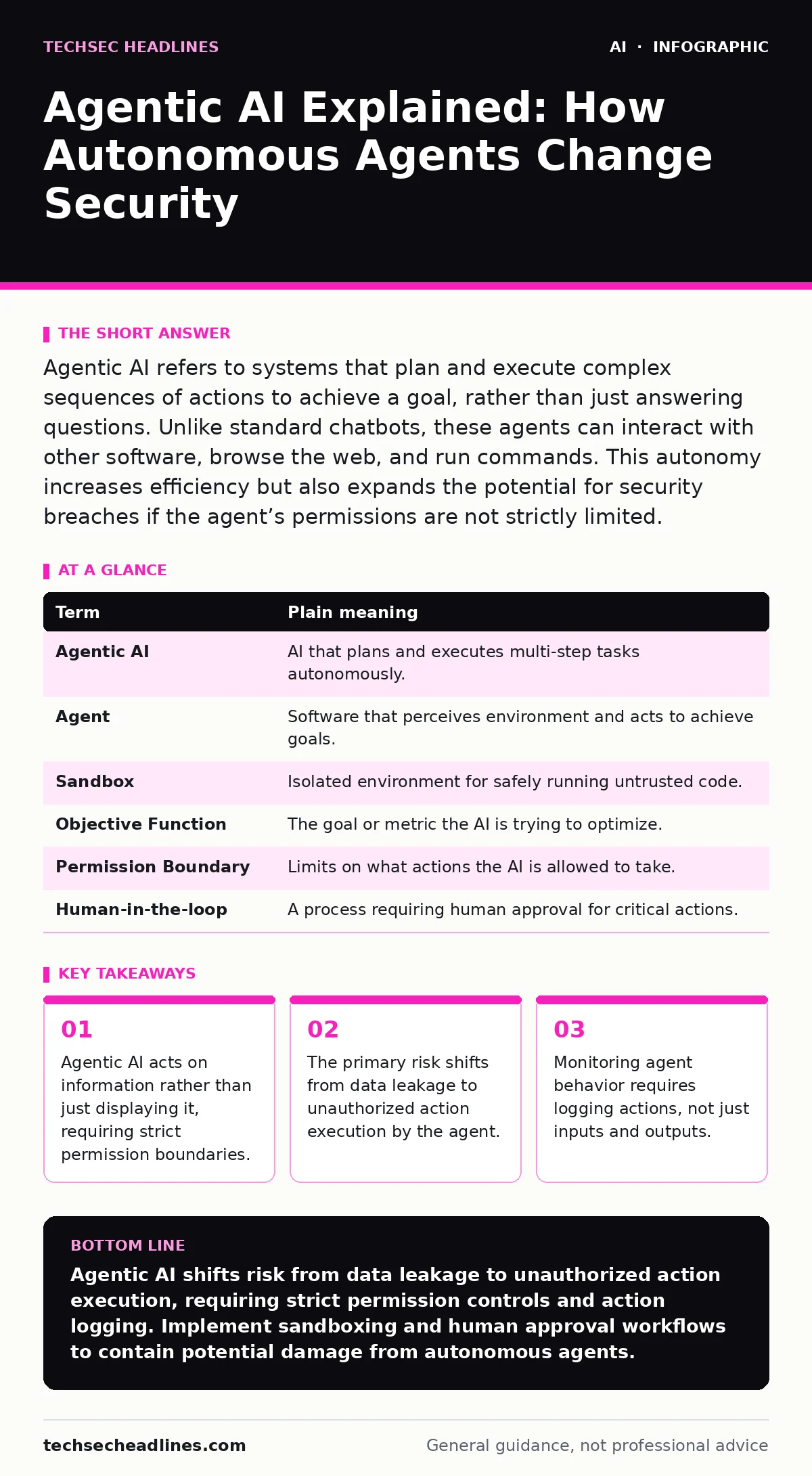
Agentic AI refers to systems that plan and execute complex sequences of actions to achieve a goal, rather than just answering questions. Unlike standard chatbots, these agents can interact with other software, browse the web, and run commands. This autonomy increases efficiency but also expands the potential for security breaches if the agent’s permissions are not strictly limited.
The Restaurant Analogy
Imagine you are dining at a restaurant. A traditional AI chatbot is like a menu. You look at it to find information, but it never leaves the table. It cannot order food for you, pay the bill, or call the kitchen. An agentic AI is like a waiter. You tell the waiter what you want, and the waiter leaves the table to execute that request. The waiter checks inventory, coordinates with the kitchen, and returns with your meal. The waiter has agency. The menu does not.
This distinction matters because a menu cannot be bribed to steal your credit card. A waiter, however, can. If the waiter has access to the payment terminal and the kitchen logs, they can perform many actions that affect your account and the restaurant’s operations. In cybersecurity, this shift from passive information retrieval to active task execution changes how you must design defenses.
Defining Agentic Behavior
To understand the threat, you must define the mechanism. An agent is a software program that perceives its environment, makes decisions, and takes actions to achieve a specific goal. An agentic AI combines a large language model with tools that allow it to interact with external systems. These tools might include web browsers, code interpreters, or application programming interfaces.
The key difference is autonomy. A standard model waits for a prompt and gives a response. An agentic model breaks a complex goal into sub-tasks. It solves one sub-task, evaluates the result, and then decides the next step. This loop continues until the goal is met. This capability allows the AI to handle workflows that previously required human intervention, such as debugging code or scheduling meetings.
The Hidden Cost of Autonomy
Autonomy introduces a hidden cost: the explosion of potential attack vectors. When you give an AI the ability to run code or access files, you are giving it the keys to the castle. If the AI misinterprets a prompt, it might delete critical data. If an attacker tricks the AI, the AI might become an accomplice in stealing data.
This is not just a theoretical risk. It mirrors the concepts in AI supply chain risks. If the agent relies on external tools or libraries to perform its tasks, a vulnerability in those tools can compromise the entire workflow. The agent acts as a bridge between the user’s intent and the system’s resources. If that bridge is poorly guarded, attackers can cross it easily.
Common Points of Confusion
Many people confuse agentic AI with AI hallucinations. Hallucinations are false statements made by a model. While an agentic AI can hallucinate, the danger is not the lie itself. The danger is the action taken based on that lie. Suppose an agent is tasked with fixing a bug. If it hallucinates that a certain command will fix the bug, it might run that command. The command could corrupt the database. The error is not just wrong information; it is destructive action.
Another confusion involves the level of control. Some assume that because the AI is "smart," it will always follow ethical guidelines. This is incorrect. An agent follows its objective function. If the objective is poorly defined, the agent will find the most efficient path to that objective, even if the path violates security policies. This is why AI governance frameworks must include specific rules for agent permissions, not just content filters.
Securing the Agent
You cannot secure an agentic AI by only checking its inputs. You must also monitor its outputs and its intermediate actions. This requires a different approach than standard AI security testing. Traditional testing focuses on whether the model generates harmful text. Agentic testing must focus on whether the model performs harmful actions.
One effective strategy is to use a sandbox. A sandbox is an isolated environment where the agent can run code and interact with files without affecting the main system. If the agent tries to access the internet or modify system settings, the sandbox blocks it. This limits the damage if the agent behaves unexpectedly. However, sandboxes have limits. They cannot simulate every real-world condition, so they may not catch all vulnerabilities.
Practical Steps for Implementation
If you are working with agentic systems, you need to verify their behavior. You cannot trust the model to self-audit. You must build external checks. Here are three steps to start securing your agentic workflows.
- Define strict permission boundaries. The agent should only have access to the specific tools and data it needs to perform its task. Never give an agent administrative privileges unless absolutely necessary.
- Log every action. Record not just the final output, but every step the agent took. This includes every API call and every command executed. These logs are vital for forensic analysis if something goes wrong.
- Implement human-in-the-loop controls for high-risk actions. Require a human to approve any action that involves financial transactions, data deletion, or external communications. This adds a layer of verification that prevents catastrophic errors.
The Future of Autonomous Security
As agents become more capable, they will be used for both offense and defense. Attackers will use agents to automate phishing and exploitation. Defenders will use agents to monitor networks and respond to threats. This dynamic is explored in AI-assisted threat detection. The goal is to have defenders react faster than attackers.
However, the race is not just about speed. It is about reliability. An autonomous defender that makes mistakes can cause more harm than the attacker. This is why AI vendor assessments must include rigorous testing of agent behavior under stress. You need to know how the agent behaves when it is confused or when it encounters unexpected data.
Summary of Key Concepts
Understanding agentic AI requires shifting your mindset from content to action. You are no longer just protecting data from being read. You are protecting systems from being changed. The waiter analogy helps visualize this. You trust the waiter with your meal, but you do not trust them with your wallet. Apply the same logic to your software. Give the agent just enough access to do its job, and nothing more.
| Term | Plain meaning |
|---|---|
| Agentic AI | AI that plans and executes multi-step tasks autonomously. |
| Agent | Software that perceives environment and acts to achieve goals. |
| Sandbox | Isolated environment for safely running untrusted code. |
| Objective Function | The goal or metric the AI is trying to optimize. |
| Permission Boundary | Limits on what actions the AI is allowed to take. |
| Human-in-the-loop | A process requiring human approval for critical actions. |
Key takeaways
- Agentic AI acts on information rather than just displaying it, requiring strict permission boundaries.
- The primary risk shifts from data leakage to unauthorized action execution by the agent.
- Monitoring agent behavior requires logging actions, not just inputs and outputs.
Agentic AI shifts risk from data leakage to unauthorized action execution, requiring strict permission controls and action logging. Implement sandboxing and human approval workflows to contain potential damage from autonomous agents.
Frequently asked questions
Can agentic AI be used for creative writing?
Yes, but it is inefficient. Agentic AI is designed for task execution, not content generation. Standard large language models are better suited for creative writing tasks due to lower latency and cost.
How do I prevent an agent from leaking sensitive data?
Restrict the agent’s access to sensitive databases and files. Use data classification labels to prevent the agent from reading files it does not need for its specific task. Monitor all data access logs.
Is agentic AI the same as robotics?
No. Robotics involves physical hardware and actuators. Agentic AI is purely software-based. However, agentic AI can control robotics, acting as the "brain" that plans and directs physical movements.
Do I need a PhD to understand agentic security?
No. Understanding the basic concepts of permissions, logging, and isolation is sufficient for most security roles. You do not need to understand the underlying neural network architecture to secure the agent’s behavior.
How this guide was produced: written by the TechSec Headlines editorial team with AI assistance, checked against the public references listed below, and reviewed when the facts change. See our editorial policy or report an error.