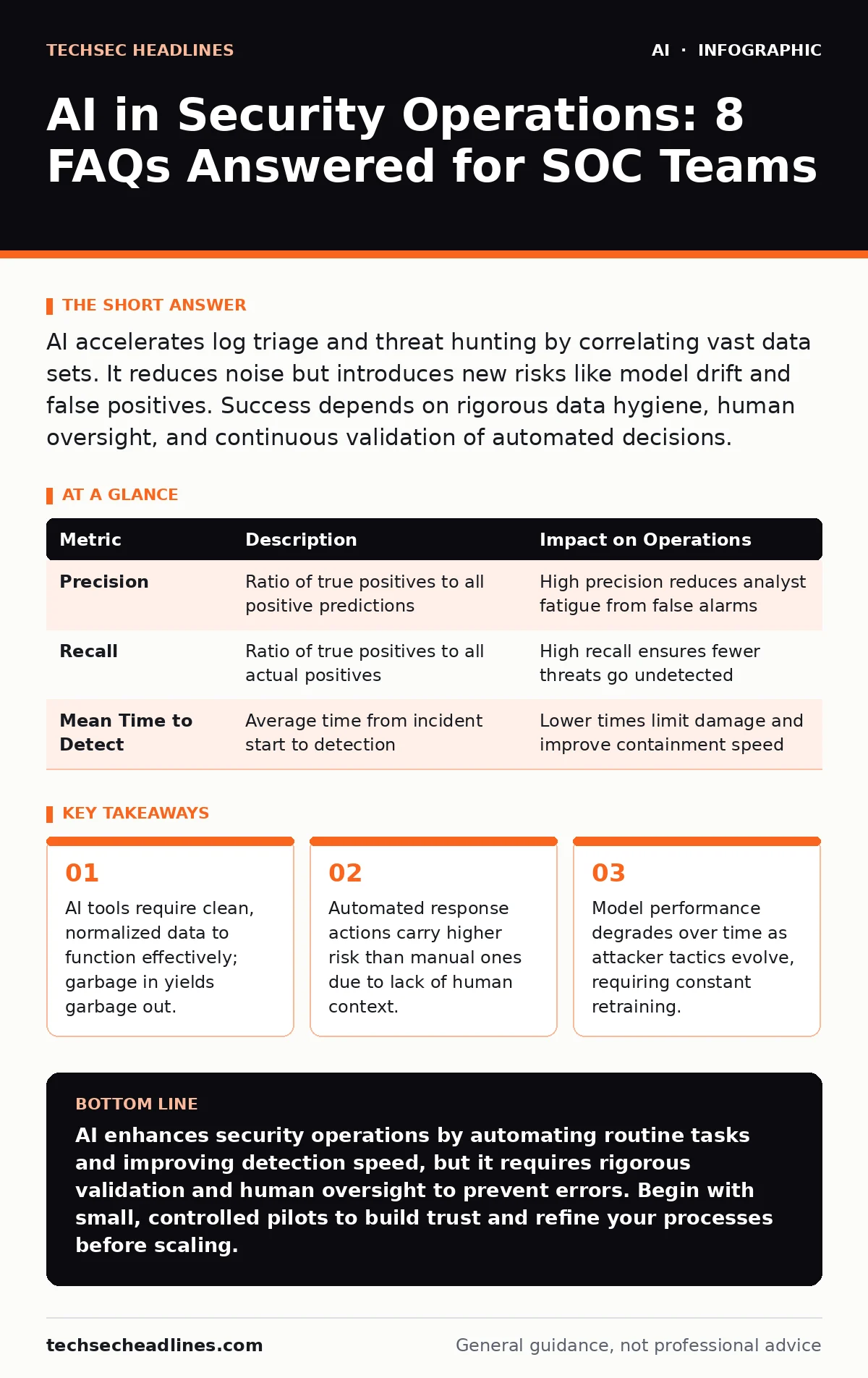
AI accelerates log triage and threat hunting by correlating vast data sets. It reduces noise but introduces new risks like model drift and false positives. Success depends on rigorous data hygiene, human oversight, and continuous validation of automated decisions.
Does AI replace human security analysts?
It frees you to focus on complex investigations and strategic decision-making. The tool processes volume; you provide context, intent analysis, and ethical judgment. This partnership reduces burnout and increases the speed of response to genuine threats.
How does AI improve threat detection accuracy?
AI models identify patterns and anomalies that rule-based systems miss by analyzing behavior across multiple data sources. Machine learning algorithms learn from historical data to distinguish normal activity from malicious actions. This allows for earlier detection of subtle attacks that do not trigger traditional signature alerts. However, accuracy depends entirely on the quality and representativeness of the training data.
What is the biggest risk of using AI in security?
The primary risk is the introduction of false positives and negatives due to model limitations or adversarial manipulation. AI can be tricked by crafted inputs designed to evade detection or trigger incorrect responses. Additionally, over-reliance on automated decisions can lead to missed threats if the model fails to recognize novel attack vectors. You must maintain human oversight to validate critical alerts and responses.
How do I prevent AI models from being poisoned?
Data poisoning occurs when attackers inject malicious data into the training set to corrupt the model’s decision-making process. Protect your training data by implementing strict access controls and integrity checks. Validate data sources rigorously and monitor for anomalies in input distributions. Regularly audit model performance to detect unexpected shifts in behavior that may indicate poisoning. See our guide on AI security testing for methods to evaluate model resilience.
Can AI automate incident response actions?
Yes, AI can automate low-risk response actions like isolating infected endpoints or blocking malicious IPs. This reduces response time and minimizes human error during high-volume incidents. However, automation should be limited to well-understood scenarios with clear playbooks. High-impact actions require human approval to prevent business disruption from false positives. Explore securing AI agents to understand how to govern autonomous decision-making.
How do I measure the effectiveness of AI security tools?
Track metrics such as mean time to detect, mean time to respond, and the rate of false positives. Compare AI-generated alerts against confirmed incidents to calculate precision and recall. Monitor resource utilization to ensure the AI system scales efficiently with data volume. Regularly review these metrics to identify areas for improvement and adjust model parameters accordingly.
What is model drift and how do I fix it?
Model drift occurs when the performance of an AI model degrades over time because the underlying data distribution changes. Attackers evolve their tactics, rendering historical training data less relevant. To fix drift, continuously retrain the model with recent, high-quality data. Implement monitoring systems to alert you when performance metrics fall below acceptable thresholds. This ensures the model remains accurate against current threats.
How do I handle AI hallucinations in security reports?
AI hallucinations are plausible but incorrect outputs generated by large language models. In security, this can lead to misleading threat assessments or incorrect remediation advice. Always verify AI-generated insights against authoritative sources and raw data. Implement guardrails that limit the model’s ability to fabricate details. Refer to our guide on AI hallucinations for strategies to mitigate these risks in operational environments.
Is AI-generated content secure from deepfakes?
AI-generated media, including audio and video, can be used to create convincing deepfakes for social engineering. These fakes bypass traditional authentication methods by mimicking trusted voices or faces. Implement multi-factor authentication and verification protocols for sensitive communications. Use deepfake detection tools to analyze media for artifacts indicative of synthetic generation. Treat unexpected requests for urgent action with heightened suspicion.
| Metric | Description | Impact on Operations |
|---|---|---|
| Precision | Ratio of true positives to all positive predictions | High precision reduces analyst fatigue from false alarms |
| Recall | Ratio of true positives to all actual positives | High recall ensures fewer threats go undetected |
| Mean Time to Detect | Average time from incident start to detection | Lower times limit damage and improve containment speed |
How do I ensure ethical use of AI in security?
Establish clear policies for data privacy, bias mitigation, and transparency in AI decision-making. Ensure that AI systems do not disproportionately target specific groups or violate user privacy rights. Document model training data and decision logic to maintain accountability. Regularly review these practices to align with evolving legal and ethical standards. See AI governance for frameworks to manage these responsibilities.
What skills do analysts need to work with AI?
Analysts must understand how AI models work, including their strengths, limitations, and potential biases. Proficiency in data analysis and interpretation is essential to validate AI outputs. Familiarity with programming languages like Python helps in customizing models and automating workflows. Continuous learning is necessary to keep pace with evolving AI technologies and attack techniques.
How do I integrate AI into existing security workflows?
Start by identifying high-volume, repetitive tasks that are prone to human error. Pilot AI solutions in these areas to measure impact and gather feedback. Gradually expand usage to more complex tasks as confidence in the model grows. Ensure seamless integration with existing SIEM, SOAR, and ticketing systems. Refer to agentic AI for insights on deploying autonomous agents within your workflow.
Key takeaways
- AI tools require clean, normalized data to function effectively; garbage in yields garbage out.
- Automated response actions carry higher risk than manual ones due to lack of human context.
- Model performance degrades over time as attacker tactics evolve, requiring constant retraining.
AI enhances security operations by automating routine tasks and improving detection speed, but it requires rigorous validation and human oversight to prevent errors. Begin with small, controlled pilots to build trust and refine your processes before scaling.
Frequently asked questions
Can AI detect zero-day vulnerabilities?
AI can identify anomalous behavior associated with zero-day exploits, but it cannot predict unknown vulnerabilities without prior training data. It relies on behavioral patterns rather than known signatures.
How much data is needed to train a security AI model?
The amount of data varies by use case, but high-quality, labeled data is more important than sheer volume. Start with smaller, focused datasets to validate model performance before scaling up.
Is cloud-based AI security safer than on-premise?
Both have trade-offs.
How this guide was produced: written by the TechSec Headlines editorial team with AI assistance, checked against the public references listed below, and reviewed when the facts change. See our editorial policy or report an error.