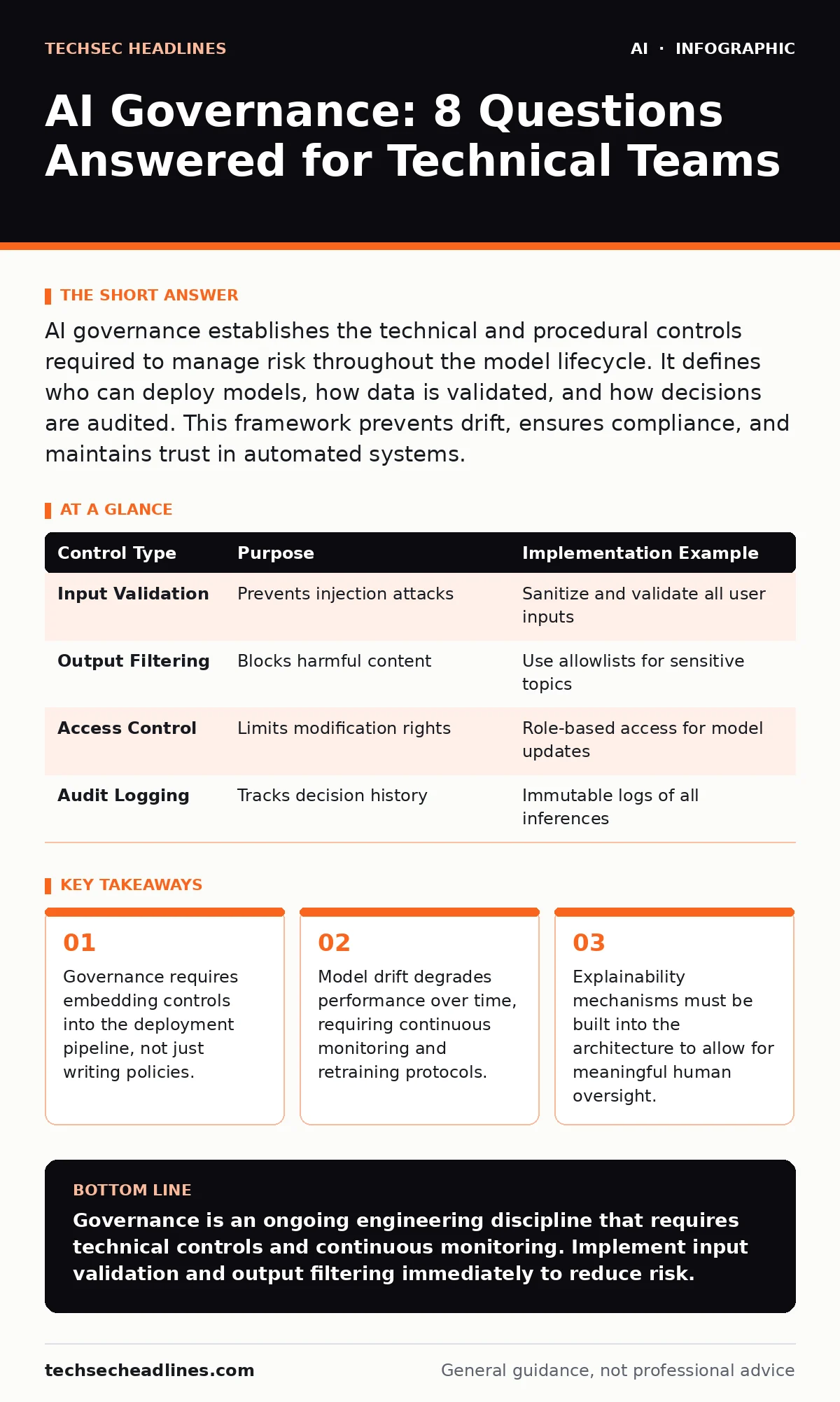
AI governance establishes the technical and procedural controls required to manage risk throughout the model lifecycle. It defines who can deploy models, how data is validated, and how decisions are audited. This framework prevents drift, ensures compliance, and maintains trust in automated systems.
What is AI governance?
AI governance is the system of rules, practices, and processes that guide the development, deployment, and monitoring of artificial intelligence systems. It ensures that models behave as intended and comply with legal and ethical standards. This framework connects technical implementation with organizational accountability.
Who is responsible for AI governance?
Responsibility is shared across legal, engineering, and operations teams rather than resting with a single department. Legal defines compliance boundaries while engineering implements technical controls. Operations monitors live systems for anomalies. This distributed model prevents single points of failure in oversight.
How do you govern model behavior?
You govern behavior by defining strict input and output constraints within the application layer. These constraints act as guardrails that filter inappropriate or unsafe content before it reaches the user. You must also implement rate limiting to prevent abuse of the model. This approach reduces the attack surface without altering the core model.
What is model drift and why does it matter?
Model drift occurs when the statistical properties of the input data change over time, causing the model’s accuracy to degrade. This happens because the real world evolves while the training data remains static. If unaddressed, drift leads to incorrect predictions and potential system failure. Continuous monitoring is required to detect these shifts early.
How do you ensure explainability?
Explainability requires integrating tools that trace model decisions back to specific input features. This allows auditors to understand why a model made a particular prediction. You cannot govern what you cannot explain. Techniques like feature importance scoring help reveal the logic behind complex neural network outputs.
What are the data governance requirements?
Data governance mandates strict controls over how training data is collected, stored, and used. You must verify that data sources are legitimate and free from bias. This includes documenting the lineage of data to prove its origin. Poor data quality directly compromises model integrity and compliance.
How do you handle third-party AI risks?
Third-party risks arise when you integrate models or services from external vendors. You must assess their security posture and data handling practices before integration. This evaluation extends to their supply chain, as seen in broader discussions on AI supply chain risks. You need contractual guarantees regarding data privacy and model updates.
What technical controls are needed for compliance?
Technical controls include logging all model interactions and securing access to model parameters. You must implement role-based access control to limit who can modify the model. Encryption protects data both in transit and at rest. These controls provide the audit trail necessary for regulatory compliance.
| Control Type | Purpose | Implementation Example |
|---|---|---|
| Input Validation | Prevents injection attacks | Sanitize and validate all user inputs |
| Output Filtering | Blocks harmful content | Use allowlists for sensitive topics |
| Access Control | Limits modification rights | Role-based access for model updates |
| Audit Logging | Tracks decision history | Immutable logs of all inferences |
How do you govern autonomous systems?
Autonomous systems, or agentic AI, require additional layers of oversight because they take actions without direct human input. You must define clear boundaries for their operational scope. This includes implementing human-in-the-loop checkpoints for high-stakes decisions. Governance here focuses on preventing unintended actions during execution.
What is the role of continuous monitoring?
Continuous monitoring detects anomalies in real-time, allowing for immediate response to threats or performance issues. It involves tracking metrics like latency, error rates, and input distribution. This proactive approach identifies problems before they impact users. It is a critical component of maintaining trust in AI systems.
Key takeaways
- Governance requires embedding controls into the deployment pipeline, not just writing policies.
- Model drift degrades performance over time, requiring continuous monitoring and retraining protocols.
- Explainability mechanisms must be built into the architecture to allow for meaningful human oversight.
Governance is an ongoing engineering discipline that requires technical controls and continuous monitoring. Implement input validation and output filtering immediately to reduce risk.
Frequently asked questions
How does AI governance differ from traditional IT governance?
AI governance focuses on probabilistic outcomes and data lineage, whereas traditional IT governance deals with deterministic systems and infrastructure. AI models can behave unpredictably, requiring dynamic monitoring rather than static checks.
Can governance slow down innovation?
Proper governance accelerates safe innovation by providing clear boundaries and reducing the risk of costly failures. It allows teams to experiment within defined parameters without compromising security or compliance.
What happens if a model generates harmful content?
Immediate mitigation involves filtering the output and investigating the root cause. You must update input validation rules and retrain the model if necessary. This incident response plan should be predefined and tested regularly.
Is governance required for internal tools?
Yes, internal tools still pose risks such as data leakage and bias. Governance ensures that even non-public models adhere to security and privacy standards. This protects sensitive organizational data and maintains operational integrity.
How this guide was produced: written by the TechSec Headlines editorial team with AI assistance, checked against the public references listed below, and reviewed when the facts change. See our editorial policy or report an error.