
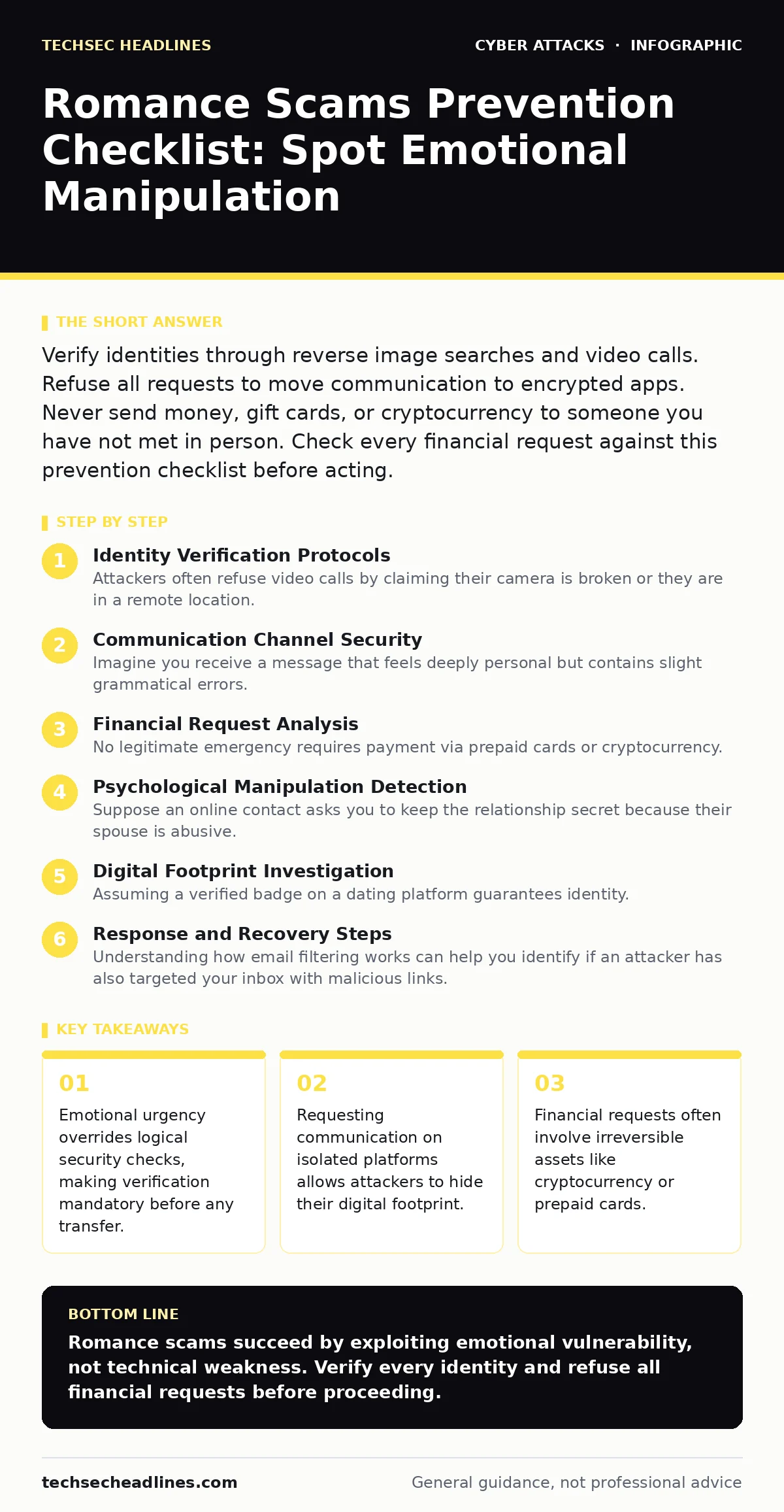
Verify identities through reverse image searches and video calls. Refuse all requests to move communication to encrypted apps. Never send money, gift cards, or cryptocurrency to someone you have not met in person. Check every financial request against this prevention checklist before acting.
Identity Verification Protocols
- Perform a reverse image search: Confirm the person uses original photos, not stolen stock images.
- Request a live video call: Static images can be faked; real-time video proves physical presence.
- Check for inconsistent details: Note changes in name, location, or job history that suggest a fabricated persona.
- Search their social media profiles: Look for a history of connections and posts that span several years.
- Verify contact information independently: Cross-reference phone numbers or emails with other public records if possible.
Communication Channel Security
- Keep chats on the original platform: Moving to private apps helps attackers avoid detection by safety algorithms.
- Disable read receipts on new apps: This prevents attackers from knowing when you are available to pressure you.
- Avoid sharing personal identifiers: Do not provide your home address, employer name, or daily routine.
- Use a secondary email address: Create a disposable account for new online relationships to protect your primary inbox.
- Monitor for copy-paste errors: Generic greetings or strange phrasing may indicate a script rather than personal interaction.
Imagine you receive a message that feels deeply personal but contains slight grammatical errors. This inconsistency often signals a scammer using translation tools or scripts. Understanding how spear phishing works reveals that attackers personalize messages to lower your defenses. You must apply the same skepticism to romantic interactions as you do to unexpected business emails.
Financial Request Analysis
- Refuse all cryptocurrency transfers: Digital coins are irreversible and untraceable, making recovery impossible.
- Decline gift card payments: These cards function like cash and provide no recourse for fraud victims.
- Avoid wire transfers: Traditional money transfers move funds quickly across borders, bypassing bank fraud protections.
- Question emergency funding requests: Scammers create fake crises to trigger an impulsive emotional response.
- Verify medical or legal claims independently: Contact the hospital or lawyer directly using public directory numbers.
Psychological Manipulation Detection
- Identify love bombing behaviors: Excessive praise and rapid declarations of love are tactics to accelerate trust.
- Recognize isolation attempts: Pressure to cut ties with friends or family removes your support network.
- Spot guilt-tripping language: Statements that imply you do not care if you hesitate are manipulation tools.
- Note secrecy demands: Requests to hide the relationship from others indicate an attempt to control your narrative.
- Assess consistency in stories: Frequent contradictions in their background or daily life suggest a fabricated identity.
Suppose an online contact asks you to keep the relationship secret because their spouse is abusive. This story exploits your empathy while isolating you from people who might question the situation. This tactic mirrors smishing strategies where attackers create a sense of urgency and secrecy to prevent you from seeking help. You must recognize that genuine relationships thrive on transparency, not hidden agendas.
Digital Footprint Investigation
- Search for duplicate profiles: Use search engines to find if the same photos appear on other dating sites.
- Check metadata of shared images: Some tools can reveal if a photo was taken recently or sourced from the web.
- Look for location inconsistencies: Weather or landmarks in photos may not match the claimed location.
- Verify professional credentials: Search for their claimed employer or professional license in public registries.
- Assess the timeline of interactions: Relationships that progress from stranger to partner in weeks are highly suspicious.
See also: Voice Cloning Scams: Risks and Protection for Small Businesses
Response and Recovery Steps
- Document all communications: Save screenshots, chat logs, and transaction records for potential law enforcement reports.
- Notify your financial institutions: Alert banks and credit card companies if you have shared any financial details.
- Change passwords immediately: Update credentials for email, social media, and banking accounts used in the interaction.
- Enable multi-factor authentication: Add an extra layer of security to prevent account takeover after compromise.
- Report the profile to the platform: Help the service remove fraudulent accounts and warn other potential victims.
Understanding how email filtering works can help you identify if an attacker has also targeted your inbox with malicious links. If you have clicked on any links sent by the scammer, you should run a security scan on your devices. This approach is similar to how organizations handle supply chain attacks, where trust in one link compromises the entire system. You must treat every external input as potentially hostile.
Long-Term Prevention Habits
- Educate yourself on social engineering: Learn how attackers exploit human psychology rather than just technical flaws.
- Establish personal financial boundaries: Decide in advance that you will never send money to someone online.
- Regularly review privacy settings: Limit the amount of personal information visible on your public profiles.
- Discuss online safety with friends: Create a support network that can help you evaluate suspicious interactions.
- Stay updated on scam trends: Awareness of new tactics helps you recognize evolving methods of manipulation.
Imagine you are targeted by a scammer who uses AI to generate realistic voice messages. This technology makes eavesdropping attacks more sophisticated, as attackers can mimic trusted voices. You must remain skeptical even if the voice sounds familiar. Technology advances faster than our intuition, so you need to rely on verification protocols rather than sensory confirmation.
Key takeaways
- Emotional urgency overrides logical security checks, making verification mandatory before any transfer.
- Requesting communication on isolated platforms allows attackers to hide their digital footprint.
- Financial requests often involve irreversible assets like cryptocurrency or prepaid cards.
Romance scams succeed by exploiting emotional vulnerability, not technical weakness. Verify every identity and refuse all financial requests before proceeding.
Frequently asked questions
How do I know if a photo is stolen?
Use a reverse image search tool to see if the image appears on other websites or stock photo sites.
Can I recover money sent via cryptocurrency?
No, cryptocurrency transactions are irreversible and cannot be recovered once sent to an attacker.
Why do scammers move conversations to private apps?
They avoid detection by dating platform safety algorithms and reduce the chance of being reported.
Is it safe to share my job title?
No, attackers use professional details to tailor their manipulation and gain trust more effectively.
How this guide was produced: written by the TechSec Headlines editorial team with AI assistance, checked against the public references listed below, and reviewed when the facts change. See our editorial policy or report an error.