
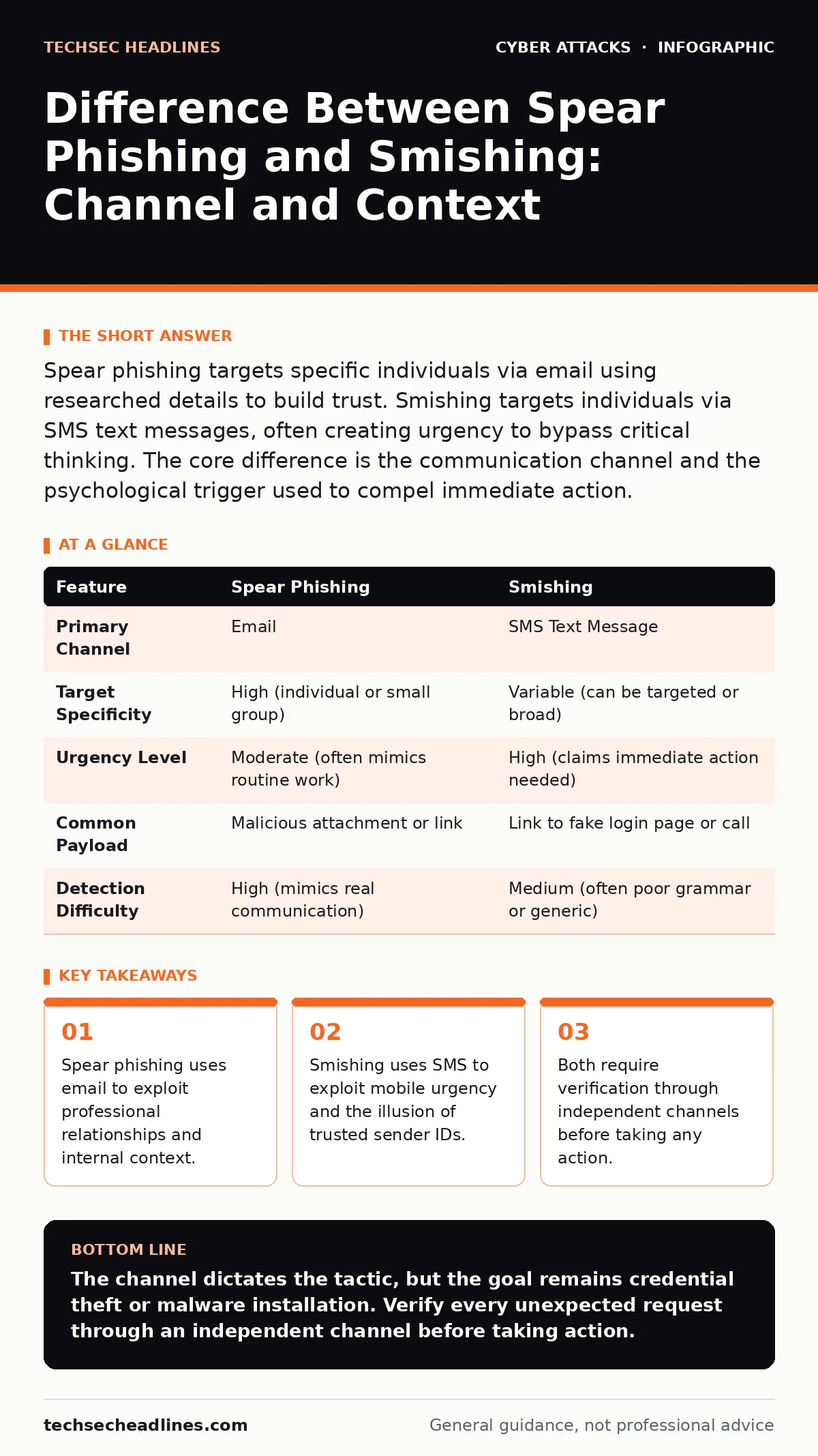
Spear phishing targets specific individuals via email using researched details to build trust. Smishing targets individuals via SMS text messages, often creating urgency to bypass critical thinking. The core difference is the communication channel and the psychological trigger used to compel immediate action.
What is the difference between spear phishing and smishing?
Spear phishing and smishing differ primarily in their delivery channel and the psychological pressure they apply. Spear phishing arrives via email and relies on detailed research about your role, colleagues, or recent projects to appear legitimate. Smishing arrives via SMS text message and relies on the immediacy of mobile notifications to create panic or urgency. You must treat both as potential threats, but the defense mechanisms vary because the contexts differ. Email allows for longer narratives and attachments, while SMS forces brevity and quick reactions.
How do attackers choose between email and SMS?
Attackers choose the channel based on the target's habits and the desired speed of compliance. Email works best when the attacker needs to establish a complex narrative or deliver a large payload. SMS works best when the attacker wants an immediate click before you have time to verify. Mobile devices sit in your pocket, creating a constant state of availability. This proximity makes SMS a powerful vector for time-sensitive scams. Attackers exploit the fact that you check texts more frequently than you check email.
Why does spear phishing require more preparation?
Spear phishing requires the attacker to gather specific intelligence about you before sending the message. They study your public profiles, recent job changes, or conference attendance to craft a believable story. This preparation creates a higher barrier to entry than mass spam. The attacker mimics a colleague, a vendor, or a service you actually use. This mimicry lowers your guard because the context feels familiar. You might receive an email that appears to come from your HR department regarding a policy change. The accuracy of the details makes the deception harder to spot.
How does smishing bypass standard security filters?
Smishing bypasses traditional email security controls because it operates outside the email infrastructure. Most organizations deploy email filtering to block malicious attachments and links. These filters do not inspect SMS traffic. Mobile carriers have limited ability to detect social engineering in plain text messages. The attacker sends a short message with a link or a phone number. You receive it on a device that lacks the same layers of inspection as your work computer. This gap allows smishing to reach users even when email security is strong.
| Feature | Spear Phishing | Smishing |
|---|---|---|
| Primary Channel | SMS Text Message | |
| Target Specificity | High (individual or small group) | Variable (can be targeted or broad) |
| Urgency Level | Moderate (often mimics routine work) | High (claims immediate action needed) |
| Common Payload | Malicious attachment or link | Link to fake login page or call |
| Detection Difficulty | High (mimics real communication) | Medium (often poor grammar or generic) |
What makes smishing feel more urgent?
Smishing messages often claim that your account is locked, a package is delayed, or a payment failed. These scenarios trigger a fear of loss or inconvenience. You want to resolve the issue quickly to avoid disruption. The attacker uses this desire for convenience against you. SMS notifications appear on your lock screen, demanding attention. You might tap the link before you even read the full message. This speed reduces the time you spend analyzing the sender's identity. The illusion of a trusted brand name in the sender ID further reduces skepticism.
See also: Voice Cloning Scams: Risks and Protection for Small Businesses
How can you verify suspicious messages?
You must verify the source through a separate, independent channel. Do not click links or reply to the suspicious message. If an email claims to be from your IT department, check your internal directory for their contact information. If a text claims to be from your bank, open your banking app or call the number on the back of your card. Never use the contact information provided in the suspicious message. Verification takes extra time, but it prevents credential theft. This habit builds a safety net that catches both spear phishing and smishing attempts.
What role does context play in detection?
Context determines whether a message seems normal or suspicious. A request for a password reset from an unknown sender is obvious. A request from a known colleague during a busy period is harder to spot. Attackers exploit busy times when you are less likely to double-check details. They send messages when you are distracted or stressed. You should pause before responding to any request that deviates from standard procedure. Even if the sender seems familiar, verify if the request itself is unusual. A sudden change in payment details or a request for sensitive data requires confirmation.
How does smishing relate to romance scams?
Smishing often serves as the initial contact method for romance scams. The attacker sends a friendly or intriguing text to start a conversation. They build a relationship over time before asking for money or personal data. This long-game approach relies on emotional manipulation rather than technical tricks. You might not suspect a threat because the interaction feels personal. The attacker uses your trust to bypass your security instincts. Recognizing that financial requests should never come through text messages helps break this cycle.
Why is security awareness training necessary?
Technical controls cannot catch every social engineering attempt. People make mistakes, especially when under pressure. Security awareness training teaches you to recognize the signs of manipulation. It helps you understand how attackers exploit human psychology. Regular training keeps these concepts fresh in your mind. You learn to spot subtle cues like mismatched URLs or unusual sender addresses. Training also encourages a culture of verification where asking questions is normal. This cultural shift reduces the success rate of both spear phishing and smishing.
What are the limits of email filtering?
Email filtering blocks many malicious messages but not all. Sophisticated spear phishing emails may pass through filters because they contain no known malware. The deception lies in the content, not the code. Filters cannot read your mind to know if a request is legitimate. You are the final layer of defense. If the filter lets a message through, you must apply your own judgment. Relying solely on technology leaves you vulnerable to well-crafted social engineering. Your vigilance complements the automated systems.
Key takeaways
- Spear phishing uses email to exploit professional relationships and internal context.
- Smishing uses SMS to exploit mobile urgency and the illusion of trusted sender IDs.
- Both require verification through independent channels before taking any action.
The channel dictates the tactic, but the goal remains credential theft or malware installation. Verify every unexpected request through an independent channel before taking action.
Frequently asked questions
Can smishing infect my phone with malware?
Yes, if you click a link that downloads a malicious app or script. Modern mobile operating systems have protections, but user interaction can bypass them.
Is spear phishing only for high-value targets?
No, attackers target anyone who can provide access to systems or data. Small organizations and individual users are frequent targets due to weaker defenses.
How do I report a smishing attempt?
Forward the message to your carrier using their reporting shortcode or delete it. You can also report it to relevant consumer protection agencies.
Does changing my email address stop spear phishing?
It reduces exposure if the new address is not public. Attackers can still find your new address through other social media or professional networks.
How this guide was produced: written by the TechSec Headlines editorial team with AI assistance, checked against the public references listed below, and reviewed when the facts change. See our editorial policy or report an error.