
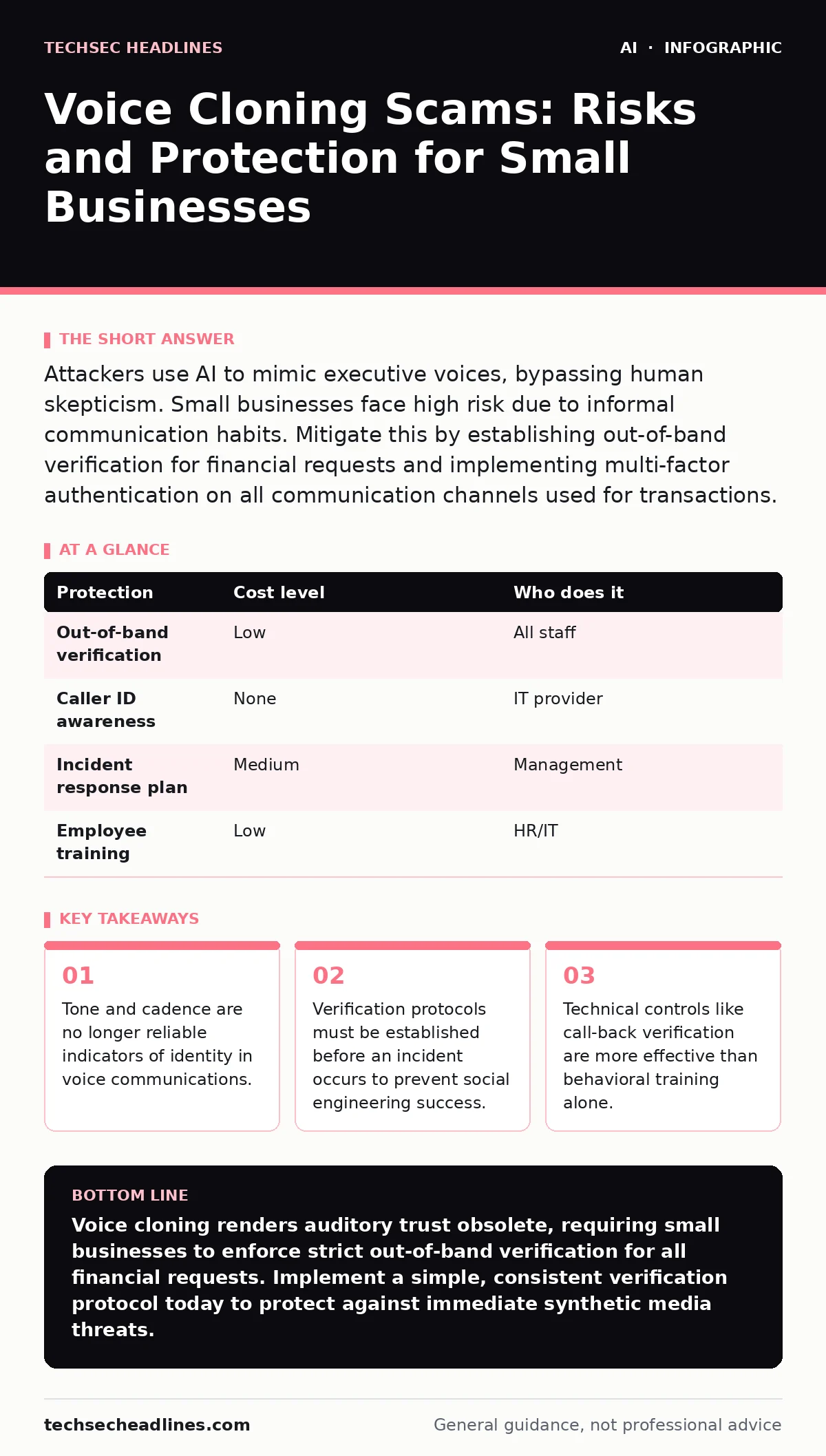
Attackers use AI to mimic executive voices, bypassing human skepticism. Small businesses face high risk due to informal communication habits. Mitigate this by establishing out-of-band verification for financial requests and implementing multi-factor authentication on all communication channels used for transactions.
The Erosion of Auditory Trust
For decades, you relied on the human ear to verify identity. A familiar voice, specific accent, or emotional tone served as a biological authentication factor. This method was cheap, fast, and intuitive. Synthetic voice technology dismantles this assumption. Modern models can clone a voice from short audio samples with high fidelity. The result is not a robotic imitation but a convincing reproduction that captures breath patterns and inflection.
This shift creates a hidden cost for small organizations. You can no longer trust your ears. When auditory cues are compromised, every phone call involving money or sensitive data becomes a potential security event. The cognitive load on employees increases because they must question interactions they previously accepted without thought. This friction slows down operations and creates resistance to new security policies.
Why Small Organisations Are Exposed
Small teams often lack formalized security protocols. Communication tends to be informal, with quick decisions made over calls or instant messages. Attackers exploit this speed. They target roles with financial authority, such as accountants or office managers, who may not have specialized security training. The social engineering tactic relies on urgency and authority, bypassing logical checks.
Large enterprises often have redundant approval workflows that slow down fraudulent requests. Small businesses operate with fewer layers of approval. A single employee may have the authority to release funds or change data. This concentration of power makes them efficient but vulnerable. If that single point of failure is tricked by a cloned voice, the organization suffers immediate damage. There is no backup process to catch the error.
The Mechanics of Social Engineering
The attack vector is simple but effective. The attacker gathers audio from public sources. These sources include social media videos, press releases, or customer service calls. They feed this audio into a generative model to create a custom voice profile. The attacker then places a call, often spoofing the caller ID to match the executive’s number.
This combination of visual spoofing and auditory cloning creates a powerful illusion. You see the correct name on your screen and hear the correct voice. Your brain registers this as a trusted source. The attacker then introduces urgency. They claim a problem has arisen that requires immediate action. This pressure reduces the time you have to verify the request. The goal is to trigger an emotional response that overrides rational caution.
Low-Cost Protection Strategies
You do not need expensive software to defend against voice cloning. The most effective controls are procedural. Establish a strict policy for any request involving money, data changes, or credential resets. These requests must be verified through a different channel. If you receive a call, verify the request via email or a secure messaging app. If you receive an email, verify via a known phone number.
| Protection | Cost level | Who does it |
|---|---|---|
| Out-of-band verification | Low | All staff |
| Caller ID awareness | None | IT provider |
| Incident response plan | Medium | Management |
| Employee training | Low | HR/IT |
This verification step introduces friction. Employees may complain that it slows them down. You must communicate the reason clearly. Explain that the cost of one failed transaction far exceeds the time saved by skipping verification. Consistency is key. If you only verify sometimes, attackers will learn when you are lax.
What to Ask an IT Provider
Your IT provider plays a critical role in implementing these controls. You need to ensure they understand the specific threat of synthetic media. Do not assume standard security measures cover this vector. Ask specific questions to gauge their preparedness.
- How do you monitor for caller ID spoofing on our business lines?
- What procedures are in place to verify identity for high-risk transactions?
- Do you offer training on recognizing synthetic audio and deepfake indicators?
- How do we update our incident response plan to include voice cloning attacks?
These questions reveal whether your provider treats voice cloning as a distinct threat. If they give vague answers, you may need to adjust your expectations or seek additional support. You are responsible for the final policy, but their technical implementation supports it.
See also: What Is Smishing Scam: Mechanics, Traps, and Defense
The Trade-Off of Verification
Implementing strict verification changes your workplace culture. It shifts trust from individuals to processes. This can feel impersonal. Employees may feel that their judgment is not respected. You must balance security with usability. If the verification process is too complex, people will find ways to bypass it.
Keep the verification method simple and consistent. Use a pre-agreed code word or a specific question that only the executive and the employee know. This adds a layer of security that is difficult for attackers to replicate. However, even this is not foolproof. Attackers can guess code words if they have access to other internal communications. The best defense is a combination of technical and procedural controls.
Long-Term Resilience
As voice cloning technology improves, the quality of synthetic audio will become indistinguishable from reality. Your defenses must evolve accordingly. Regularly review your policies and test them with simulated attacks. These tests help identify gaps in your procedures. They also reinforce the habit of verification among your staff.
Integrate these lessons into your broader security strategy. Consider how voice cloning fits into the wider context of AI threats. For a deeper look at managing these risks, refer to our guide on AI governance. This framework helps you establish clear rules for technology use. Additionally, understanding deepfake detection can provide technical insights, though procedural controls remain more reliable for small teams.
Key takeaways
- Tone and cadence are no longer reliable indicators of identity in voice communications.
- Verification protocols must be established before an incident occurs to prevent social engineering success.
- Technical controls like call-back verification are more effective than behavioral training alone.
Voice cloning renders auditory trust obsolete, requiring small businesses to enforce strict out-of-band verification for all financial requests. Implement a simple, consistent verification protocol today to protect against immediate synthetic media threats.
Frequently asked questions
Can I use software to detect if a voice is AI-generated?
Detection tools exist but are not reliable for real-time use. They often produce false positives, blocking legitimate calls. Relying solely on detection is risky; procedural verification is safer.
What if the attacker spoofs my caller ID?
Caller ID spoofing is common and easy to bypass. Do not trust the displayed number. Always verify the caller’s identity through a separate, trusted channel like a pre-saved phone number or secure email.
Do I need to ban all phone calls for financial matters?
No, you do not need to ban calls. You must add a verification step. Require that any financial request made over the phone is confirmed via a different medium before action is taken.
How often should I update my verification procedures?
Review your procedures at least annually or after any significant change in staff or technology. Regular updates ensure that new threats are addressed and that employees remain trained on current protocols.
How this guide was produced: written by the TechSec Headlines editorial team with AI assistance, checked against the public references listed below, and reviewed when the facts change. See our editorial policy or report an error.