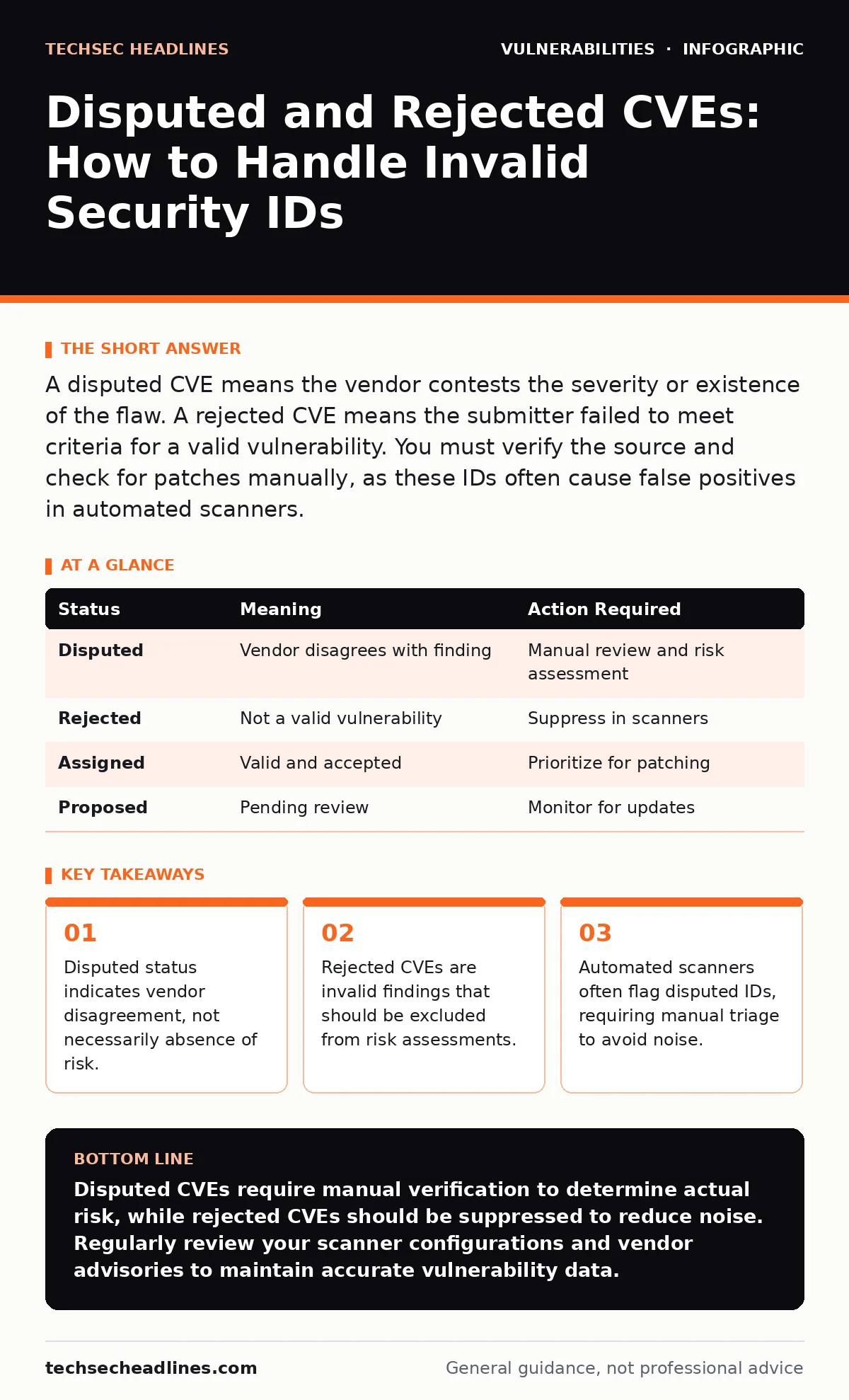
A disputed CVE means the vendor contests the severity or existence of the flaw. A rejected CVE means the submitter failed to meet criteria for a valid vulnerability. You must verify the source and check for patches manually, as these IDs often cause false positives in automated scanners.
What is the difference between a disputed and a rejected CVE?
A disputed CVE indicates that the affected vendor disagrees with the classification or severity of the reported vulnerability. A rejected CVE means the submission did not meet the criteria for a valid security vulnerability. The Common Vulnerabilities and Exposures system relies on community consensus and vendor input. Disagreements happen when vendors believe the issue is not exploitable or is already mitigated. Rejections occur when the report describes a feature, not a bug, or lacks technical detail. Understanding this distinction prevents wasted effort on invalid findings.
Why do vendors dispute security findings?
Vendors dispute findings when they believe the reported issue does not constitute a security risk. Common reasons include the requirement for physical access, the need for privileged credentials, or the presence of existing mitigations. Some vendors argue that certain configurations are intended behavior rather than defects. This disagreement delays the assignment of a final status. It also creates confusion for users who rely on automated scanning tools. The vendor’s perspective often differs from the researcher’s threat model.
How do rejected CVEs impact vulnerability management?
Rejected CVEs create noise in vulnerability management workflows. Automated scanners may still report these IDs if the database has not been updated. This leads to false positives that consume analyst time. You must filter out rejected IDs to maintain accurate risk metrics. Including them inflates your vulnerability count and skews priority decisions. Manual verification is necessary when a scanner flags a rejected CVE. The goal is to focus resources on genuine threats.
What causes a CVE to be rejected?
A CVE is rejected when the submission fails to describe a valid security vulnerability. Common causes include reporting a feature as a bug, lacking proof of concept, or describing an issue that requires impossible conditions. Some submissions are rejected because the reported behavior is expected by design. Others are rejected due to insufficient technical detail. The CVE Numbering Authority reviews these submissions to ensure quality. Rejection protects the integrity of the database.
Can a disputed CVE become valid later?
Yes, a disputed CVE can be validated if new evidence emerges. Vendors may change their stance after further analysis or after seeing a working exploit. The status can shift from disputed to assigned. This change usually happens after a patch is released. You should monitor disputed CVEs for status updates. Ignoring them entirely can leave you exposed if the vendor eventually acknowledges the flaw. The process is iterative and depends on ongoing dialogue.
How do you handle disputed CVEs in scanners?
You must configure your scanners to handle disputed CVEs carefully. Most tools allow you to suppress specific IDs. Create a suppression list for disputed CVEs that you have manually assessed. Document your reasoning for each suppression. This prevents the same false positive from appearing in future reports. Regularly review this list to ensure no disputed CVEs have been validated. Automation helps, but human judgment is required.
What is the role of the CVE Numbering Authority?
The CVE Numbering Authority assigns IDs and manages the status of vulnerabilities. It reviews disputes and rejections to ensure consistency. The authority works with vendors and researchers to resolve disagreements. It publishes guidelines on what constitutes a valid vulnerability. This process helps maintain trust in the CVE system. The authority does not judge the severity of the flaw, only its validity. Its decisions are final regarding the ID status.
Why do false positives occur with disputed CVEs?
False positives occur because automated tools rely on static databases. These databases may not reflect the latest status changes. A disputed CVE might remain in the database for months. Scanners match patterns without understanding context. This leads to alerts for issues that vendors have contested. You must cross-reference scanner results with official sources. Relying solely on automation increases noise. Manual verification reduces false alarms.
| Status | Meaning | Action Required |
|---|---|---|
| Disputed | Vendor disagrees with finding | Manual review and risk assessment |
| Rejected | Not a valid vulnerability | Suppress in scanners |
| Assigned | Valid and accepted | Prioritize for patching |
| Proposed | Pending review | Monitor for updates |
How does this relate to other security topics?
Understanding disputed CVEs connects to broader security practices. For example, threat modeling helps you determine if a disputed issue is relevant to your context. If a vendor disputes a finding because it requires physical access, your threat model might confirm this is not a risk. Similarly, malicious typosquatted packages can sometimes be misreported as vulnerabilities. Knowing how to validate findings prevents confusion. You can also apply this diligence when reviewing end-of-life software risks. Invalid CVEs on unsupported software are less relevant than known exploits.
What steps should you take when you see a disputed CVE?
You should first verify the current status of the CVE. Check the official CVE database and the vendor’s advisory page. Determine if the vendor’s reasoning aligns with your environment. If the dispute is based on configuration, check your settings. If the dispute is based on exploitability, assess your exposure. Document your decision to accept or suppress the finding. This creates an audit trail. It also helps your team understand the rationale.
How do you communicate disputed CVEs to stakeholders?
You must explain the nature of the dispute clearly. Avoid technical jargon when speaking to non-technical stakeholders. Focus on the risk level and the recommended action. If you suppress a disputed CVE, explain why it is not a threat to your organization. If you treat it as valid, explain the evidence. Transparency builds trust. It also ensures that decisions are based on facts, not fear. Clear communication reduces panic and confusion.
What is the long-term impact of disputed CVEs?
Disputed CVEs can erode trust in vulnerability databases. If too many disputes occur, users may ignore alerts. This leads to complacency and increased risk. The industry relies on accurate data to prioritize patches. Disagreements highlight the need for better standards. They also show the importance of independent validation. You cannot rely solely on vendor statements. Independent research and community feedback are vital. This ecosystem keeps the system honest.
How do you stay updated on CVE status changes?
You should subscribe to notifications from the CVE database. Many tools offer alerts for status changes. Follow security researchers and vendors on social media. They often share updates before official databases are updated. Participate in security communities to hear about emerging disputes. This proactive approach helps you stay ahead. It also allows you to adjust your defenses quickly. Staying informed is a continuous process.
Key takeaways
- Disputed status indicates vendor disagreement, not necessarily absence of risk.
- Rejected CVEs are invalid findings that should be excluded from risk assessments.
- Automated scanners often flag disputed IDs, requiring manual triage to avoid noise.
Disputed CVEs require manual verification to determine actual risk, while rejected CVEs should be suppressed to reduce noise. Regularly review your scanner configurations and vendor advisories to maintain accurate vulnerability data.
Frequently asked questions
Can a rejected CVE be re-submitted?
Yes, if the submitter provides additional evidence or clarifies the technical details, a rejected CVE can be re-submitted for review.
Do disputed CVEs affect compliance audits?
It depends on the auditor. Some may require you to address all CVEs, while others accept documented justifications for suppressing disputed findings.
How long does a dispute last?
Disputes can last from days to months, depending on the complexity of the issue and the responsiveness of the vendor.
Are disputed CVEs included in security scores?
Many security scoring systems include disputed CVEs, which can negatively impact your score. You should request exclusions if possible.
How this guide was produced: written by the TechSec Headlines editorial team with AI assistance, checked against the public references listed below, and reviewed when the facts change. See our editorial policy or report an error.