
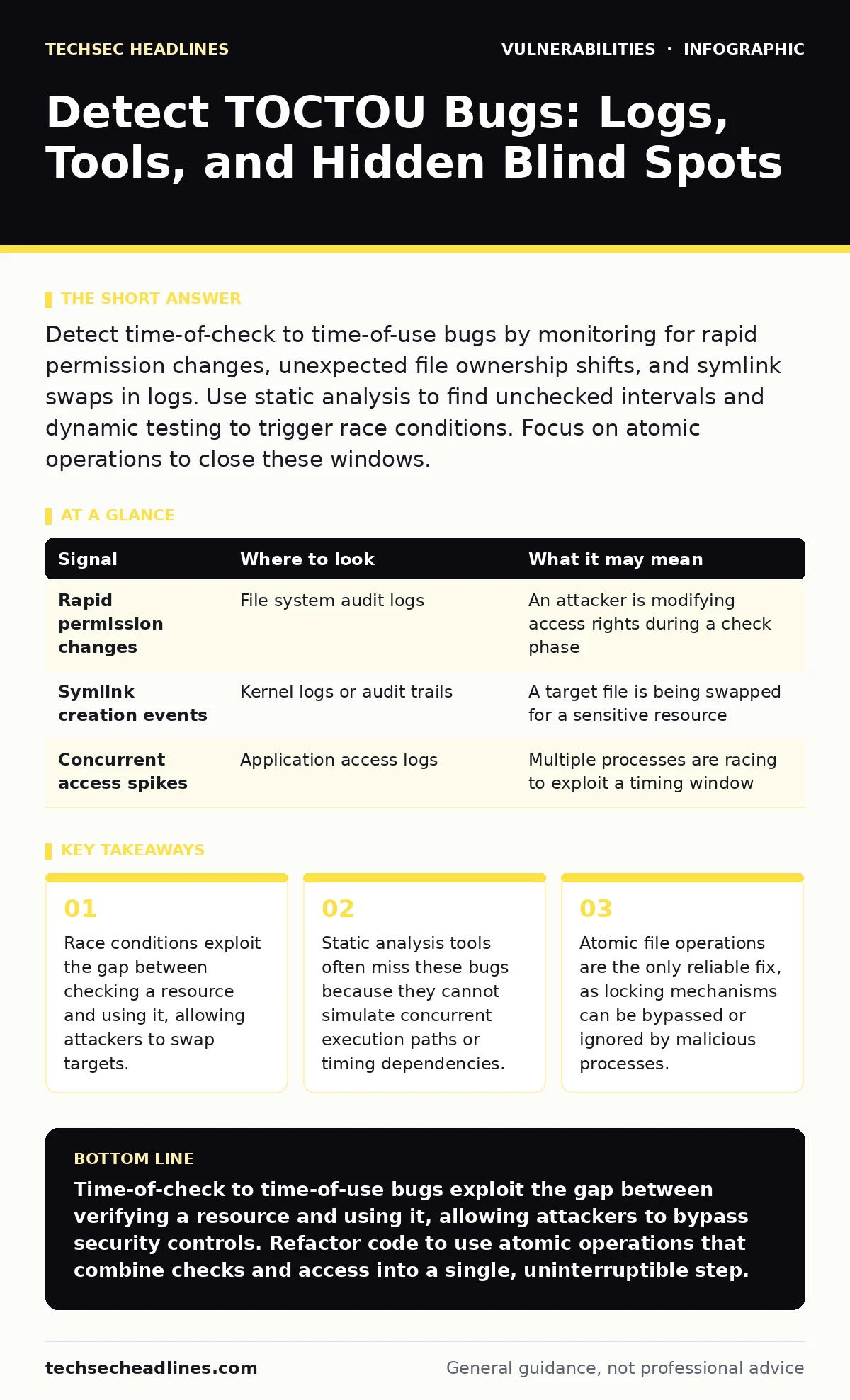
Detect time-of-check to time-of-use bugs by monitoring for rapid permission changes, unexpected file ownership shifts, and symlink swaps in logs. Use static analysis to find unchecked intervals and dynamic testing to trigger race conditions. Focus on atomic operations to close these windows.
Understanding the Race Condition Mechanism
Time-of-check to time-of-use (TOCTOU) bugs occur when a system checks the state of a resource and then uses that resource after the state has changed. This window exists because the check and the use are two separate operations. An attacker exploits this gap by altering the resource between the two steps. The system proceeds with the assumption that the initial check remains valid. This assumption fails in concurrent environments where multiple processes access shared resources simultaneously.
Imagine a web server checking if a user has permission to read a file. The server verifies the permission, then opens the file. If an attacker swaps the target file with a sensitive system file during that brief interval, the server reads the sensitive data. The server believed it accessed a safe file because the check passed. The use phase, however, interacts with the new, dangerous file. This discrepancy creates a security breach that traditional access controls cannot prevent.
Signals in System Logs
Log analysis reveals TOCTOU activity through anomalies in timing and metadata changes. Look for sequences where permission checks are immediately followed by access events on different files. Rapid changes to file ownership or group permissions often indicate an attack in progress. Monitor for multiple processes accessing the same file path in quick succession. These patterns suggest a race condition is being triggered intentionally.
| Signal | Where to look | What it may mean |
|---|---|---|
| Rapid permission changes | File system audit logs | An attacker is modifying access rights during a check phase |
| Symlink creation events | Kernel logs or audit trails | A target file is being swapped for a sensitive resource |
| Concurrent access spikes | Application access logs | Multiple processes are racing to exploit a timing window |
Reviewing these logs requires correlating events across different sources. A single log entry rarely proves a TOCTOU bug. You must connect the check event with the subsequent use event and any intermediate modification. This correlation exposes the window where the state changed unexpectedly. Without this context, the logs appear as normal system activity.
Static Analysis Limitations
Static application security testing (SAST) tools analyze code without executing it. They search for known patterns of unsafe API usage. However, TOCTOU bugs depend on runtime behavior and timing. Static tools often miss these vulnerabilities because they cannot predict when a race condition will occur. They see the check and the use as separate, safe operations. The temporal relationship between them is invisible to static analysis.
Developers must manually review code paths that interact with shared resources. Look for functions that check file existence or permissions before opening them. If the check and the use are not atomic, a race condition exists. Atomic operations combine the check and use into a single, uninterruptible step. This eliminates the window for interference. Refactoring code to use atomic APIs is the most effective mitigation strategy.
Dynamic Testing for Race Conditions
Dynamic testing involves running the application and attempting to trigger race conditions. This requires specialized tools that can manipulate timing and concurrency. Fuzzing tools can send rapid requests to exploit timing windows. These tools automate the process of checking and swapping resources. They help identify vulnerabilities that static analysis misses.
You can also use debugging tools to pause execution between the check and use phases. This manual intervention allows you to modify the resource state. If the application behaves unexpectedly after the modification, a TOCTOU bug is likely present. This method is labor-intensive but provides high confidence in detecting subtle timing issues. It requires a deep understanding of the application's logic and concurrency model.
Common Blind Spots in Detection
Many security teams overlook TOCTOU bugs because they assume file systems are secure. Standard access controls do not prevent race conditions. Attackers exploit this assumption by targeting the gap between checks. Another blind spot is the belief that locking mechanisms solve the problem. Locks can be bypassed or ignored if the attacker controls the process initiating the check.
Suppose a service uses a lock file to ensure exclusive access. An attacker can delete the lock file and recreate it during the check phase. The service sees the lock and proceeds, but the attacker has already swapped the target. This bypass renders the lock ineffective. Teams must recognize that locks do not guarantee atomicity. They only serialize access, which can still be exploited if the serialization logic is flawed.
Mitigation Through Atomic Operations
The only reliable way to fix TOCTOU bugs is to use atomic operations. These operations ensure that the check and use happen as a single, indivisible unit. File systems provide atomic APIs that check permissions and open files simultaneously. This eliminates the window for interference. Developers should replace separate check-and-use patterns with these atomic alternatives.
Refactoring existing code to use atomic operations can be challenging. It requires understanding the underlying file system capabilities. Some older systems may not support atomic operations for certain resources. In these cases, you must design workarounds that minimize the race window. This might involve using unique, unpredictable file names to prevent guessing. However, atomic operations remain the gold standard for security.
The Cost of Ignoring Timing Windows
Ignoring TOCTOU bugs creates significant security technical debt. These vulnerabilities are often subtle and hard to detect. They can persist in code for years without triggering obvious failures. When an attacker finally exploits them, the impact can be severe. Unauthorized access to sensitive data or system privileges is common.
Preventing these bugs requires a shift in mindset. Security teams must consider timing and concurrency as part of the threat model. This adds complexity to development and testing. However, the cost of remediation after a breach is far higher. Proactive detection and atomic design reduce this risk. They ensure that the system remains secure even under concurrent access pressures.
Key takeaways
- Race conditions exploit the gap between checking a resource and using it, allowing attackers to swap targets.
- Static analysis tools often miss these bugs because they cannot simulate concurrent execution paths or timing dependencies.
- Atomic file operations are the only reliable fix, as locking mechanisms can be bypassed or ignored by malicious processes.
Time-of-check to time-of-use bugs exploit the gap between verifying a resource and using it, allowing attackers to bypass security controls. Refactor code to use atomic operations that combine checks and access into a single, uninterruptible step.
Frequently asked questions
How do I know if my application has a TOCTOU bug?
Look for code patterns where file permissions or existence are checked before opening the file. If these steps are separate, a race condition likely exists.
Can locking files prevent TOCTOU vulnerabilities?
Locking can reduce the risk but does not eliminate it. Attackers can bypass locks by manipulating the lock file itself during the check phase.
What is the difference between a TOCTOU bug and a standard access control failure?
Access control failures happen when permissions are misconfigured. TOCTOU bugs happen when permissions change between the check and the use, bypassing the control.
Do all file systems support atomic operations?
Most modern file systems support atomic open operations. Older or specialized file systems may require workarounds to achieve similar security guarantees.
How this guide was produced: written by the TechSec Headlines editorial team with AI assistance, checked against the public references listed below, and reviewed when the facts change. See our editorial policy or report an error.