
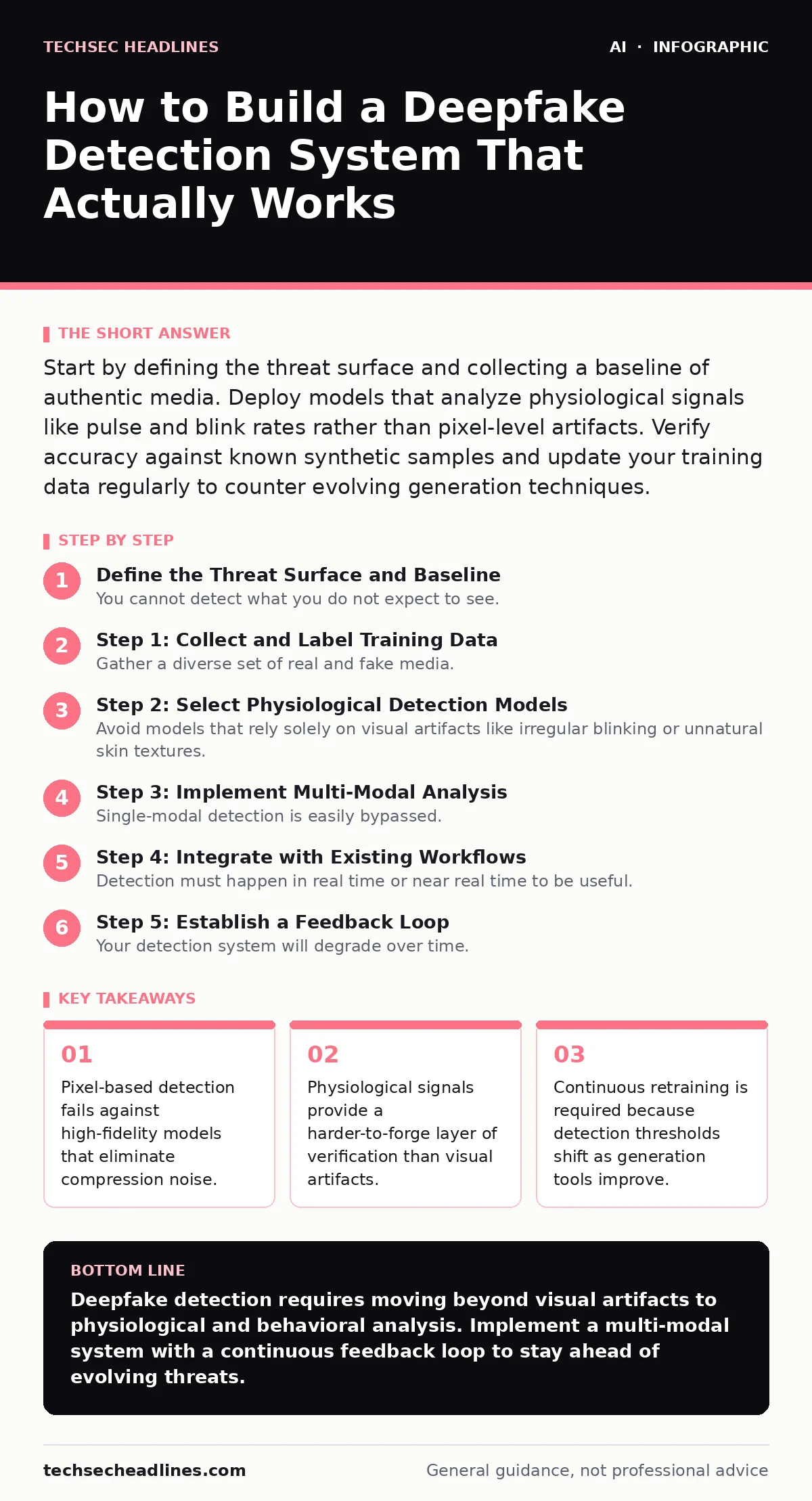
Start by defining the threat surface and collecting a baseline of authentic media. Deploy models that analyze physiological signals like pulse and blink rates rather than pixel-level artifacts. Verify accuracy against known synthetic samples and update your training data regularly to counter evolving generation techniques.
Define the Threat Surface and Baseline
You cannot detect what you do not expect to see. Before writing code or selecting models, you must map where synthetic media enters your environment. This includes email attachments, video conferencing streams, and social media posts. Identify the specific channels where an attacker would introduce a deepfake to achieve their goal.
Establish a baseline of authentic content from your key subjects. This means recording genuine video and audio samples under controlled conditions. You need this data to teach your system what "real" looks like for your specific context. Without a known-good reference, any detection tool is guessing.
Step 1: Collect and Label Training Data
Gather a diverse set of real and fake media. The fake samples must come from multiple generation methods, not just one tool. Include videos created with autoencoders, generative adversarial networks, and diffusion models. Label each sample clearly as authentic or synthetic.
Ensure your dataset covers various lighting conditions, camera angles, and compression levels. Real-world attacks will not occur in a studio setting. If your training data only contains high-resolution, uncompressed files, your system will fail when faced with a compressed video from a smartphone.
Step 1 Verification Checklist
- Dataset includes samples from at least three different generation architectures.
- Samples cover low-resolution and heavily compressed media.
- Labels are verified by multiple reviewers to reduce human error.
Step 2: Select Physiological Detection Models
Avoid models that rely solely on visual artifacts like irregular blinking or unnatural skin textures. Modern generators correct these flaws automatically. Instead, select models that analyze physiological signals. These include remote photoplethysmography, which detects subtle color changes in the skin caused by blood flow.
Look for tools that examine audio-visual synchrony. This checks if the lip movements match the phonemes in the audio track at a micro-second level. Generative models often struggle to maintain perfect temporal alignment between sight and sound. This misalignment is a stronger indicator of fraud than visual glitches.
Step 3: Implement Multi-Modal Analysis
Single-modal detection is easily bypassed. An attacker might generate a perfect video but use a real voice recording, or vice versa. Implement a system that cross-references multiple data streams. Combine visual analysis with audio spectrogram analysis and metadata inspection.
Metadata can reveal inconsistencies in camera headers or creation timestamps. While metadata can be stripped or forged, it provides an additional layer of scrutiny. If the visual model is uncertain, the audio model may provide the deciding factor. This redundancy reduces false positives and increases confidence.
Step 4: Integrate with Existing Workflows
Detection must happen in real time or near real time to be useful. Integrate your detection engine into the platforms where media is consumed. This might mean adding an API call to your video conferencing software or your email gateway. The system should flag suspicious content before it reaches the user.
Do not block content automatically upon a single detection. False positives disrupt business and erode trust. Instead, flag the content for human review. Provide the reviewer with a confidence score and the specific reason for the flag, such as "abnormal pulse rate" or "lip-sync desync."
Step 4 Verification Checklist
- API latency does not degrade user experience.
- Flags include specific technical reasons, not just a binary result.
- Human reviewers have clear protocols for handling flagged content.
Step 5: Establish a Feedback Loop
Your detection system will degrade over time. As generation tools improve, the artifacts they leave behind change. You must create a mechanism to capture new false negatives and false positives. When a human reviewer overrides a flag, record that decision.
Use these corrections to retrain your models. This is not a one-time task. It is a continuous cycle of detection, correction, and improvement. Without this loop, your system becomes a relic that misses the latest threats.
Maintain Detection Efficacy
Regularly update your threat intelligence. New generation techniques emerge frequently, often bypassing current detection methods. Subscribe to research feeds and monitor open-source repositories for new detection algorithms. Test your system against these new methods before they become widespread.
Consider the risks of AI supply chain risks. If your detection model relies on third-party libraries, those libraries could be compromised. Ensure your dependencies are vetted and updated. A compromised detection tool is worse than no detection at all.
Verify Against Known Threats
Imagine a scenario where an attacker uses a voice cloning scam to impersonate a executive. Your system should detect the subtle inconsistencies in the voice synthesis. Test this specific scenario with a controlled sample. Verify that the audio-visual synchrony check triggers an alert.
Suppose an attacker uses a deepfake video in a phishing email. Your email gateway should flag the attachment or link. Verify that the integration works end-to-end. Check that the alert reaches the security team and that the user sees the warning.
Upkeep and Governance
Regular audits of your detection system are necessary. Review the performance metrics monthly. Look for trends in false positives and negatives. Adjust the sensitivity thresholds as needed to balance security and usability.
Document your processes and decisions. This supports AI governance by providing a clear record of how synthetic media is handled. It also helps in investigating incidents where a deepfake bypassed detection. Clear records allow you to trace the failure back to its root cause.
Key takeaways
- Pixel-based detection fails against high-fidelity models that eliminate compression noise.
- Physiological signals provide a harder-to-forge layer of verification than visual artifacts.
- Continuous retraining is required because detection thresholds shift as generation tools improve.
Deepfake detection requires moving beyond visual artifacts to physiological and behavioral analysis. Implement a multi-modal system with a continuous feedback loop to stay ahead of evolving threats.
Frequently asked questions
Can I detect deepfakes using only free tools?
Free tools often lack the sophistication to detect high-fidelity deepfakes. They may catch obvious forgeries but will miss sophisticated attacks that require physiological analysis.
How often should I retrain my detection models?
Retrain your models at least quarterly or whenever a new generation technique emerges. Continuous retraining is necessary to adapt to evolving threats.
What is the biggest weakness in current detection methods?
The biggest weakness is reliance on visual artifacts. Modern generators eliminate these artifacts, making physiological and behavioral analysis more effective.
Does metadata provide reliable detection?
Metadata is unreliable on its own as it can be stripped or forged. It should be used as one layer in a multi-modal detection strategy, not as the sole source of truth.
How this guide was produced: written by the TechSec Headlines editorial team with AI assistance, checked against the public references listed below, and reviewed when the facts change. See our editorial policy or report an error.