The deepfake detection challenge arises because synthetic media evolves faster than classifiers. Detection relies on pixel artifacts and signal inconsistencies that generators actively suppress. You must verify sources through out-of-band channels rather than trusting automated scores or visual inspection alone.
Why Deepfakes Are Hard to Spot
Imagine receiving a video call from your boss asking for urgent wire transfers. The face moves naturally. The voice matches perfectly. Yet the person is not on the other end. This is the result of generative adversarial networks, systems where one AI creates content and another tries to detect it. This competition pushes generation quality beyond human perception.
The core problem is that detection tools look for errors. Early deepfakes had blurry eyes or mismatched lighting. Modern models fix these flaws during training. They learn to produce clean, coherent media that lacks the traditional artifacts. When the fake looks perfect, the detector has nothing to flag.
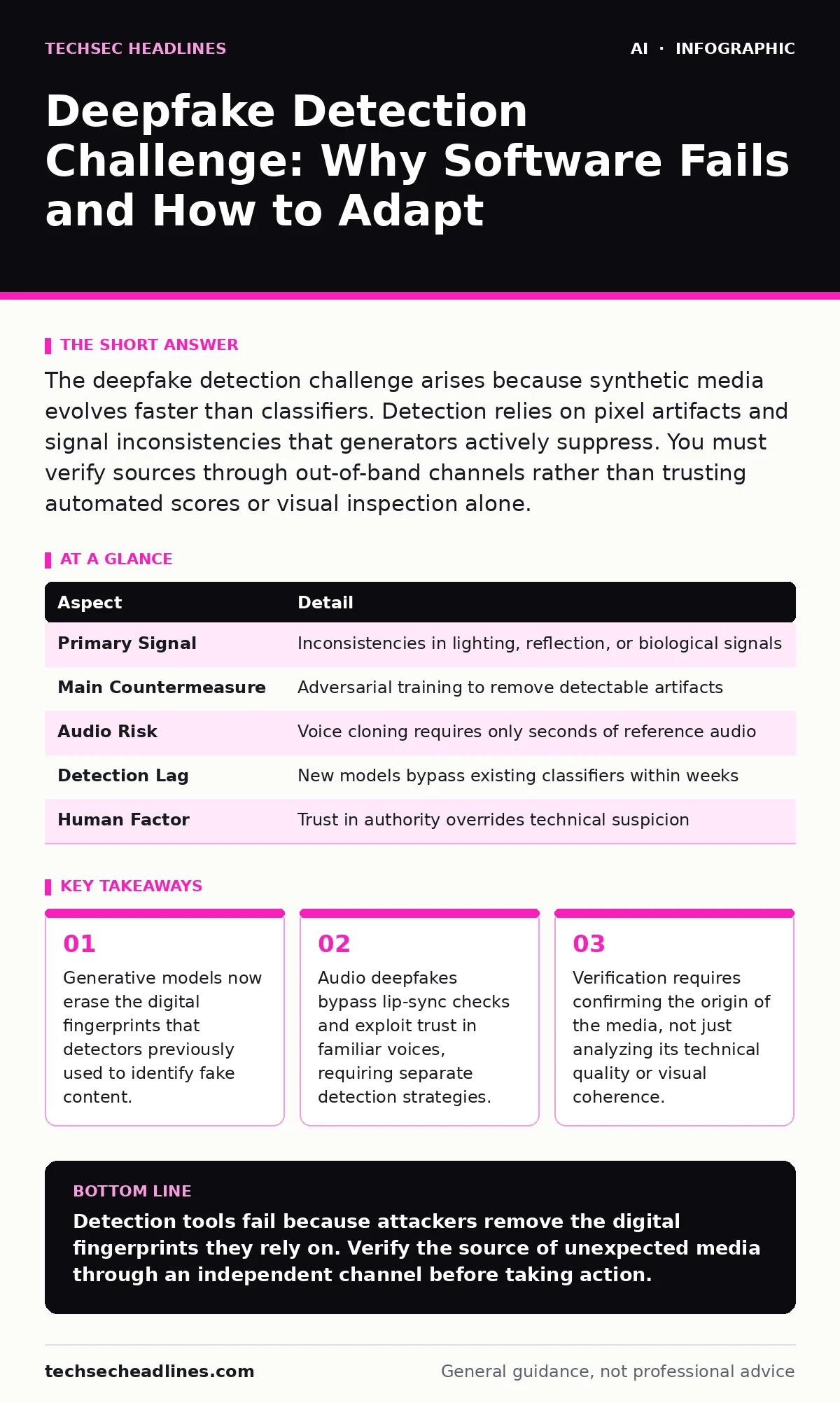
| Aspect | Detail |
|---|---|
| Primary Signal | Inconsistencies in lighting, reflection, or biological signals |
| Main Countermeasure | Adversarial training to remove detectable artifacts |
| Audio Risk | Voice cloning requires only seconds of reference audio |
| Detection Lag | New models bypass existing classifiers within weeks |
| Human Factor | Trust in authority overrides technical suspicion |
The Mechanics of Synthetic Media
Deepfakes use neural networks to map one face onto another. The system analyzes thousands of frames to learn facial expressions, lighting, and head movements. It then generates new frames that match the target identity. This process is called face swapping. More advanced models use diffusion processes to generate entirely new images from text prompts.
Audio deepfakes use voice conversion models. These models separate the content of the speech from the timbre of the voice. They can then apply the timbre of a target speaker to new text. The result is audio that sounds like the target, even if they never said those words. This decoupling makes audio forgery easier than video forgery.
The Deepfake Detection Challenge
The deepfake detection challenge is that detection models are static while generation models are dynamic. A detector trained on data from last year will fail against models released this month. This is known as model drift. Attackers know how detectors work. They add noise to their output that is invisible to humans but confuses the classifier. This noise is called an adversarial example.
Detectors often rely on frequency analysis. They look for patterns in the image data that cameras do not produce naturally. Generative models now include filters that smooth out these frequencies. The fake image passes the frequency check. The detector returns a "real" score. The system fails silently. You cannot trust a single score.
What People Usually Get Wrong
Most people assume that better AI will solve the problem. They believe a stronger detector will catch every fake. This is false. The arms race favors the attacker. It is easier to generate one convincing fake than to train a detector to recognize all possible fakes. The attacker needs only one success. The defender needs to stop every attempt.
Another error is relying on visual inspection. Humans are bad at spotting high-quality fakes. We trust what we see. If the face looks right, we assume the context is right. We ignore the source. We ignore the timing. We ignore the request. This psychological bias is the primary vulnerability. Technical flaws are secondary.
Who Is Most at Risk
Financial institutions face immediate fraud risks. Attackers use voice cloning to impersonate executives. They request urgent payments. The urgency prevents verification. Small businesses are vulnerable because they lack dedicated security teams. They rely on standard communication tools.
Individuals face reputational harm. Deepfakes can be used to create compromising images or videos. These can spread quickly on social media. The damage occurs before detection is possible. Verification takes time. The viral spread does not wait.
Media organizations suffer from eroded trust. Audiences cannot tell what is real. This creates a paradox of disbelief. People start dismissing real footage as fake. This undermines public discourse. The cost is not just technical. It is social.
How to Verify Authenticity
You must verify the source, not the content. If you receive unexpected media, contact the sender through a different channel. Use a known phone number. Use a secondary email address. Do not use the contact information in the suspicious message.
For video calls, ask for a specific gesture. Ask the person to cover one eye. Ask them to turn their head in a specific way. These actions are hard for real-time deepfakes to render correctly. The model must predict the new lighting and geometry instantly. It often fails.
Check for biological signals. Real humans have pulse rates. The skin color changes slightly with each beat. This is called remote photoplethysmography. Some advanced detectors use this. You cannot see it easily, but specialized tools can. This adds a layer of verification that static images lack.
Integrating Detection Into Workflow
Detection should be part of a broader security strategy. You should read our guide on AI security testing to understand how to validate your own models. If you use third-party AI services, consult AI vendor assessments to ensure they have safety measures.
Do not rely on a single tool. Use multiple detectors. If they disagree, treat the content as suspicious. Implement a challenge-response protocol for high-value requests. Require a passphrase that only the real person knows. Change this passphrase regularly.
The Role of Human Judgment
Technology alone cannot solve this. You need clear policies. Define what constitutes a critical request. Require multi-factor verification for those requests. Train staff to recognize social engineering. The technical aspect is only half the battle.
The other half is culture. Encourage questions. Make it safe to say "I am not sure." If someone asks for verification, they should not be penalized for slowness. They should be praised for caution. This shifts the burden from the tool to the process.
Future of Synthetic Media
The gap between fake and real will close further. Real-time deepfakes will become common. Video conferencing will be a primary attack vector. You must assume that any media can be forged. Trust must be earned through verification, not assumed through presentation.
This aligns with the risks described in AI supply chain risks. If the model generating the content is compromised, the output is untrusted. You must secure the entire pipeline. From data collection to final output. No single step is safe.
Key takeaways
- Generative models now erase the digital fingerprints that detectors previously used to identify fake content.
- Audio deepfakes bypass lip-sync checks and exploit trust in familiar voices, requiring separate detection strategies.
- Verification requires confirming the origin of the media, not just analyzing its technical quality or visual coherence.
Detection tools fail because attackers remove the digital fingerprints they rely on. Verify the source of unexpected media through an independent channel before taking action.
Frequently asked questions
Can I trust a website that says it detects deepfakes?
No single tool is reliable. Use multiple detectors and treat their scores as indicators, not proof. Always verify the source independently.
Are audio deepfakes easier to detect than video?
Audio deepfakes are often easier to create but harder to spot by ear. They lack visual cues like lip-sync errors. You must listen for unnatural intonation or background noise inconsistencies.
Does watermarking solve the problem?
Watermarking helps but is not foolproof. Attackers can strip watermarks or use models that do not include them. Rely on watermarking as a secondary check, not a primary defense.
Should I block all AI-generated content?
Blocking all AI content is impractical. Focus on verifying high-risk requests. Use technical controls to flag likely fakes, but rely on human judgment for final decisions.
How this guide was produced: written by the TechSec Headlines editorial team with AI assistance, checked against the public references listed below, and reviewed when the facts change. See our editorial policy or report an error.