
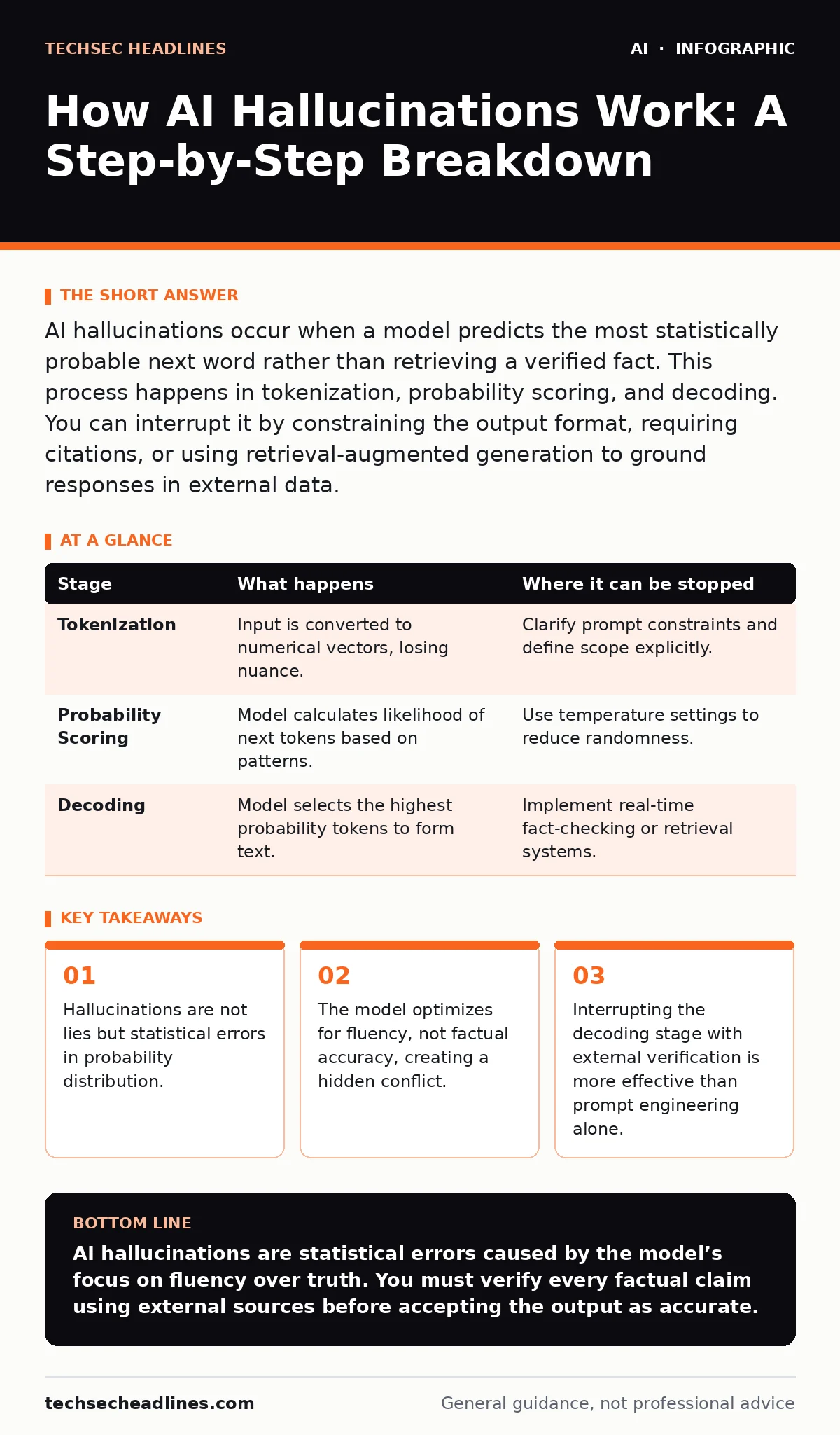
AI hallucinations occur when a model predicts the most statistically probable next word rather than retrieving a verified fact. This process happens in tokenization, probability scoring, and decoding. You can interrupt it by constraining the output format, requiring citations, or using retrieval-augmented generation to ground responses in external data.
The Statistical Nature of Fabrication
Generative artificial intelligence does not "know" facts in the way a human does. It does not have a database of truths it queries. Instead, it is a mathematical engine trained to predict the next likely word in a sequence. This fundamental difference is the root of every hallucination. When you ask a question, the model does not look up an answer. It constructs one word by word, choosing each token based on patterns it learned during training.
This mechanism creates a specific vulnerability. The model is optimized for coherence and grammatical correctness, not truth. A sentence that sounds authoritative and flows well is often statistically more probable than a correct but awkward sentence. The system rewards plausibility. This means the output will often feel right to a reader, even when it is entirely fabricated. You must treat every output as a draft that requires verification, not as a final fact.
### Stage 1: Tokenization and Context Framing
The process begins when your input text is broken down into tokens. A token is a unit of text that can be as short as a single character or as long as a whole word. The model converts these tokens into numerical vectors, which are mathematical representations of meaning. This step strips away nuance. If your prompt contains ambiguous phrasing, the model interprets it based on the most common usage in its training data, not your specific intent.
Suppose you ask for a legal summary of a contract. The tokenization process captures the words "legal," "summary," and "contract." It does not capture the specific jurisdiction or the unique clauses you intend to highlight. The model fills in these gaps with generic legal language. This is the first point of failure. If the context is incomplete, the model assumes a default scenario. You can interrupt this by providing explicit constraints and defining the scope clearly in the prompt.
| Stage | What happens | Where it can be stopped |
|---|---|---|
| Tokenization | Input is converted to numerical vectors, losing nuance. | Clarify prompt constraints and define scope explicitly. |
| Probability Scoring | Model calculates likelihood of next tokens based on patterns. | Use temperature settings to reduce randomness. |
| Decoding | Model selects the highest probability tokens to form text. | Implement real-time fact-checking or retrieval systems. |
### Stage 2: Probability Scoring and Pattern Matching
Once the context is established, the model calculates the probability of every possible next token. It looks at the billions of text sequences it has seen before. It identifies patterns that frequently follow your specific input. This is not a search for truth. It is a search for familiarity. If the training data contains many incorrect but common myths, the model will assign a high probability to those myths.
The model does not distinguish between a verified fact and a widely repeated error. It weighs statistical frequency. This is why hallucinations often involve plausible-sounding but incorrect details. The model is following the path of least resistance. It chooses the word that makes the sentence most likely to continue in a standard way. This stage relies entirely on the quality and bias of the training data. You cannot fix this inside the model. You must fix it by ensuring the input context is grounded in verified sources.
### Stage 3: Token Selection and Decoding
The model selects the token with the highest probability score. This is the decoding step. It adds this token to the output and repeats the process for the next word. This happens thousands of times per second. The model has no global view of the final answer. It only sees the immediate next step. This myopic view prevents it from correcting early errors. If the first few words are slightly off, the rest of the response will drift further from reality.
This stage is where the illusion of understanding is created. The output flows smoothly because each word is statistically compatible with the previous one. However, the logical consistency of the entire paragraph is not guaranteed. The model does not check if the conclusion matches the premise. It only checks if the next word fits the current sentence. You can interrupt this by using techniques like chain-of-thought prompting, which forces the model to show its reasoning steps. This exposes logical gaps before the final answer is generated.
### Stage 4: Output Generation and Post-Processing
The final stage involves compiling the selected tokens into readable text. The model applies formatting rules and punctuation. It may also filter out harmful content based on safety guidelines. However, these filters do not check for factual accuracy. They only check for policy violations. A hallucinated medical advice can be polite, safe, and grammatically perfect, yet still be dangerous.
This is the final output you see. It looks like a complete answer. It has no markers indicating which parts are guessed and which are known. The model does not provide confidence scores for its facts. It presents everything with the same authority. This uniformity is deceptive. You must assume that any specific detail, such as a name, date, or statistic, could be fabricated. The structure may be correct, but the substance may be void.
The Hidden Cost of Fluency
There is a trade-off between creativity and accuracy. Models that are tuned to be more creative are more likely to hallucinate. Models that are tuned to be safe and precise may refuse to answer complex questions. This is not a bug; it is a feature of the architecture. The model cannot prioritize truth over fluency without external guidance. You, the user, must provide that guidance.
This creates a hidden cost for users. You spend time verifying outputs that look correct. This verification is not optional. It is part of the workflow. If you skip verification, you risk propagating errors. The model is a powerful tool for drafting and brainstorming, but it is a poor tool for fact retrieval. Use it for structure, not for substance.
Interrupting the Hallucination Loop
You can interrupt the hallucination process at multiple stages. The most effective method is to ground the model in external data. This is known as Retrieval-Augmented Generation. Instead of relying on its internal training data, the model first retrieves relevant documents from a trusted source. It then uses these documents to construct its answer. This limits the model to facts that exist in the provided text.
Another method is to constrain the output format. If you ask for a list of steps, require the model to cite the source for each step. If you ask for code, require it to explain why each function is used. These constraints force the model to align its output with verifiable information. They reduce the room for statistical guessing. You can also use multiple models to cross-check answers. If two independent models give different answers, you know at least one is hallucinating.
Verifying the Final Output
The final step is your responsibility. You must verify the output against independent sources. Do not trust the model’s confidence. Trust your own verification process. Look for logical inconsistencies. Ask the model to explain its reasoning. If the explanation is vague or circular, the output is likely fabricated.
This process adds time to your workflow. It is necessary. The model is a statistical engine, not a truth engine. Understanding this distinction allows you to use the technology safely. You gain speed and creativity, but you retain control over accuracy. The goal is not to eliminate hallucinations entirely, which is currently impossible. The goal is to detect and correct them before they cause harm.
Key takeaways
- Hallucinations are not lies but statistical errors in probability distribution.
- The model optimizes for fluency, not factual accuracy, creating a hidden conflict.
- Interrupting the decoding stage with external verification is more effective than prompt engineering alone.
AI hallucinations are statistical errors caused by the model’s focus on fluency over truth. You must verify every factual claim using external sources before accepting the output as accurate.
Frequently asked questions
Why does the model sound so confident when it is wrong?
The model is trained to generate text that mimics human writing, which often uses confident language. It does not have a concept of uncertainty or doubt, so it presents all outputs with the same authoritative tone.
Can I stop the model from hallucinating by changing the prompt?
Prompting can reduce hallucinations by providing context and constraints, but it cannot eliminate them. The model still relies on statistical probabilities. You must use external verification to ensure accuracy.
What is the difference between a hallucination and a lie?
A lie is an intentional deception. A hallucination is an unintentional error. The model does not know it is wrong. It is simply predicting the most likely next word based on its training data.
How do I know if a citation is real?
You must check the citation against a known database or search engine. The model can generate plausible-looking citations for non-existent papers. Never assume a citation is valid without independent verification.
How this guide was produced: written by the TechSec Headlines editorial team with AI assistance, checked against the public references listed below, and reviewed when the facts change. See our editorial policy or report an error.