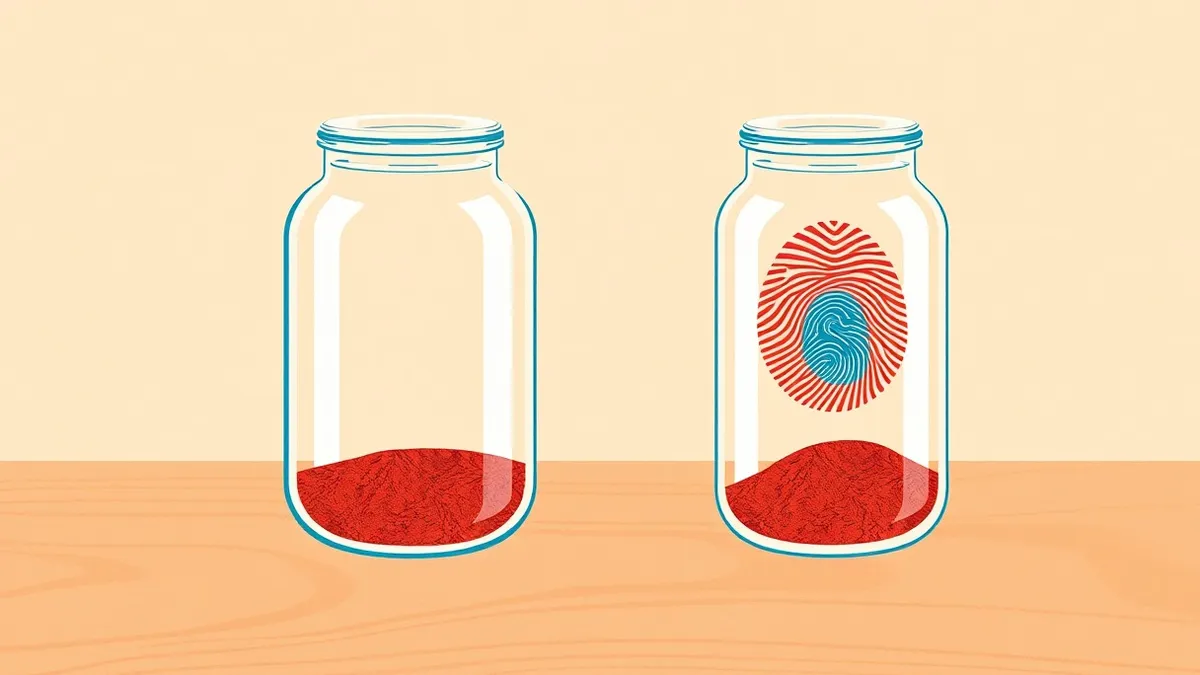
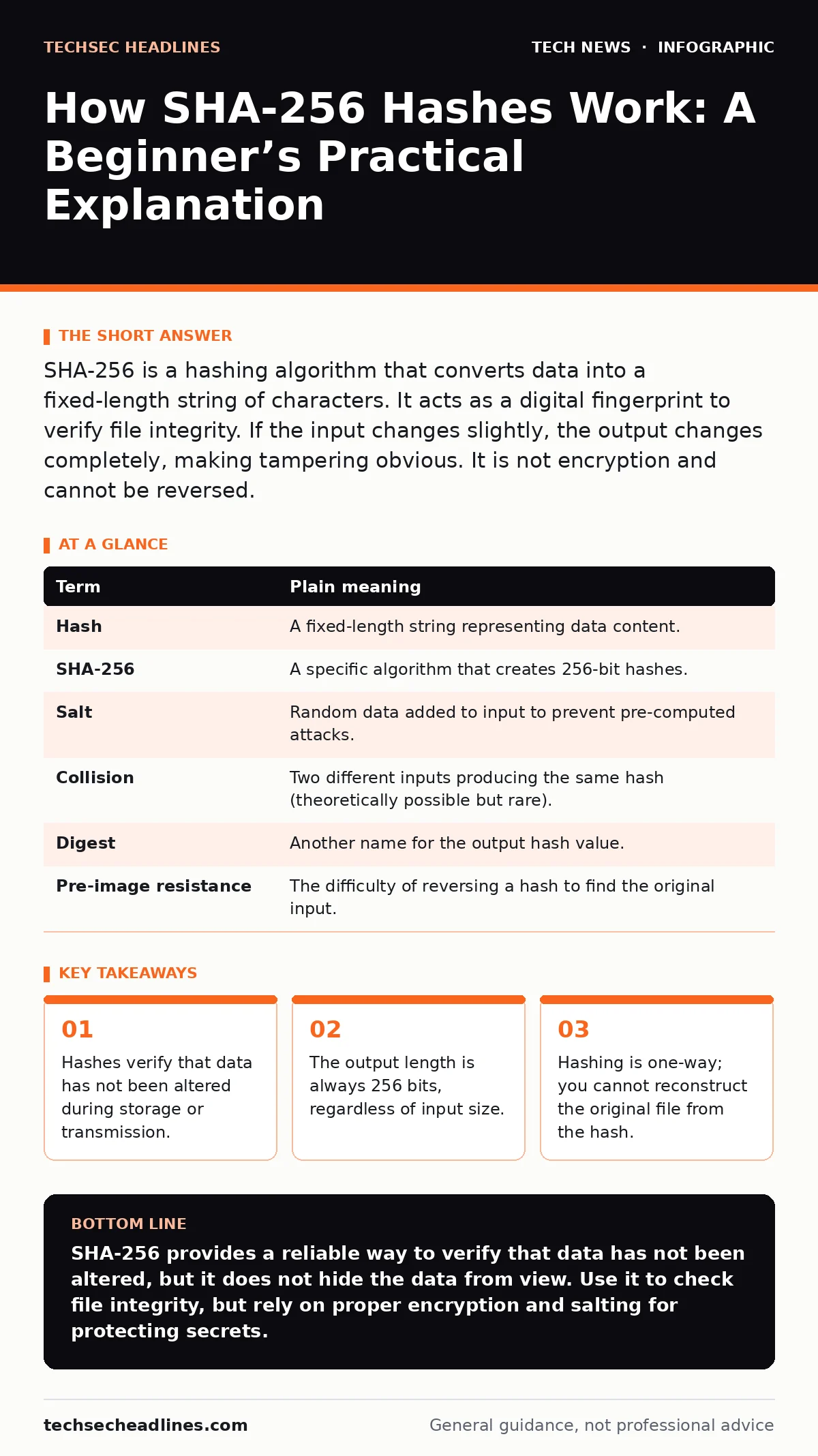
SHA-256 is a hashing algorithm that converts data into a fixed-length string of characters. It acts as a digital fingerprint to verify file integrity. If the input changes slightly, the output changes completely, making tampering obvious. It is not encryption and cannot be reversed.
The Wax Seal Analogy
Imagine you are sending a valuable letter through a courier service. You want to be sure the letter arrives exactly as you wrote it, without anyone reading it or changing the words. You place the letter in an envelope and seal it with a unique wax stamp. The pattern of the wax is complex and specific to that exact seal.
If the courier drops the envelope and the wax cracks, the pattern changes. You do not need to open the envelope to know something is wrong. The seal itself tells you the integrity is broken. SHA-256 works like this digital wax seal, but for computer data. It creates a unique pattern based on the exact content of a file.
What Is a Cryptographic Hash?
A cryptographic hash is a mathematical function that takes an input of any size and produces a fixed-size output. This output is called a hash value or digest. The input can be a tiny text message or a massive video file. The output will always be the same length.
For SHA-256, that length is 256 bits. This is represented as 64 hexadecimal characters. Hexadecimal is a number system using sixteen digits, including letters A through F. This fixed length makes it easy for computers to compare hashes quickly. The process is deterministic, meaning the same input always produces the same hash.
The Avalanche Effect
The most powerful feature of SHA-256 is the avalanche effect. This means a tiny change in the input causes a massive change in the output. If you change one letter in a ten-page document, the resulting hash will look completely different.
It is not just one character that changes. Roughly half of the bits in the new hash will flip from zero to one or vice versa. This makes it impossible to guess how the input changed by looking at the hash. It also prevents attackers from modifying a file slightly and keeping a similar hash to bypass verification.
This property is why SHA-256 is used in HTTPS connections. When you visit a secure website, your browser checks the hash of the site’s certificate. If an attacker tries to modify the certificate, the hash changes, and the connection fails.
Common Points of Confusion
Many beginners confuse hashing with encryption. Encryption is reversible. You can lock data with a key and unlock it later with the same or a paired key. Hashing is not reversible. There is no key to unlock a hash and get the original file back.
Another confusion involves password storage. Systems do not store your actual password. They store the hash of your password. When you log in, the system hashes your input and compares it to the stored hash. If they match, you are granted access. This protects your password if the database is stolen.
However, simple hashing has a weakness. If two users have the same password, they have the same hash. Attackers use rainbow tables, which are pre-computed lists of hashes for common passwords, to reverse this. To stop this, systems add a salt. A salt is random data added to the password before hashing. It ensures that even identical passwords produce different hashes.
Practical Applications Beyond Passwords
SHA-256 is the backbone of Domain Name System security extensions. It helps verify that the DNS responses you receive are authentic and have not been spoofed. It is also central to blockchain technology, where it links blocks of transactions together. Changing any transaction in a block changes its hash, breaking the chain and alerting the network.
Software developers use SHA-256 to verify downloads. When you install new software, the developer often publishes the hash of the installer. You can calculate the hash of your downloaded file and compare it. If they match, the file is identical to the original. If they differ, the file may be corrupted or infected.
This verification step is critical for USB security. If you transfer files between computers using a USB drive, you can hash the files on both ends to ensure they copied correctly. This is especially useful for large datasets or critical backups.
Mini Glossary
| Term | Plain meaning |
|---|---|
| Hash | A fixed-length string representing data content. |
| SHA-256 | A specific algorithm that creates 256-bit hashes. |
| Salt | Random data added to input to prevent pre-computed attacks. |
| Collision | Two different inputs producing the same hash (theoretically possible but rare). |
| Digest | Another name for the output hash value. |
| Pre-image resistance | The difficulty of reversing a hash to find the original input. |
Try This Now
- Find a SHA-256 generator tool online. Type the word "hello" and record the resulting hash string.
- Change the input to "Hello" with a capital H. Observe how the entire hash string changes completely.
- Delete one letter to make "hell". Note that the new hash is unrelated to the previous two, demonstrating the avalanche effect.
Key takeaways
- Hashes verify that data has not been altered during storage or transmission.
- The output length is always 256 bits, regardless of input size.
- Hashing is one-way; you cannot reconstruct the original file from the hash.
SHA-256 provides a reliable way to verify that data has not been altered, but it does not hide the data from view. Use it to check file integrity, but rely on proper encryption and salting for protecting secrets.
Frequently asked questions
Can SHA-256 be broken by quantum computers?
Quantum computers could theoretically speed up hash inversion, but SHA-256 remains secure for practical purposes today. Researchers are developing post-quantum algorithms for future safety.
Is SHA-256 better than MD5?
Yes. MD5 is considered broken and vulnerable to collision attacks. SHA-256 has no known practical collisions and is significantly more secure for integrity checks.
Why is the output always the same length?
The algorithm processes data in fixed blocks and combines them mathematically. This design ensures consistent output size, making it efficient for storage and comparison in databases.
Can I use SHA-256 to compress files?
No. Hashing loses information permanently. You cannot recover the original file size or content from the hash, so it is not a compression method.
How this guide was produced: written by the TechSec Headlines editorial team with AI assistance, checked against the public references listed below, and reviewed when the facts change. See our editorial policy or report an error.